
Table of Contents
⚡ QUICK FACTS
- Online coding classes for kids in smaller US cities close the gap when specialist teachers are few and the nearest one is a long drive away.
- Live 1:1 online coding gives your child a specialist mentor’s full attention every session.
- The FCC’s 2026 broadband report found about 96.9% of Americans can get fixed broadband at 100/20 Mbps.
- ItsMyBot coding classes for kids cover Scratch, Python, AI and machine learning, robotics, game development, and app development.
- The free trial class includes a skills assessment, so your child starts at the right level.
⚡ AT A GLANCE
- What: Live 1:1 online coding classes for kids who live outside major tech hubs.
- Who: Parents of kids aged 5–15+ in smaller US cities, towns, and rural areas.
- Why: Local options are often limited, far away, or paced for a group.
- When: Now. Early curiosity turns into confidence when kids build something real.
- How: A live mentor, a real project every session, and progress updates for you.
You’ve searched “coding classes for kids near me” and found one full club and a robotics night 45 minutes away. Your child is curious, but the options aren’t. Meanwhile, that early spark starts to fade.
Online coding classes for kids in smaller US cities fix that. A live mentor joins your child on screen, so your zip code stops deciding what your child can learn. This guide shows what to look for, what kids build, and when live 1:1 coding classes beat a local classroom.

Big tech hubs fill their calendars with coding academies, robotics labs, and weekend bootcamps. Smaller cities like Fargo, Billings, Cheyenne, Burlington, Boise, and Wichita often have far fewer.
Smaller doesn’t mean less capable. Kids in these cities are just as curious as kids in Austin or San Jose. The difference is access to specialist teachers, advanced topics, and open seats.
Three gaps show up again and again:
School helps, but programs vary by district. Code.org publishes district-level data showing the share of high schools that offer foundational computer science. Check your district before you assume school covers it.
Even a strong school course introduces ideas. It rarely teaches a child to build a working project alone.
Large hubs face limits too. Our guide to coding classes for kids in Austin shows why families there still switch to live 1:1.
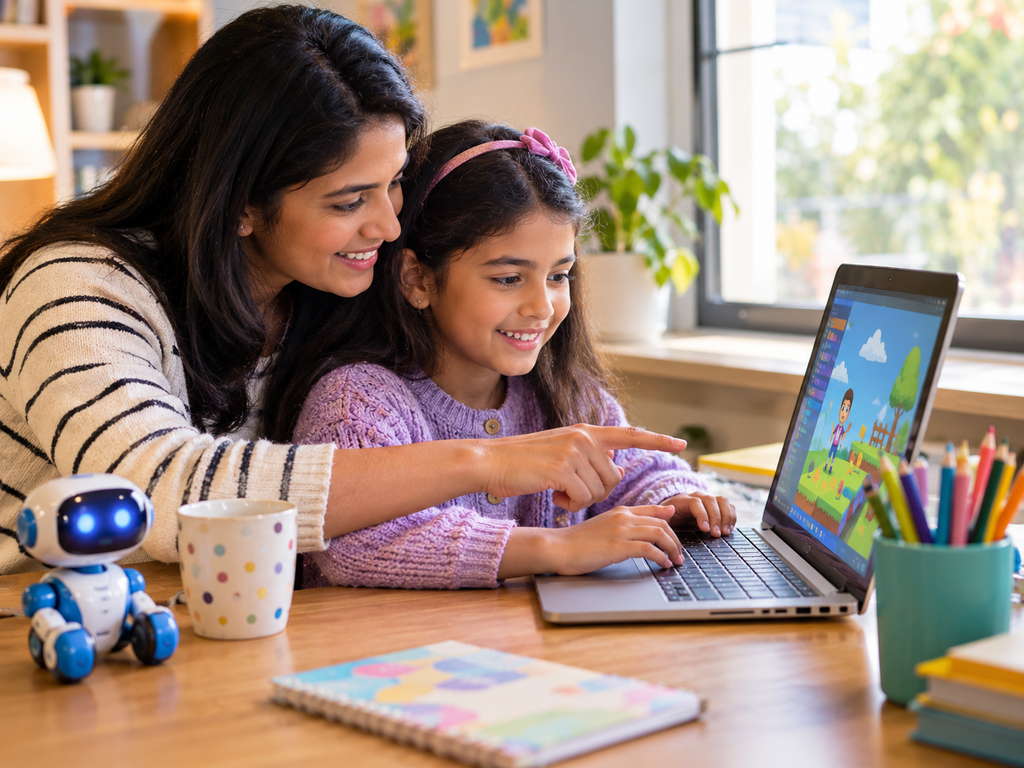
Many local programs sell coding exposure. Real coding education builds skills your child can use alone. Here’s how to tell them apart.
| Coding exposure | Coding education |
|---|---|
| Following a template someone else built | Writing code from scratch in a blank editor |
| Watching a recorded lesson | A live mentor watching your child’s own code |
| Earning a badge or certificate | A working project your child can show and explain |
| A group class with one teacher | 1:1 instruction with direct mentor time |
| Letting AI write the code | Understanding code well enough to judge AI output |
The six-month test: After six months, can your child open a blank editor and build something that works? If yes, they’re learning. If no, they’re following along.
Read more: how to choose the right coding course for your child, is coding really helpful for kids, and common myths about coding for kids.
Each format has a place. In-person clubs spark interest. Self-paced courses suit independent learners. Live 1:1 classes suit kids who need guidance and a clear path.
| Factor | In-Person Club (Local) | Self-Paced Online | Live 1:1 Online (ItsMyBot) |
|---|---|---|---|
| Instructor attention | Shared across the group | None during lessons | A specialist mentor focused on your child |
| Mistakes fixed in real time | Sometimes | No | Yes, every session |
| Pace | Group pace | Fixed modules | Adapts to your child |
| Distance | Drive to a fixed site | None | None |
| Schedule | Fixed day and time | Anytime | Chosen around school and family, across US time zones |
| Advanced paths (Python, AI, robotics) | Limited to the venue | Varies | A full path from Scratch to AI |
| Progress you can see | Varies | Badges and certificates | Real projects and parent updates |
For the full format analysis, read live 1:1 vs group coding classes. Still weighing whether online works at all? See is online coding worth it for kids.
Online classes take your zip code out of the equation. Here’s what changes for your family:
Will your internet handle live classes? Probably. According to the FCC’s 2026 broadband report, about 96.9% of Americans can get fixed broadband at 100/20 Mbps. The report also says the number of rural Americans without fixed 100/20 Mbps service fell by more than 44% over two years. Averages hide gaps, so test your connection at home first.
Want a deeper look? Read our online coding classes for kids parents’ guide, compare the best online coding classes for kids and teens, and learn how to keep kids motivated in online coding classes.
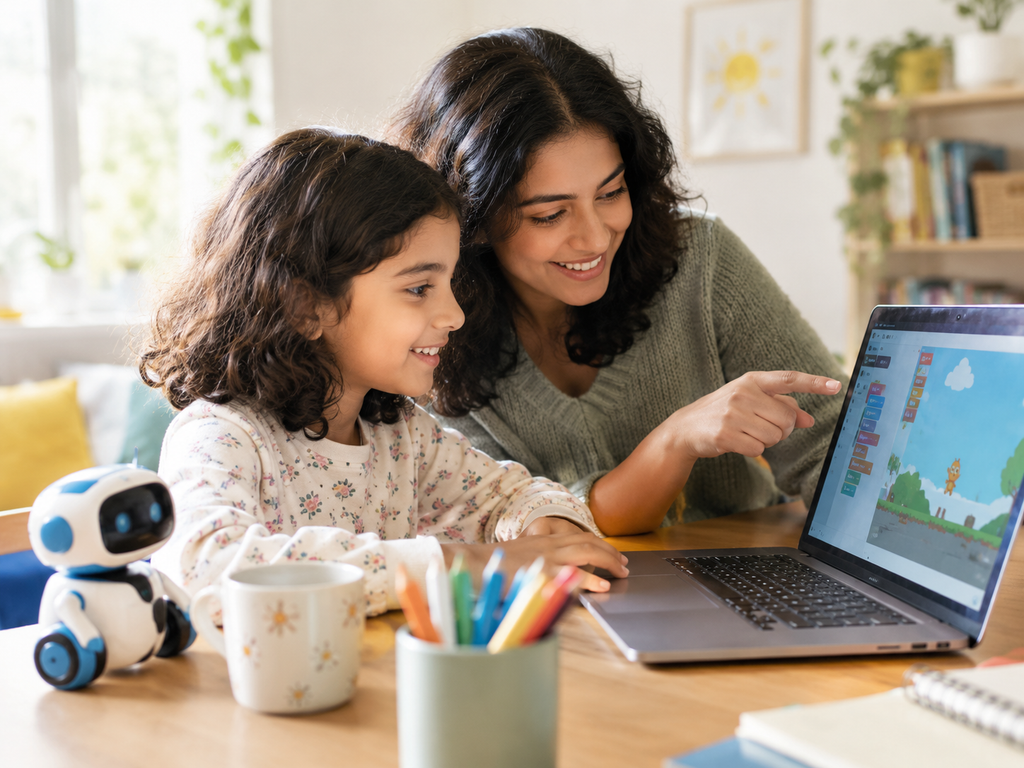
Readiness matters more than age. A skills assessment places your child at the right level, not the right birth year.
Your child uses real tools from the start, like Scratch from MIT and Python. Every concept builds on the last. For the wider picture, read Python for kids: the complete guide and how Scratch compares with Python.
Projects are the proof. A child who has built something can run it, explain it, and change it. Here’s what to expect at each level.
Beginner
Intermediate
Advanced
See real student work on the ItsMyBot student projects page. Highlights include the Rock Paper Scissors Shoot game, the Password Strength Meter Generator, the Gesture Controlled Maze Game, My Fairy Story with GenAI, and the Line Following Robo Goods Mover.
Turn Screen Time Into Skill Time
Book a free trial class. Your child meets a live mentor, builds a real project, and takes a skills assessment. No commitment.
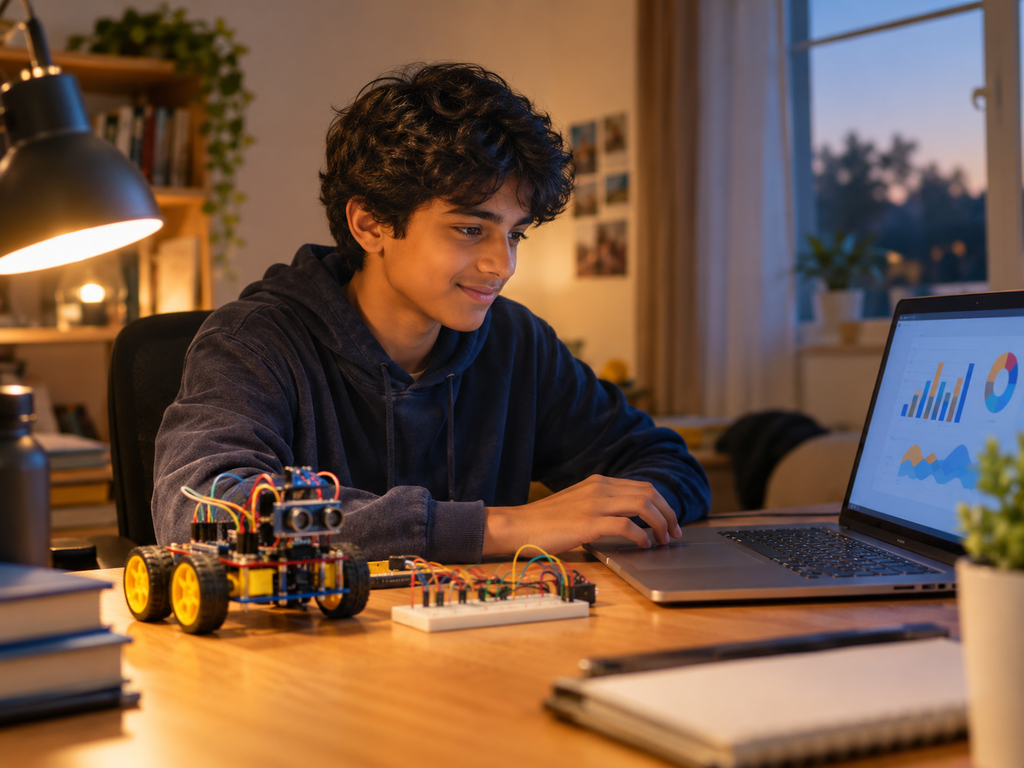
These illustrative scenarios show when online makes the most sense.
Scenario A: The only club in town is full. Your child in Billings wants to start now, not next semester. Best fit: Live 1:1 sessions starting with the Scratch programming course or the Little Coder path.
Scenario B: Your child outgrew the school coding unit. An 11-year-old in Wichita finished the Scratch basics and wants more. Best fit: The Python course for kids, guided by how to move from Scratch to Python.
Scenario C: You homeschool and need a clear path. Your family in Fargo wants structure that fits your own schedule. Best fit: Coding classes for homeschoolers, plus our guide to online coding classes for homeschoolers.
Scenario D: Your teen wants a portfolio. A high schooler in Lexington wants AI skills and projects for applications. Best fit: Advanced Python and AI Foundations, supported by coding for teens and university chances.
Scenario E: Your child loves robots, but the nearest lab is hours away. A builder in Cheyenne wants hands-on robotics. Best fit: The robotics courses and our guide to coding vs robotics for kids.

“Will my child stay focused on a screen?” A 1:1 session has a mentor watching your child’s work the whole time. Your child can’t hide in a group. See how coding helps kids with ADHD and how to keep kids motivated online.
“Isn’t this just more screen time?” It’s screen time with a purpose. Your child builds games, apps, and robots instead of scrolling. Our guide on how to reduce screen time for kids shows how to balance both.
“Is it safe online?” Safety matters most with kids. Read our guide on how to keep your kids safe online, and ask about safety practices during your free trial.
“What device do we need?” A computer or laptop, a webcam, and headphones cover most classes. Check the best coding websites for Chromebook, system requirements for Scratch, and minimum hardware requirements for Python.
“Will my child miss out on peers?” Online doesn’t have to mean isolated. Your child can still test skills through coding competitions and hackathons, with a mentor giving live feedback along the way.
“My school already teaches coding. Is this a repeat?” No. School builds awareness. Specialist mentoring builds the skill to execute independently. The two work well together.
Use this checklist before you enroll anywhere. Start with the first group.
Non-negotiable
Strong quality indicators
Differentiators
The simplest test: Ask what your child will build in the first eight sessions. A precise answer signals a project-led curriculum. For more, read top coding programs for kids in 2026 and signs your child is ready to learn coding.
Every course runs live and online. Pick the path that matches your child’s curiosity.
| Course | Built for | Explore |
|---|---|---|
| Little Coder (ages 5–7) | Games, stories, and creative projects | Little Coder |
| Junior Coder (ages 7–12) | Games, apps, websites, and real coding skills | Junior Coder |
| Scratch Programming | First projects with block coding | Scratch course |
| Python for Kids | First text-based code | Python course, Python classes |
| Web Design and JavaScript | Websites and interactive pages | Web design, JavaScript |
| 3D Design and Animation | Creative builders | 3D design course |
| Mobile App Development | Apps your child can show off | App course, App development hub |
| AI and Machine Learning | Intelligent, real-world projects | AI and ML courses, AI course for kids |
| Senior Coder (ages 10–15+) | Python, AI, and software development | Senior Coder, AI Engineer Program |
| Senior Coder Specialties | JavaScript, full-stack, Java and Android, C | JavaScript, Full-Stack, Java and Android, C and robotics |
| Robotics (ages 7–15+) | Building and programming robots | Robotics courses, Cruiser, Flyer, IoT, Arduino |
| Game Development (ages 7+) | Roblox and Lua games | Roblox course |
| C++ Programming | Next-level programming skills | C++ course |
Browse every option on the ItsMyBot courses page or the main coding classes for kids page. Need a different angle? See coding classes for girls, best coding for teens, and the best robotics classes for kids.
| City | Coding Classes | STEM and Robotics | After-School | AI Course |
|---|---|---|---|---|
| Fargo, ND | Fargo | Fargo | Fargo | Fargo |
| Billings, MT | Billings | Billings | Billings | Billings |
| Cheyenne, WY | Cheyenne | Cheyenne | Wyoming | Wyoming |
| Burlington, VT | Burlington | Burlington | Burlington | Vermont |
| Boise, ID | Boise | Boise | Weekend classes | Boise |
| Wichita, KS | Wichita | Wichita | After-school hub | Wichita |
| Lexington, KY | Lexington | Lexington | Lexington | Lexington |
| Lincoln, NE | Nebraska | Lincoln | Lincoln | Lincoln |
Live in a smaller town or rural area? Find your statewide page: Montana, Wyoming, North Dakota, South Dakota, Vermont, New Hampshire, Maine, Alaska, Idaho, Nebraska, Iowa, Kansas, and West Virginia. See every ItsMyBot location.
Your zip code shouldn’t decide what your child can build. Online coding classes for kids in smaller US cities give you a live mentor, a clear path, and projects you can see.
- Local isn’t always best. Distance, group pace, and shallow paths limit many smaller-city options.
- Live 1:1 changes the outcome. Every session brings a mentor, real feedback, and a project.
- Start small. One free trial class shows you the fit with no commitment.
Often, the best option isn’t local. Smaller cities tend to have fewer specialist teachers and limited advanced paths. Live 1:1 online coding classes bring a specialist mentor to your home, with sessions that fit your school and family schedule. Start with a free trial class to see the format before you commit.
Yes, if your connection supports a live video call. The FCC’s 2026 broadband report found about 96.9% of Americans can get fixed broadband at 100/20 Mbps. Test your connection at home first. Then check our guides to Chromebook-friendly coding websites and hardware requirements for Python to confirm your device is ready.
Ages 5 to 7 suit Little Coders with games and stories. Ages 7 to 12 fit Junior Coders, starting with Scratch. Ages 10 and up can join Senior Coders for Python and AI. Readiness matters more than age, so the skills assessment in your trial places your child at the right level.
You need a computer or laptop, a webcam, headphones, and a stable internet connection. A wired connection helps if your Wi-Fi drops during video calls. Ask about setup details when you book your trial, and read our guide to the system requirements for Scratch for beginner needs.
Yes. Sessions fit around school terms, sport seasons, and exam blocks across all US time zones. You choose a time that fits your family’s routine. Looking for extra structure outside school hours? See our after-school programs and weekend classes, or ask about homeschool coding classes.
Beginners build Scratch games and animations. Intermediate students build Python programs like quiz apps, hangman, and chatbots. Advanced teens build AI and data projects for science fairs and portfolios. Browse real student projects, or read our guides to Scratch projects and AI projects for kids.
Yes. ItsMyBot offers a free trial class: one live session with a mentor, a real project, and a skills assessment. You’ll see the teaching style and your child’s reaction before you commit anything. Book a free trial class to get started, or contact our team with questions.
They can. A portfolio of Python and AI projects shows initiative that grades alone don’t. Documented projects, science fair entries, and the ability to explain your own code stand out in STEM applications. Read our guide to coding for teens and university chances for practical steps.
Your child doesn’t need a big-city zip code to build real skills. Start with one free live coding session and let them create something real this week.
Choosing and learning online
Why coding and AI matter now
Robotics and STEM
Compare large-city and smaller-city options

Online coding, AI, and robotics classes that help kids ages 5–16 build real skills — and confidence — one project at a time.
No commitment · Live class with an expert teacher
© ItsMyBot 2026. All Rights Reserved.