
Artificial intelligence is no longer a future skill — it’s a present reality in your child’s world. It recommends what they watch, powers the games they play, and increasingly shapes what careers will look like by the time they graduate. Yet most parents asking “should my child learn AI?” are met with either overwhelming technical jargon or oversimplified promises that a weekend course will make their child “AI-ready.”
The truth is more nuanced — and more actionable. AI for kids in 2026 is a genuine educational discipline with a clear entry age, a structured learning path, and real, impressive projects children build along the way. Done well, it gives your child one of the most future-relevant skill sets available. Done badly, it wastes their time on buzzword-heavy content that produces no lasting capability.
This complete parent guide covers everything: what AI education actually means for children, what age makes sense, what they build, how AI connects to coding, which concerns are valid and which aren’t, and how to find a programme that delivers real results.
Table of Contents
By 2026, artificial intelligence is embedded in virtually every professional field — healthcare, engineering, finance, creative industries, logistics, and education itself. The children entering the workforce in 10 to 15 years won’t just encounter AI as users. The roles that will grow — and the salaries that will reflect genuine value — will belong to those who understand how AI works, where it fails, and how to build with it.
This isn’t a distant concern for parents to file away. It’s already shaping university entrance criteria, school enrichment curricula in leading education systems, and the hiring expectations of companies that are actively recruiting the next generation. The question isn’t whether AI will matter to your child’s future. It’s whether your child will be equipped to navigate it confidently — or encounter it as a black box they can’t interrogate.
There’s a critical distinction that most parents haven’t been given clearly: the difference between using AI and understanding AI. A child who uses ChatGPT to summarise a text has used AI. A child who understands what training data is, how a model learns from examples, what makes an output accurate or biased, and how to build a simple classifier — that child has AI literacy. The first skill is available to everyone; the second is what will differentiate your child in a world where AI tools are commoditised.
For a deeper exploration of why this distinction matters now, read our dedicated posts on why AI learning is important for kids and AI literacy for kids — what it means and how to build it. For parents who want to understand the broader technology landscape their child is growing into, our post on what the metaverse means for kids provides useful context.
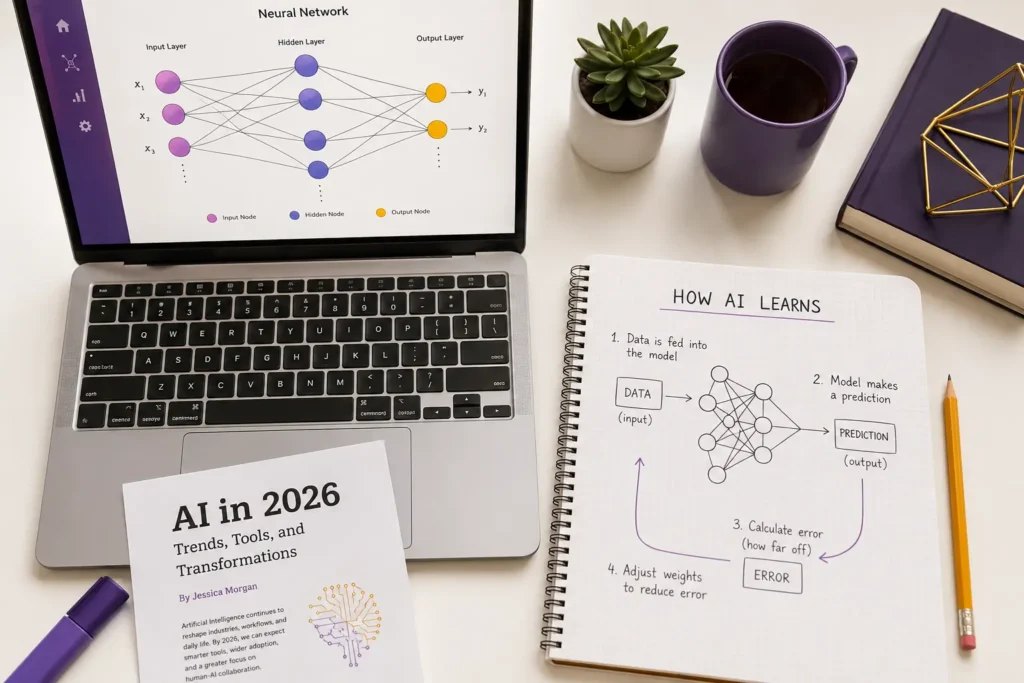
The phrase “AI for kids” covers an enormous range — from genuine machine learning education to a chatbot demo repackaged as a curriculum. Before choosing any programme, parents need to understand what meaningful AI education actually looks like at a child’s level.
The best entry point into purposeful AI use for children is prompt engineering — the skill of communicating with AI models clearly and effectively to get useful results. Our complete guide on prompt engineering for kids shows what this looks like in practice. For parents who want to understand which AI tools are genuinely appropriate for children, our post on the best free AI tools for kids provides a curated, age-appropriate overview.
One of the most common parent questions — and one that has a clear, evidence-based answer. The right age depends on what “learning AI” means at each stage. Here’s a practical framework:
Children this age aren’t ready for machine learning code, but they’re absolutely ready to explore how AI touches their world. Why does the app recommend that video? How does the voice assistant understand speech? Building curiosity, critical awareness, and early questioning habits at this stage is entirely appropriate and valuable. Story-driven introductions, guided observation of AI tools, and age-appropriate discussion all work well.
This is the most productive entry point for structured AI literacy. Children this age can understand that machines learn from labelled examples (training data), that they identify patterns and make predictions, and that the quality of the data affects the quality of the output. Hands-on projects using visual AI training platforms — like training an image classifier using a browser-based tool — are both achievable and genuinely exciting at this age.
Python foundations begun at this age make the transition to code-based AI significantly smoother. See our complete Python for kids guide for the natural stepping stone into deeper AI work.
Children with some Python coding background can engage with genuinely substantive AI projects: building and training simple neural networks, creating text classifiers, working with datasets, understanding model accuracy, overfitting, and bias. At this age, AI education produces portfolio-quality work that matters in university applications and early career contexts.
For inspiration at this level, see our post on 25 best AI science fair projects for students and our tutorial on how to make AI in Python.
For overall coding readiness context, read our posts on signs your child is ready to learn coding and the best age for kids to start coding.
Projects are the most reliable evidence of genuine learning — and they’re what a quality AI programme delivers at every stage. Here’s what children realistically build at each level:
For practical tutorials at this level, see our posts on how to build a chatbot in Python and how to make a game using ChatGPT.
See our tutorials on building NLP chatbots with Dialogflow and DialoGPT and how to clean and prepare data with Pandas in Python for what this level of work looks like.
This is the question parents ask most often when considering AI education — and it has a clear answer with important nuance.
Coding should come first — but the two are deeply connected, not mutually exclusive.
Meaningful AI education at the project level requires programming logic. A child who can’t write a Python function will hit a wall in any substantive AI curriculum. The foundations — variables, loops, conditionals, functions, data structures — aren’t optional prerequisites that can be skipped with the right platform. They’re the cognitive toolkit that makes AI concepts genuinely learnable rather than superficially understood.
That said, AI can and should be the motivation for learning to code, even from early stages. A child learning Python through AI-themed projects — training a simple classifier, building a chatbot, processing a small dataset — learns the same coding fundamentals as one building games, but with a context that connects directly to their curiosity about the technology shaping their world.
| Your child’s situation | Recommended path |
|---|---|
| No coding experience, ages 7–10 | Begin with Scratch; introduce AI concepts through exploration and visual tools |
| No coding experience, ages 11–13 | Begin Python immediately using AI-themed projects to drive motivation |
| Has Scratch or beginner coding experience | Transition to Python; begin beginner AI projects within 2–3 months |
| Confident Python user, ages 12+ | Ready for a dedicated AI/ML curriculum immediately |
| Interested in AI but finds coding difficult | Use visual AI tools while building coding confidence; don’t skip the foundations |
For the coding-to-AI progression in detail, see our guides on moving from Scratch to Python, block-based vs text-based coding for kids, and Python vs Java — which to learn first. For the AI-robotics connection, see our post on artificial intelligence in robotics.
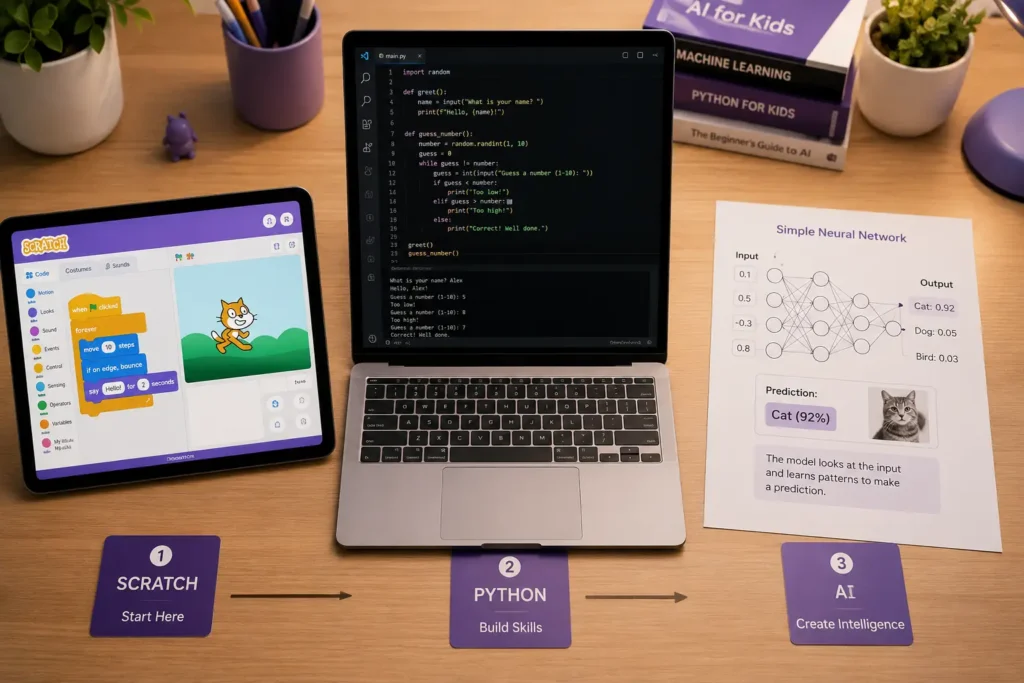
A realistic, well-sequenced AI learning path for a child in 2026 — assuming they’re starting from scratch with no prior experience:
📍 The ItsMyBot AI Progression Framework
Phase 1 — AI Awareness (Ages 7–10)
Understanding that AI learns from data, makes predictions, and exists in everyday tools. No code required. Visual platforms, guided exploration, and critical discussion. Goal: curiosity and early critical thinking about AI outputs.
Phase 2 — Python Foundations with AI Context (Ages 10–12)
Variables, loops, conditionals, functions — all taught through AI-themed mini-projects. Goal: solid Python foundations, with the first AI project (visual classifier or simple chatbot) as the milestone achievement.
Phase 3 — Beginner AI Projects (Ages 11–13)
Training image classifiers, building Python chatbots, creating basic NLP tools, working with small datasets. Goal: complete at least two AI projects independently, with explanation of how each works.
Phase 4 — Intermediate ML (Ages 13–14)
Scikit-learn, neural network basics, data preprocessing with Pandas, model evaluation (accuracy, precision, recall). Goal: a complete ML pipeline — data in, model trained, evaluation output, conclusions drawn.
Phase 5 — Specialisation (Ages 14–15+)
Choose a direction: NLP and chatbot development, computer vision, data science, AI in robotics, or AI ethics and critical analysis. Portfolio-level projects produced at this stage. Explore ItsMyBot’s AI courses →
This is the question that resonates most with parents whose children may not become software engineers — and the answer is both broad and genuinely important.
Learning AI doesn’t just produce technical competence. It builds a thinking framework that is valuable across virtually every future context:
These skills matter in medicine, law, journalism, design, business strategy, and every other field that will be shaped by AI in the coming decades. A child who learns to think this way isn’t just prepared for a career in technology — they’re prepared to participate meaningfully in a world that AI is reshaping.
For broader STEM context, read our posts on why STEM education is important for kids, STEM vs STEAM education, and best STEM careers for kids to explore. For how AI fits into the robotics and physical computing world, see our posts on AI in robotics and our complete robotics for kids guide.
The word “AI” on a course title or marketing page means almost nothing without context. Here is a practical framework for evaluating whether a programme is genuinely educating your child or capitalising on a trending term.
A useful real-world test: a child who has genuinely learned AI can explain what their model was trained on, what it gets right, what it gets wrong, and why. A child who has completed an “AI course” of the hype variety can describe outputs they received but nothing about how those outputs were produced. Our guide on how to choose the right coding course for your child applies equally to AI programmes.
“My child is too young for AI.”
At ages 7–9, deep AI programming is not appropriate — but AI awareness, exploration, and critical thinking absolutely are. The conceptual entry point is younger than most parents assume. At 10+, structured AI learning is well-timed and age-appropriate with the right programme.
“Won’t AI just replace all jobs? Why learn it?”
The evidence consistently points the other way. The jobs most at risk from AI are those that don’t require AI literacy. The roles that will grow — and the people who will lead organisations navigating AI transformation — will be those who understand it deeply. Early AI education is a protection, not an indulgence. See our complete answer to this question in our post on why AI learning is important for kids.
“My child doesn’t know Python yet — should we wait?”
For visual AI exploration tools and conceptual learning: start now. For Python-based AI development: build coding foundations first, then layer in AI. The two can run in parallel with the right programme. A child who learns Python through AI-motivated projects is doing both simultaneously.
“Is AI just a trend?”
AI is not a trend — it’s a structural shift in how technology works and how economies are organised. The skills AI education builds (data literacy, systems thinking, critical evaluation) are durable regardless of which specific AI tools dominate in 15 years.
“Will it be too abstract or boring for my child?”
Only if the programme is badly designed. AI is intrinsically fascinating to children who already interact with it daily — they just haven’t been given the framework to understand it yet. The key is connecting abstract concepts to things they recognise (why did YouTube recommend that?) and building projects they’re genuinely proud of. Our post on whether coding is really helpful for kids addresses the engagement question directly.
“How do I know my child is actually learning and not just using AI tools?”
Ask for project evidence. A child who can explain what their model was trained on, what it gets right, what it gets wrong, and why — has learned AI. A child who can only describe outputs they received has not. For a parent’s framework on tracking real progress, read our post on how to support your child’s coding journey.
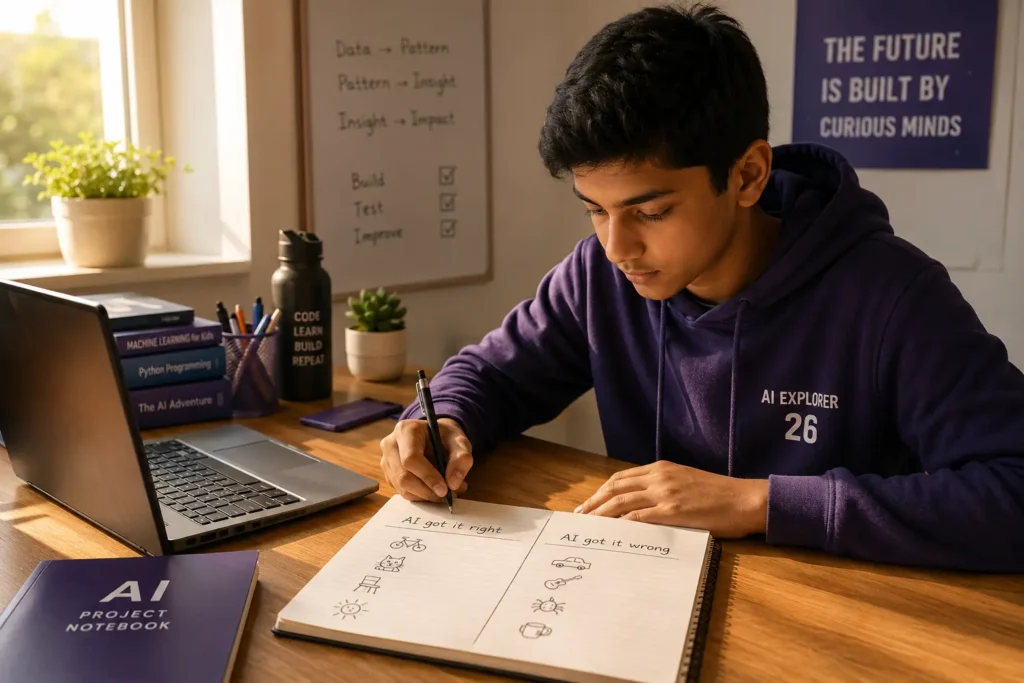
The AI education market ranges from genuinely excellent to deeply misleading. This checklist helps you evaluate any programme before committing.
✅ AI Course Quality Checklist for Parents
NON-NEGOTIABLE
STRONG QUALITY INDICATORS
DIFFERENTIATORS
ItsMyBot offers AI courses for children across multiple locations. Find the right programme for your region: AI courses in Singapore | Doha | Dubai | Abu Dhabi | Malaysia | Muscat | Kuwait City | Riyadh | Dammam | All AI course locations →
At ItsMyBot, we turn screen time into skill time. Our AI curriculum is built on a foundational belief: every child deserves to understand the technology that will shape their world — not just use it as a passive consumer, but comprehend it, build with it, and think critically about it.
Here’s what that looks like in practice:
Whether your child is exploring AI for the first time or ready to build a Python-based machine learning project, ItsMyBot has a programme built for where they are right now. Explore our full AI course range and year-round coding classes for kids. See also our summer AI and coding programmes for families looking for an intensive starting point.
Book Your Child’s Free AI Demo Session
One live session with a qualified ItsMyBot instructor. A real AI project to start. Proof — not promises — that this is the right fit for your child.
AI for kids refers to age-appropriate education that teaches children how artificial intelligence works — not just how to use AI tools, but how machines learn from data, identify patterns, and make predictions. Genuine AI education for kids involves building real projects (image classifiers, chatbots, data models), critical thinking about AI outputs, and progressively deeper engagement with Python programming as children advance.
Yes — with the right programme and the right timing. AI literacy is becoming as foundational as digital literacy. Children who understand how AI works, what its limitations are, and how to build with it will be significantly better prepared for the future workforce and for critical participation in an AI-shaped world. The key is finding education that builds genuine understanding through projects, not just exposure to AI tools. Read our full post on why AI learning is important for kids.
Ages 7–9 are ready for AI awareness and exploration — understanding conceptually that machines learn from data. Ages 10–12 can engage with real beginner AI projects using visual tools, with Python foundations being built simultaneously. Ages 13–15 with Python experience can tackle substantive machine learning projects. Read our guide on the best age for kids to start coding.
For beginner AI exploration using visual tools: no. For Python-based AI development: coding foundations are important. The best approach is building coding skills and AI curiosity simultaneously — using AI-themed projects as the motivating context for learning Python. A child who starts Python because they want to build a chatbot learns the same fundamentals as one who starts Python to build games, but with stronger long-term motivation. See our Python for kids complete guide.
At beginner level: image classifiers, simple chatbots, basic recommendation systems using visual AI training tools. At intermediate level: Python-based sentiment analysers, NLP chatbots, custom trained models. At advanced level: full machine learning pipelines with data preprocessing, model training, evaluation, and visualisation. Projects are the proof — ask any programme what your child will build before booking a single session.
Using ChatGPT is consuming AI. Learning AI means understanding how it works — what training data is, how patterns are identified, what makes a model accurate or biased, and how to build systems that use these principles. A child who has learned AI can evaluate outputs critically and build their own. A child who has only used AI tools cannot. Read our guide on AI literacy for kids for the full distinction.
The roles most at risk from AI are those that don’t require AI literacy. The jobs that will grow, and the people who will lead organisations through AI transformation, will be those who understand it deeply and can work alongside it purposefully. Teaching your child to understand AI isn’t preparing them for a world that doesn’t need humans — it’s ensuring they’re the humans that world will need most.
ItsMyBot delivers every AI session live, with a qualified instructor. Children build real projects at every stage — not tutorial copies, not certificate modules. Our curriculum is built on genuine Python foundations, with AI projects that require critical thinking about outputs, not just celebration of results. We place every child based on individual assessment, keep parents informed throughout, and offer a clear progression from beginner AI exploration to advanced machine learning. Explore our full AI course range →
ItsMyBot offers live online AI courses for children globally, including dedicated programmes for families in Singapore, Dubai, Abu Dhabi, Doha, Malaysia, Muscat, Kuwait City, Riyadh, and many more locations worldwide.
Your Child’s Future Is Being Shaped by AI — Give Them the Skills to Shape It Back
AI literacy isn’t a bonus skill in 2026. It’s a foundational one. ItsMyBot’s AI programmes give children the concepts, the projects, the critical thinking, and the Python foundations to navigate — and build — the future. Start with a free demo session. No commitment required.
→ Explore the Full ItsMyBot AI Course Range
→ Year-Round Coding and AI Classes for Kids
→ Why AI Learning Is Important for Kids — Read the Full Guide

Online coding, AI, and robotics classes that help kids ages 6–18 build real skills — and confidence — one project at a time.
No commitment · Live class with an expert teacher
© ItsMyBot 2026. All Rights Reserved.