
Updated July 2026 · 8 min read
Quick Overview
You’ve seen the ads. “Turn your child into the next tech genius.” “Future-proof your kid’s career.” Every coding platform promises the world. And as a parent, you’re right to be sceptical. So let’s ask the real question — is online coding worth it for kids actually, or is this just a well-packaged trend?
If you pick the wrong platform, you’ll waste money and kill your child’s curiosity in the process. If you pick the right one, you’ll watch your child build real confidence, skills, and a way of thinking that stays with them for life. This guide cuts through the noise and gives you the honest answer.
Table of Contents
Yes — when the course is structured, live, and personalised. No — when it’s a passive app dressed up as education.
This isn’t a binary yes/no question. The research is clear that learning to code builds genuine cognitive skills — logical thinking, problem decomposition, persistence. But the delivery method matters enormously. A self-paced app and a live, mentor-led course both call themselves “coding education.” They produce very different results.
Let’s separate what’s proven from what’s marketing:
| Claim | Evidence | Verdict |
|---|---|---|
| Coding improves maths skills | Google/Gallup research confirmed | ✅ True |
| Coding builds problem-solving | MIT cognitive science research | ✅ True |
| Any app teaches real coding | No evidence — contradicted by outcomes data | ❌ False |
| Coding is a guaranteed career path | Overclaimed — but logic/tech skills transfer broadly | ⚠️ Partly true |
| Live instruction beats self-paced | Consistent across education research | ✅ True — especially for kids |
The Bureau of Labor Statistics projects software development roles to grow 17% through 2034, data science 36%, and cybersecurity 33% — all far ahead of the 4% average growth rate across occupations. Coding isn’t just a hobby. It’s preparation for where the economy is already heading. See our guide on the top coding programs for kids in 2026.
Online coding is worth every penny when these conditions are in place:
Be honest here — some coding products genuinely aren’t worth your child’s time. Avoid these:
❌ Gaming apps marketed as “coding” — if the child can’t explain what they built afterwards, they didn’t code.
❌ One-size-fits-all recorded courses — these assume every child is at the same level, with the same interests. They’re rarely either.
❌ Courses without parent visibility — if you have no idea what your child is learning, red flag. Transparency is a trust signal.
❌ No free trial or demo session — any quality provider lets your child try before you commit. If they won’t, ask why.
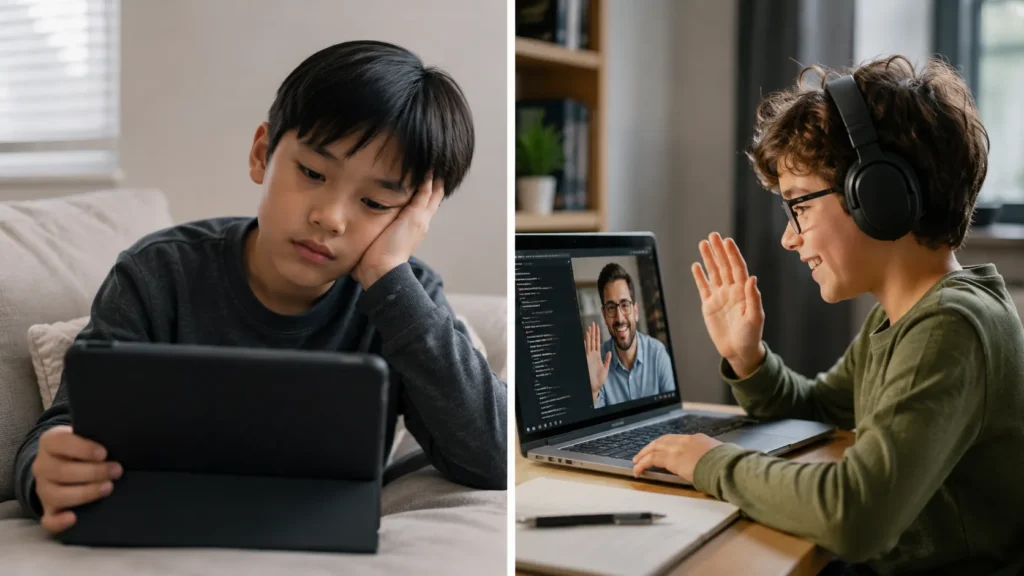
Use this checklist before enrolling your child in any online coding course:
Compare options in our guide to the best online coding classes for kids and teens and see how different providers stack up.
See for yourself — before you decide.
Book a free demo session for your child. No commitment. Just one session to see what real coding education looks like.
❌ Choosing based on price alone — the cheapest option is often the one with no live instruction and no real outcomes. The right question is value, not cost.
✅ Fix: Trial a session first. See what your child actually does.
❌ Enrolling without the child’s input — a course your child chose is far more likely to stick than one you chose for them.
✅ Fix: Show your child the demo session first. Let them decide if they want to continue.
❌ Measuring success by hours completed — time in a chair means nothing. Measure by what your child built.
✅ Fix: Ask to see a project after every 4 sessions. If there isn’t one, that’s a problem.

The Bottom Line
Online coding is worth it when it’s live, personalised, and project-based. The research backs the benefits. The caveat is that not all coding products are coding education — many are entertainment platforms with a coding label.
If you’re still unsure, the answer is simple: try one free session and watch what your child does in it. A quality course will show you its value before you pay for anything.
Book your child’s free demo with ItsMyBot today. See what they build. Then decide.
Don’t guess — see the difference in one free session.
Is online coding just a passing trend or a valuable long-term skill?
Long-term skill. The Bureau of Labor Statistics projects computing roles to grow significantly through 2034, and AI is making coding-literate individuals more valuable — not less — across every industry. The ability to understand and create with technology is as foundational as numeracy.
How do I tell the difference between a real coding course and a gaming app?
Ask your child to explain what they built after a session. If they can describe it — a game, a tool, an animation — they’re coding. If they just say “I played levels,” they’re not. A real course produces things, not just scores.
At what age should kids start online coding classes?
Ages 5–7 are ideal for play-based visual coding. Ages 8–10 can begin structured block coding with project outputs. Ages 11–15 are ready for real programming languages like Python. The right time is when your child shows curiosity about how technology works.
Will coding help my child even if they don’t want to be a programmer?
Yes. The skills coding builds — logical decomposition, persistence, and systematic problem-solving — transfer directly into academic performance, creative thinking, and professional effectiveness in any field. Many non-tech professionals credit early coding with shaping how they think.
How much should I expect to pay for a quality kids coding course?
Quality live instruction is an investment. Self-paced platforms range from free to $50/month; live private instruction typically sits above that. The right question isn’t cost — it’s whether your child is actually building skills and staying engaged. A free demo session answers that before you spend anything.

Online coding, AI, and robotics classes that help kids ages 6–18 build real skills — and confidence — one project at a time.
No commitment · Live class with an expert teacher
© ItsMyBot 2026. All Rights Reserved.