
You’ve decided your 8-year-old should learn to code — brilliant. But now comes the harder part: which class is actually worth your time and money? There are hundreds of options out there, ranging from engaging and effective to expensive and forgettable. Without knowing what to look for, it’s genuinely difficult to tell the difference.
This guide walks you through exactly what matters when choosing a coding class for an 8-year-old — what the best programmes have in common, what red flags to avoid, and how to make a confident, informed decision. By the end, you’ll know precisely what questions to ask before you enrol.
Quick Facts
- What: A parent’s checklist for choosing the right coding class for an 8-year-old
- Who: Parents of 7–9 year olds exploring coding education
- Why: The wrong class wastes time and kills a child’s enthusiasm before it starts
- When: Before you enrol — use this as your decision-making framework
- How: By matching curriculum, teaching style, and safety standards to your child’s needs

Yes — absolutely. 8-year-olds are at the perfect cognitive stage to start learning programming concepts. At this age, children can follow multi-step instructions, think in sequences, and start understanding cause-and-effect logic — all core skills in coding.
The key is choosing a format and language that matches their developmental stage. An 8-year-old shouldn’t be writing Python on day one. But with block-based visual coding tools like Scratch, they can build games, stories, and animations within their first few sessions — creating genuine excitement and a real sense of achievement.
Read more: Is Scratch safe for kids? — Everything parents need to know about the platform most 8-year-olds start with.
Our Little Coder programme is designed specifically for children aged 5–8, blending playful exploration with structured skill-building from the very first class.
Not all coding is created equal — especially for young learners. Here’s how the main options compare:
| Type | Best For | 8-Year-Old Suitability |
|---|---|---|
| Scratch / Block Coding | Games, stories, animations | ⭐⭐⭐⭐⭐ Ideal starting point |
| Python (text-based) | Data, AI, web apps | ⭐⭐ Better at 10–11+ |
| Robotics / IoT | Hands-on building + coding | ⭐⭐⭐⭐ Great with simple kits |
| Game Dev (Roblox etc.) | Game creation and logic | ⭐⭐⭐⭐ Very motivating |
For most 8-year-olds, Scratch is the best starting point — and here’s why: it removes the frustration of syntax errors while teaching the exact same logical thinking as text-based programming. It’s not ‘baby coding’ — it’s smart pedagogy. You can explore our thinking further in Scratch vs Blockly: which block-based tool is right for your child?
When your child is ready to move beyond Scratch, our best Scratch alternatives for kids in 2026 guide covers the natural next steps.
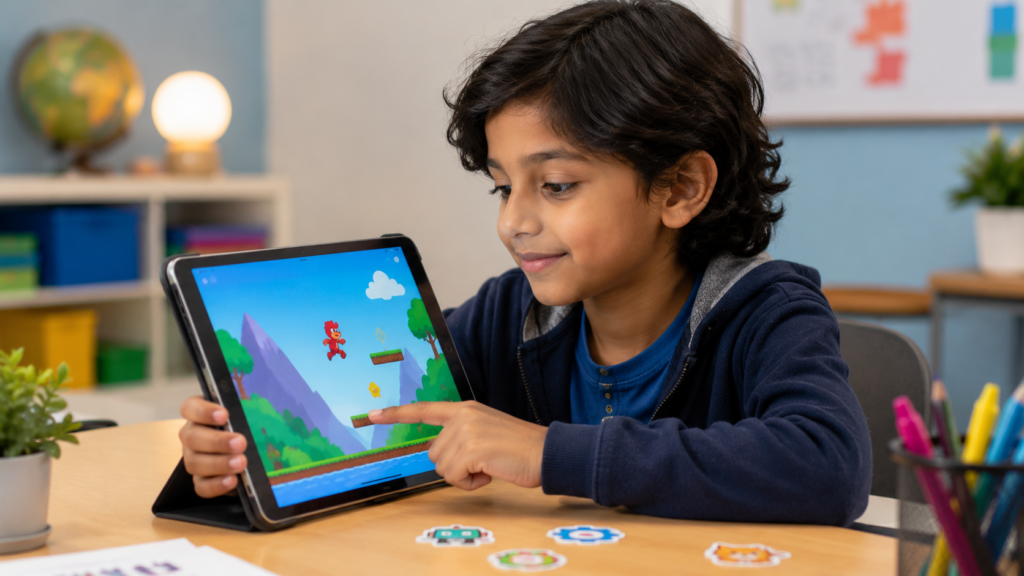
A quality coding class for an 8-year-old isn’t just about learning commands. It should build three things simultaneously: computational thinking, creative confidence, and practical skills.
Look for curricula that include:
Classes should progress logically — not repeat the same content in different skins. If your child feels like they’re doing the same thing every week, the curriculum probably isn’t structured well enough.
Explore our coding classes for 8-year-olds to see how our Little Coder curriculum builds these skills systematically
At 8 years old, attention spans are shorter than you think — and engagement is everything. A teaching style that works for adults or older teens won’t necessarily work for a child in Year 3 or 4.
The best coding teachers for 8-year-olds use:
At ItsMyBot, our mentors are trained to teach in a way that excites rather than overwhelms — meeting each child exactly where they are. Our coding classes for kids page explains our teaching philosophy in detail.
🚀 Book a Free Trial Class — See How We Teach 8-Year-Olds to Love Coding →
Both formats can work well — but online coding classes offer specific advantages that many parents underestimate:
The key with online learning for young children is live, interactive sessions — not pre-recorded videos. An 8-year-old watching a tutorial alone doesn’t have the feedback, motivation, or accountability they need to progress. Our online coding classes for kids are always live, always mentored.
If you’re looking for classes that fit around the school week, our after-school coding classes offer convenient scheduling options for families.
These are the hallmarks of a coding class worth investing in for your 8-year-old:
Not every coding class is as it appears. Watch out for:
❌ Classes taught entirely through pre-recorded videos An 8-year-old can’t ask a video a question when they’re stuck. Live mentorship is non-negotiable at this age.
❌ No structured curriculum — just ‘free exploration’ Creative freedom is wonderful, but young children need scaffolding. A class that lets kids ‘just build whatever’ without teaching underlying concepts builds enthusiasm without skills.
❌ No visible results after the first month Your child should be showing you something they built within the first 2–4 sessions. If they can’t, the class isn’t paced for their age.
❌ No parent communication or progress tracking You have every right to know how your child is getting on. Good coding schools actively involve parents. That’s core to how we operate at ItsMyBot.
❌ Certificates without competence Some programmes hand out completion badges with no real skill behind them. Look for programmes that produce genuine projects — not just paperwork.
Use these questions to evaluate any coding class for your 8-year-old:
A confident, high-quality coding school should be able to answer all of these clearly and specifically — not with vague reassurances.

At ItsMyBot, we’ve built our Little Coder and Junior Coder programmes with exactly these questions in mind — because we know that the first coding experience shapes whether a child loves or abandons the skill entirely.
Here’s what your 8-year-old gets with ItsMyBot:
Whether your child is curious about robotics, AI for kids, or just wants to make their own game, ItsMyBot has the right programme to grow with them.
If you’re exploring STEM learning more broadly, our STEM robotics classes and summer coding camp 2026 are both excellent next steps for young learners who want more.
Most children are ready to start coding between 5 and 8 years old, using visual block-based tools like Scratch. At 8, children are in the perfect cognitive window — they can follow multi-step logic, think sequentially, and build simple projects with guided support. Starting early builds a strong foundation for text-based coding later.
Scratch is almost always the right starting point for an 8-year-old. It teaches the same logical concepts as Python — loops, conditionals, sequences — without the frustration of text-based syntax errors. Most children naturally transition to Python by 10 or 11. Read: Scratch vs Blockly — which is right for your child?
45 to 60 minutes per session is the sweet spot for 8-year-olds. Longer than 60 minutes and focus drops sharply. Two or three sessions per week creates strong momentum without fatigue.
The clearest sign is whether your child can show you what they built. After every few sessions, they should have a project — a game, an animation, a quiz — to share. If they can’t explain what they made or show you something working, the class isn’t producing real learning.
Yes — when they’re live, structured, and on a monitored platform. ItsMyBot’s sessions are always live with a named mentor, in a secure online environment without open forums. For more on digital safety for young children, read Is Scratch safe for kids?
A coding class follows a structured curriculum with clear progression, assessed by a mentor who tracks your child’s development. A coding club is typically less structured, peer-led, and better suited to children who already have foundational skills. For beginners aged 8, a structured class almost always produces faster, more lasting results.
No prior experience is needed at all. The best coding classes for 8-year-olds start from absolute zero — assuming your child has never touched a coding interface before. What matters is curiosity and willingness to try. Everything else is taught from the very first session.
Ready to find the perfect coding class for your 8-year-old? Let’s start with a free trial.
We covered what 8-year-olds are ready to learn, which coding types suit them, what a quality curriculum looks like, and the red flags that signal a class isn’t right for your child.
Choosing the right coding class for your 8-year-old is about matching the class to the child — not the other way around. The right programme builds confidence, curiosity, and real skills simultaneously.
Your child’s first coding experience sets the tone for everything that follows. Book a free demo class today and let’s make it brilliant.
Explore More
- History of STEM Education: How It Evolved Over Time
- Advantages & Disadvantages of Learning Block Coding
- Python Tkinter Tutorial: Complete Beginner’s Guide
- Scratch vs Blockly: Which Block Coding Tool Is Best?
- The Impact of AI on Kids: Benefits & Challenges
- How to Convert a List to a Tuple in Python
- How to Prepare Kids for Coding Competitions
- How to Fix Cloning Bugs in Scratch
- Coding Gifts for Kids: Best Tech Picks by Age
- Hackathon Preparation for Kids: A Complete Guide

Online coding, AI, and robotics classes that help kids ages 6–18 build real skills — and confidence — one project at a time.
No commitment · Live class with an expert teacher
© ItsMyBot 2026. All Rights Reserved.