
Quick Overview
Every parent wants to give their teenager the best possible chance at university. And in 2026, coding for teens’ university admission has become a genuinely meaningful differentiator — not just a tech skill, but a signal of intellectual capability, self-directed learning, and real-world problem-solving that admissions teams actively look for.
But parents often underestimate how. It’s not just about studying computer science. A teen who learned to code, built real projects, and competed in hackathons has a portfolio that stands out in medicine, law, business, engineering — and yes, technology. This guide tells you exactly how it works, what universities are looking for, and how to build that advantage before your child’s application year.
Table of Contents
Yes — but not simply because your teen “knows Python.” The advantage comes from what coding enables a teen to demonstrate. Here’s how it works:
📁 Portfolio of real work
A teen who built 10 real projects over 2 years has tangible proof of capability. Most applicants have certificates. A portfolio is proof.
🏆 Competitions and hackathons
Coding competitions demonstrate initiative, performance under pressure, and the ability to collaborate — qualities every admissions team looks for.
🧠 Demonstrable problem-solving
Coding teaches structured thinking that transfers directly into essays, interviews, and aptitude tests — all of which feature heavily in competitive applications.
🌍 Global collaboration
Teens who’ve worked with peers from different countries on coding projects have a genuine international experience story — not just a holiday entry on a form.
Admissions beyond grades is increasingly the norm at competitive universities. Here’s what they look for — and how coding directly addresses each one:
| What Universities Look For | How Coding Delivers It |
|---|---|
| Evidence of intellectual curiosity | Self-directed projects show a teen who explores beyond the syllabus |
| Problem-solving ability | Debugging is structured problem-solving. Every coding session practices it. |
| Resilience and persistence | Sitting with a hard bug and solving it demonstrates grit — a quality interviewers specifically probe |
| Real-world application of learning | A working app, game, or tool is proof. Most applicants only have coursework to show. |
| Future-readiness | Universities increasingly value AI and digital literacy across all subjects — law, medicine, design, business |
Also explore our AI-specific course options — an AI course for kids and teens further strengthens a university application in 2026.
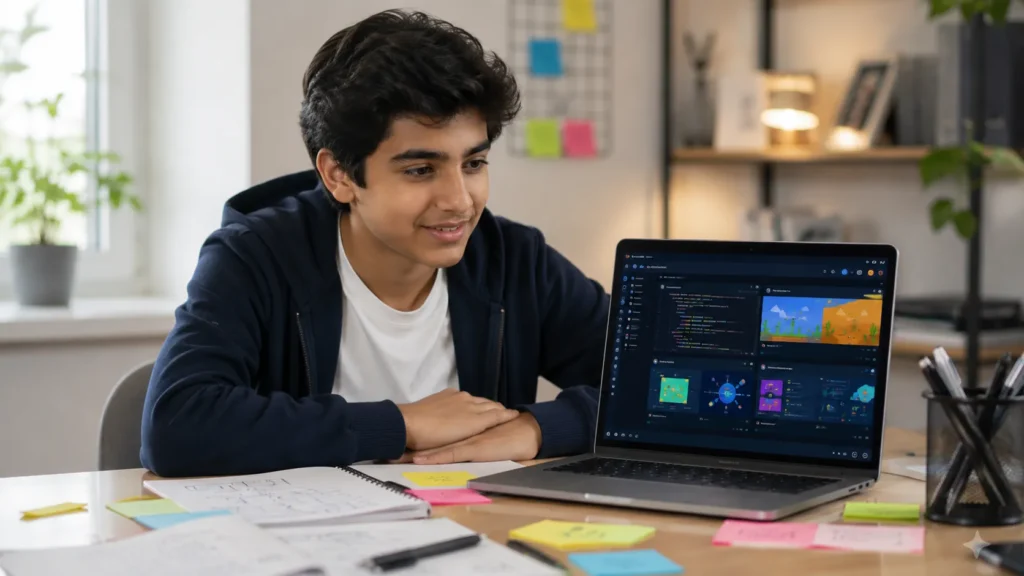
A coding portfolio is the ultimate “show don’t tell” addition to any university application. Here’s what it demonstrates that a grade or certificate cannot:
Strongly yes. This is one of the most underrated aspects of teen coding. Here’s how it plays out across different fields:
⚖️ Law
Tech law, data privacy, and AI regulation are the fastest-growing legal specialisms. A law student who understands code has a rare edge.
🏥 Medicine
AI in diagnostics, health data analysis, and digital therapeutics — all require medical professionals who understand how the technology works.
🎨 Design & Creative Arts
Generative AI, interactive media, digital tools — creative industries now expect technical literacy from their most competitive graduates.
💼 Business
Data analysis, automation, and AI-powered decision-making are transforming business. Future business leaders who code will lead the rest.
Let’s use real numbers. According to the Bureau of Labor Statistics, across tech roles, median salaries sit significantly above the national average:
But the career advantage isn’t only in tech. Every industry is becoming a technology industry. A teenager who learns to code opens doors in virtually every professional direction — and with a far stronger starting position than their peers who didn’t.
Explore our resources on the coding skills future-ready careers require and our AI projects for kids and teens that build genuine portfolio value.
Your teen’s university application is being built right now.
Every project they build at ItsMyBot becomes part of a portfolio that stands out. Book a free demo and start building that advantage today.
The ideal timeline to build a meaningful coding portfolio for university applications starts at ages 11–13. Here’s the recommended path:
Ages 11–12: Start with Python fundamentals. Build small, satisfying projects — games, tools, simple apps. Establish the habit and build confidence. See our Python coding challenges for beginners.
Ages 13–14: Expand into specialisation. AI, robotics, web development, data science — pick the direction that excites your teen and build deeper. Every project from this stage is portfolio material.
Ages 14–15: Compete and collaborate. Enter hackathons, coding competitions, and science fairs with code-based projects. These achievements appear directly on university applications and demonstrate performance, not just practice.
Application year: Curate the portfolio. Select the 5–8 best projects. Document the problem each one solved, the approach taken, and what was learned. This is the personal statement evidence that admissions teams remember.

What You Now Know
Coding helps your teenager’s university prospects in multiple, concrete ways — a real portfolio, demonstrated problem-solving, intellectual curiosity, and global experience. And it works whether your teen is heading for tech, law, medicine, or design.
The window between ages 11 and 15 is when that advantage is built. Every session your teen has now is a project in their future portfolio — and a skill that compounds for the rest of their life.
Book a free demo with ItsMyBot and start building your teen’s competitive edge today.
Build your teen’s university advantage — one project at a time.
Do universities specifically look for coding experience in applications?
Increasingly yes — especially for STEM, business, and design courses. But even for humanities subjects, a coding portfolio demonstrates the intellectual qualities (curiosity, rigour, independent problem-solving) that competitive universities prioritise across all applicants.
How early should my teen start coding to build a strong university portfolio?
Starting at 11–13 gives your teen 3–4 years to build a meaningful portfolio before application season. Starting at 14–15 is still beneficial but leaves less runway. The earlier they start, the richer and more distinctive their application evidence becomes.
Does coding help with university entrance exams and aptitude tests?
Yes. The structured thinking coding develops — breaking problems into steps, testing hypotheses, working through errors — directly transfers to aptitude tests, logic puzzles, and numerical reasoning assessments used by top universities globally.
What’s the difference between a coding certificate and a coding portfolio?
A certificate says your teen completed a course. A portfolio shows what they built with it. Universities and employers can verify a portfolio — they can see working code, live projects, and real problem-solving. That’s a fundamentally stronger credential than a completion badge.
Can coding help my teen’s personal statement or interview performance?
Absolutely. A teen who built a real project has a genuine story to tell. “I built an AI quiz tool for my school’s science week” is a personal statement sentence that’s specific, memorable, and verifiable. That’s exactly what admissions tutors are looking for — over generic statements about passion for learning.

Online coding, AI, and robotics classes that help kids ages 6–18 build real skills — and confidence — one project at a time.
No commitment · Live class with an expert teacher
© ItsMyBot 2026. All Rights Reserved.