
Updated September 2026 · 9 min read
⚡ Quick Facts
Your teenager wants to learn AI. They’ve heard about it everywhere — in school, in the news, from their friends. They want to build things with it. And you’re wondering: where do they start? The most common mistake parents and teens make at this stage is the same one every time — trying to skip Python and jump straight to AI tools.
Without Python foundations, AI becomes a black box your teen can use but never understand. They can prompt ChatGPT — but they can’t build with it. They can run a pre-built model — but they can’t modify it, debug it, or explain what it’s doing. The teenagers who will shape AI are the ones who understand the code underneath. And that starts with Python.
Table of Contents
Here’s the honest answer: because using AI and building AI are completely different skills. A teenager who types prompts into ChatGPT is using AI. A teenager who writes the Python code that calls an AI API, processes the output, and builds something with it is doing something fundamentally different — and far more valuable.
Every major AI framework that actually matters — TensorFlow, PyTorch, scikit-learn, Hugging Face — is built in Python. When a professional AI engineer builds a machine learning model, writes a neural network, or deploys a language model, they are writing Python. The tools that wrap AI for casual users (apps, chatbots, no-code platforms) are convenient. But they don’t teach anything about how the technology works.
Read our full guide: AI for kids — the complete 2026 parent guide and our analysis of AI vs coding classes for kids — what’s the difference?
AI tools hand teenagers answers. Python teaches them to think. Here’s the specific difference, concept by concept:
| Python concept | What it actually teaches | Why it matters for AI |
|---|---|---|
| Variables & data types | How programs store, label, and retrieve information | Every AI model works with data — understanding data types is non-negotiable |
| Loops & conditionals | How to make a program repeat and make decisions | Training loops, iteration through datasets — the engine of machine learning |
| Functions | Breaking problems into reusable, modular pieces | Every AI model is built from functions — understanding them is how you modify models |
| Lists & dictionaries | Organising, accessing, and manipulating data collections | Datasets, training data, model outputs — all built on these structures |
| Debugging | Finding why something doesn’t work and fixing it systematically | AI models fail constantly — debugging is half the job of every AI engineer |
| Libraries & modules | Using existing tools to extend what your code can do | TensorFlow, PyTorch, NumPy, Pandas — these are Python libraries, not separate tools |
Explore what teens actually build while learning these concepts: 50 Python coding challenges for beginners and Python science fair project ideas for kids.
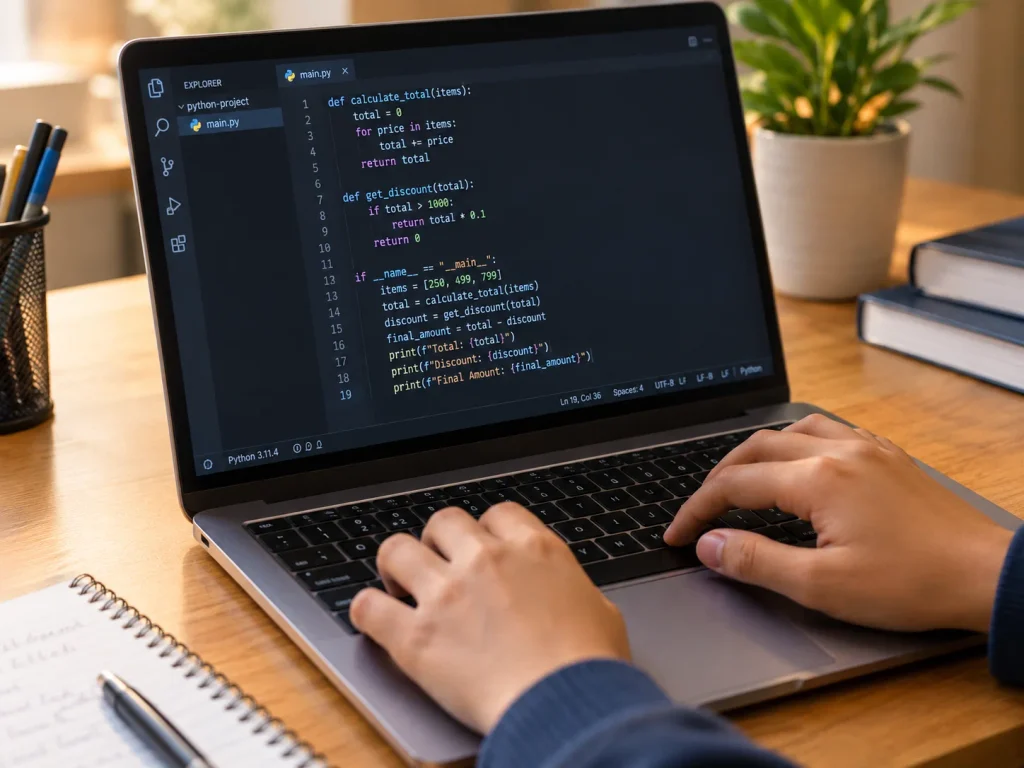
The connection isn’t metaphorical — it’s direct. Python is the primary working language of AI. Here’s what that looks like in practice for a teen progressing through the Python → AI pathway:
Python fundamentals (months 1–3). Variables, loops, functions, data structures, debugging. Not a single AI concept yet — just clean thinking about how software works. This is the layer AI sits on top of.
Python libraries introduction (months 3–5). NumPy for numerical data, Pandas for dataset manipulation. These are the tools data scientists and AI engineers use every day — and they’re just Python libraries.
AI-assisted development introduction (from month 4). Using tools like ChatGPT and NotebookLM as coding partners — but only after the Python foundation exists. The teen who knows Python evaluates AI output critically. The teen who doesn’t just copies it.
ML fundamentals (6 months+). Machine learning concepts using scikit-learn, first classifier models, neural network basics. By this point, everything makes sense — because the Python underneath it is already familiar.
See the technical side: how to make AI in Python — a step-by-step guide for beginners and our overview of what machine learning actually is.
It’s a common path — and it consistently produces the same outcome. Here’s what it actually looks like:
🚧 Can’t debug their own code
When something breaks — and it always does — they have no framework for finding why. They try different prompts and hope something works. This is a dead end.
🚧 Can’t modify or improve models
Pre-built AI tools do one thing. A teen who wants to change, extend, or adapt that behaviour needs to write code. Without Python, they’re stuck with what someone else built.
🚧 Can’t evaluate AI output critically
AI generates code that looks correct but isn’t. The teen who knows Python spots the error. The teen who doesn’t copies the broken code and wonders why nothing works.
🚧 Becomes AI-dependent, not AI-literate
There’s a real difference between using AI as a tool and being dependent on it. Teens without coding foundations become dependent — because they have no other option.
Read more on this distinction: AI literacy for kids — what it actually means and should kids learn AI in 2026 — the honest answer.
Less time than most parents expect — and the early milestones arrive quickly enough to keep teenagers motivated. Here’s a realistic timeline based on weekly live instruction:
| Timeframe | Where your teen is | What they can build |
|---|---|---|
| Week 1–2 | First Python programs running | Simple calculators, user input programs |
| Month 1 | Variables, loops, conditionals solid | Eligibility checkers, number games, smart tools |
| Month 2–3 | Functions, data collections, file handling | Password validators, quiz apps, student record managers |
| Month 4 | AI-assisted development introduced | Using ChatGPT and NotebookLM as coding partners |
| Month 5–6 | Complete applications, portfolio projects | Task managers, data analysis tools, movie databases |
| Month 6+ | Ready for Advanced Python & AI Foundations | Machine learning concepts, AI-powered projects |
See our research on this: how long does it take for a teen to get good at coding? and our full guide to is Python easy to learn for beginners?
This is what keeps teenagers motivated — not abstract theory, but real things they built, understand, and can explain. Here’s what the Python → AI progression produces:
🐍 Python stage
🤖 Python + AI tools stage
🧠 Advanced AI stage
See real AI projects teens build: AI projects for kids and teens and 25 best AI science fair projects for students.
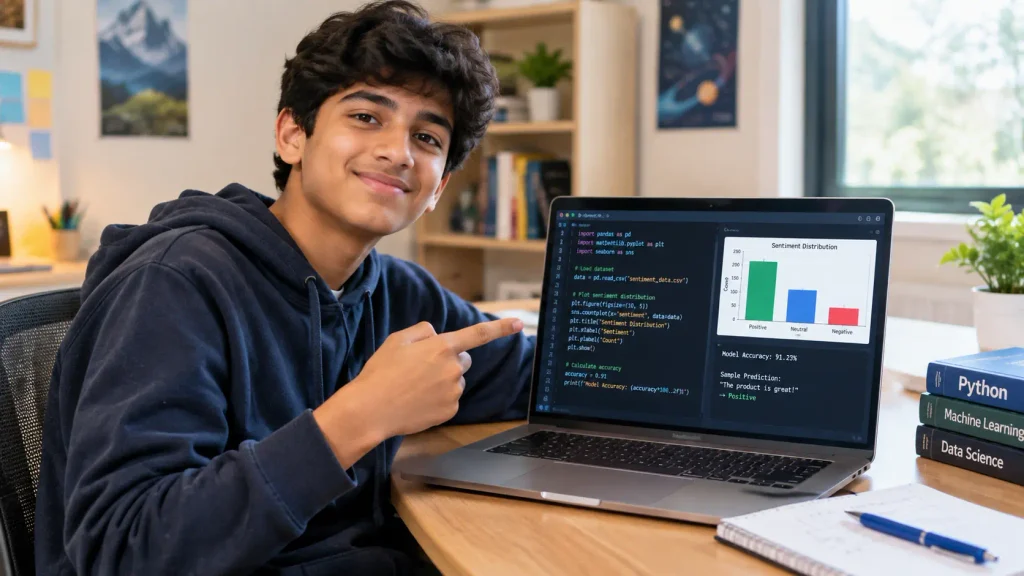
This is the part that surprises most parents. A good Python course for teens does include AI — but deliberately, at the right moment, in the right way. Here’s the approach that ItsMyBot’s Python Foundations course uses:
Think — Understand the problem and plan a solution independently, before any AI involvement.
Code — Write the Python solution themselves. This is non-negotiable — the cognitive work of writing code is where the learning happens.
Test — Run the program. Find what breaks. This is where debugging skills are built.
Ask AI — Now, use ChatGPT or NotebookLM to investigate the error, explore an alternative, or understand a concept more deeply.
Evaluate — Does the AI suggestion actually make sense? Is it correct? This is the critical thinking that only exists if the teen knows enough Python to judge it.
Improve and explain — Modify the code, test it again, and demonstrate understanding of the final solution. The teen who can explain their code owns it.
Three things matter at the start — and the order is important.
ItsMyBot’s Python Programming Foundations course is built for exactly this starting point — ages 10–15+, 42 live hours, real projects from session one, AI integration from month 4, and a clear progression into Advanced Python, AI & Machine Learning, and Software Engineering.
Also read: coding for 12-year-old beginners — where to start, the complete coding guide for teens, and will coding help my teen get into university?
What You Now Know
Python isn’t a detour on the way to AI. It’s the foundation AI is built on. Every major AI framework is Python. Every professional AI engineer writes Python. Every teenager who arrives at machine learning having skipped Python faces the same wall — they can use AI tools, but they can’t build with them, debug them, or understand them.
The Python → AI path takes 6–12 months with consistent weekly instruction. It produces teenagers who don’t just use AI — they understand it, evaluate it critically, and build with it. That’s a meaningfully different capability than anything a no-code AI platform can offer.
Start at the right place: explore ItsMyBot’s Python Programming Foundations course or book a free trial session today.
The future of AI belongs to teenagers who learn Python first.
Can my teen learn AI without learning Python first?
They can use AI tools without Python — but they can’t build AI, modify it, debug it, or understand it. The difference is between an AI user and an AI developer. For teens who want more than surface-level understanding, Python is the non-negotiable starting point.
Why is Python specifically recommended for teens learning AI — not JavaScript or C++?
Python is the primary language of every major AI and machine learning framework — TensorFlow, PyTorch, scikit-learn, Hugging Face. JavaScript is excellent for web development but is not used in AI research or ML engineering. C++ is used in performance-critical systems but is significantly harder for beginners. Python’s readable syntax and direct relevance to AI make it the clearest first step.
How old does my child need to be to start the Python → AI path?
Ages 10–12 is a strong starting point for Python fundamentals, with AI concepts introduced from month 4 onwards. Children who start at 10 are typically ready for real AI and machine learning projects by 13–14 — well ahead of what most university courses introduce.
Does my teen need any prior coding experience to start Python at ItsMyBot?
Some prior coding experience — even Scratch or block coding — helps, but it’s not required. The Python Foundations course starts from the beginning. A free trial session includes an assessment of your child’s current level, after which a personalised roadmap is built around exactly where they are.
What comes after Python Foundations — how does the AI path continue?
After Python Foundations, students progress to Advanced Python & AI Foundations, then to AI-Powered Software Development with Python, and then to the full AI & Machine Learning pathway — covering machine learning, computer vision, NLP, large language models, and agentic AI. Each level builds directly on the previous one.
Will Python skills help my teen’s university application?
Significantly. A teen who has built Python projects over 2–3 years has a real, verifiable portfolio — not just a certificate. University admissions for engineering, computer science, medicine, and even law and business increasingly value technical literacy. Working Python projects are evidence of capability that distinguishes applicants clearly.

Online coding, AI, and robotics classes that help kids ages 6–18 build real skills — and confidence — one project at a time.
No commitment · Live class with an expert teacher
© ItsMyBot 2026. All Rights Reserved.