
Most children learn to code in class or at home — but nothing accelerates growth like a real challenge with real stakes. Competitions push your child to think faster, build more creatively, and take pride in what they create.
The problem? Finding the right coding competition ideas for kids at the right level is harder than it sounds. Enter a competition too advanced, and your child feels defeated. Too easy, and they’re bored. This guide maps 15 genuine options — from beginner Scratch game jams to international robotics contests — so you can find the right match for your child’s skills and goals.
💡 Quick Facts
- Kids who enter coding competitions build problem-solving skills faster than those in classroom-only settings
- Most global coding competitions for kids are free to enter
- Competitions exist for ages as young as 5 (Scratch game jams) through to 18+ (international olympiads)
- Team competitions are often better for beginners — collaboration reduces pressure
- A structured course is the most effective preparation for any competition
Competition brings out something different in children. When they’re building for a real audience — real judges, real peers — they care more. They persist through bugs they’d otherwise abandon. They finish projects they’d otherwise leave half-done.
Beyond the technical skills, competitions build:
These are exactly the skills employers cite as essential for future careers in technology, science, and beyond. Before any competition, every child needs a strong foundation. Start with The ABC’s of Coding: Complete Beginner’s Guide for Kids — it builds the core concepts every competition will test.
For a deeper look at what consistent coding practice achieves, read from Scratch to success: how robotics and coding ignite children’s potential and why coding is the best summer camp activity.
Before entering your child in any contest, check for these qualities:
Age-appropriate challenge level A competition designed for 16-year-olds will discourage a 9-year-old, even a talented one. Match the competition to your child’s current skill stage, not their potential.
Clear rules and judging criteria Good competitions tell entrants exactly what they’re being judged on — creativity, technical complexity, presentation, functionality. Vague criteria lead to frustration.
Safe, moderated submission environment For younger children especially, ensure the platform is COPPA-compliant or involves no personal information beyond a parent-managed account.
Recognition, not just prizes The best competitions celebrate participation meaningfully — not just winners. A child who worked hard on a project deserves to feel that effort was seen.
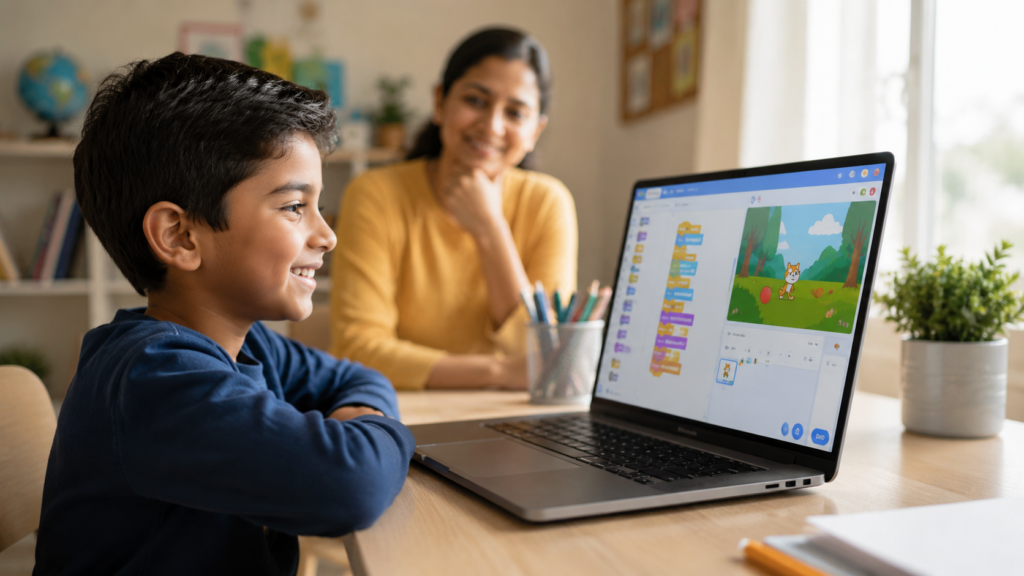
1. Scratch Game Jam MIT runs periodic themed game jams on the Scratch platform. Children build a project around a specific theme in a set timeframe. Perfect for ages 6–12. Free, beginner-friendly, and encourages creativity over technical complexity. Read our Guide to Scratch Coding to get your child competition-ready on Scratch.
2. Code.org Game Lab Contest Code.org hosts regular creative coding challenges for beginners. Children use the visual Game Lab to build interactive animations and simple games. No prior experience needed.
3. ItsMyBot Project Showcase Your child can enter their best ItsMyBot project into internal showcases, receiving mentor feedback and recognition from the global ItsMyBot community. A safe, structured first step into competitive coding for children on the Little Coder or Junior Coder programmes.
4. Hour of Code Challenge Code.org’s annual Hour of Code event (December) includes themed challenges for every age and level. Completing a challenge earns a shareable certificate — a genuine confidence-builder for young coders.
5. Scratch Design Studio An ongoing, community-curated competition on Scratch. Students submit projects to themed studios and vote for favourites. Excellent for children aged 7–12 who want peer recognition for their Scratch builds.
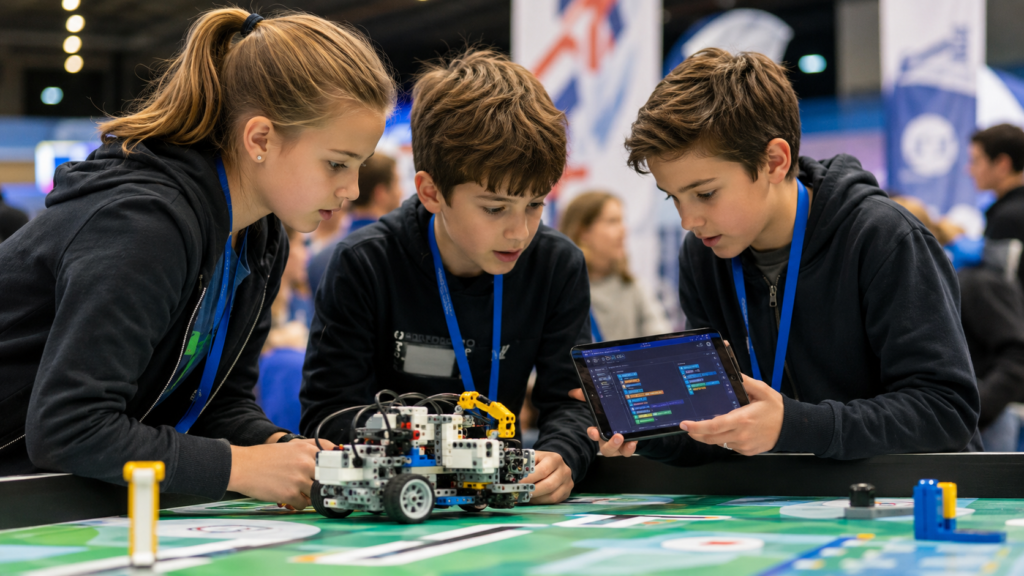
6. First Lego League (FLL) Explore and Challenge One of the most respected STEM competitions globally. Teams of 2–10 children build and programme Lego robots to complete themed missions. FLL Explore is for ages 6–10; FLL Challenge is for 9–14. Combines robotics, programming, research, and teamwork. Read Introduction to Robotics for Kids to understand the robotics concepts your child will need.
7. Bebras International Informatics Contest A computational thinking competition for ages 8–18, run annually in October. Tasks focus on logic and problem-solving rather than specific programming languages — excellent for children building foundational thinking skills. Free to enter via your child’s school.
8. CyberPatriot (Junior Division) A US-based cybersecurity competition with a junior track for middle school students. Teams identify and fix security vulnerabilities in computer systems. Develops real technical skills alongside digital safety awareness.
9. Congressional App Challenge Open to US middle and high school students, this competition invites children to build an app for a cause they care about. Projects are judged by members of Congress. Excellent for motivated 12–15 year olds. Preparation: mobile app development course for kids.
10. Tynker Game Design Competition Tynker runs regular themed game-design competitions for children aged 7–18. Intermediate tracks require building fully functional games with multiple levels, custom graphics, and sound. Strong creative element alongside technical challenge.
11. Roblox Game Development Contest Roblox runs annual developer challenges open to young creators. Children who’ve completed structured Roblox training build a real competitive advantage here. Read Roblox Coding Course for Kids to understand exactly what skills your child needs — and explore the Roblox game development course for structured preparation.
12. AI for Good Challenge Several non-profits and tech companies run AI-themed challenges for children aged 12+. Children identify a real-world problem and propose how AI could help solve it. Read Python for Kids: Complete Guide & Best Courses and explore AI & Machine Learning classes and the Young Innovators AI Lab to build the skills this competition demands.
13. International Olympiad in Informatics (IOI) The most prestigious international programming competition for students under 18. Problems require advanced algorithms and data structures. Best suited for highly motivated older teens with at least 2–3 years of text-based coding experience. Preparation track: Senior Coder → Python classes → Data Science.
14. Google Summer of Code (Student) Google’s open-source contribution programme for students. Participants contribute code to real-world open-source projects. Not a traditional competition — but winning tasks earns recognition from global tech companies. Ideal for teens on the Full Stack Development or JavaScript tracks.
15. First Robotics Competition (FRC) High school students build and programme industrial-sized robots for field challenges. Combines mechanical engineering, electronics, and programming. One of the most comprehensive STEM experiences available to teenagers. Explore robotics courses for kids and best robotics classes for kids to start your child’s robotics journey early.
Step 1: Match the competition to current skills — not aspirational skills Enter at a level where your child can succeed with effort. The ABC’s of Coding gives you a clear picture of where your child stands in the coding journey right now.
Step 2: Build real projects before the competition The best preparation is completing actual projects. Read Scratch projects for kids, beginner Roblox game projects, and the Guide to Scratch Coding for inspiration.
Step 3: Understand the judging criteria Read the rules with your child. What are judges actually looking for? Creativity? Technical complexity? Presentation? Align the project to the criteria from day one.
Step 4: Practise presenting the project Help your child articulate: What does their project do? What was the hardest part to build? What would they improve next? Clear communication is often the deciding factor.
Step 5: Enter early Last-minute entries are always weaker. Starting early gives time to test, fix bugs, and refine the presentation.
For detailed preparation strategy, read how to prepare kids for coding competitions.
Mistake 1: Choosing a competition that’s too advanced A frustrated child learns nothing from an entry they couldn’t complete.
✅ Match to current skills. Read The ABC’s of Coding first to honestly assess your child’s level.
Mistake 2: Focusing on the prize instead of the process Children who fixate on winning usually produce weaker work. The best entries come from children who genuinely care about their project.
✅ Help your child pick a theme they find interesting.
Mistake 3: Competing without enough preparation Competitions reward consistent practice, not last-minute effort.
✅ Build regular coding habits months before the competition date using structured courses like Little Coder, Junior Coder, or Senior Coder.
Mistake 4: Not reading the rules carefully Eligibility requirements, submission formats, and judging criteria vary significantly.
✅ Read every rule with your child before starting.
Competitions are most valuable as milestones, not endpoints. The real learning happens in the months of practice before and the reflection after.
A structured learning pathway — regular classes, guided projects, mentor feedback — builds the skills that make competitions meaningful. Without a foundation, entering a competition is like running a race without training.
ItsMyBot builds exactly this foundation. Personalised 1:1 sessions adapt to your child’s pace. Parents receive progress updates. Projects are real — not worksheets. When your child is ready to compete, they’ll have the skills and the confidence to do it well.
Explore the full learning journey:
ItsMyBot Course Pages:
🏁 In summary: Coding competitions accelerate your child’s growth in ways that regular practice alone can’t match. The key is choosing the right competition at the right level — and preparing with consistent, guided practice beforehand. Whether your child starts with a Scratch game jam or works toward an international robotics challenge, every competition is a chance to build real-world confidence and skills. Start building that foundation today →
Scratch Game Jams, Code.org challenges, and Hour of Code events are the best starting points for absolute beginners aged 6–12. They’re free, age-appropriate, and focused on creativity rather than technical complexity. Start with The ABC’s of Coding and Guide to Scratch Coding before entering.
Competitions exist for children as young as 5–6 through to 18+. Most structured competitions start around age 8–10. The key is matching the competition to your child’s current skill level, not just their age.
Both options exist. Team competitions like First Lego League are often better for younger children because collaboration reduces pressure and makes the experience more fun. Individual competitions like Bebras test solo problem-solving skills.
It depends on the competition. Scratch competitions use visual blocks. Bebras is language-agnostic. Advanced competitions like IOI use Python, C++, or Java. Read Python for Kids: Complete Guide and Introduction to Robotics for Kids to understand which language best fits your child’s goals.
Build a regular coding habit before the competition date. Work on real projects, not just tutorials. Read the competition rules carefully and practise explaining the project aloud. A mentor-guided course — like Junior Coder or Senior Coder — is the most effective preparation.
Yes. Roblox runs regular developer challenges for young creators. Read Roblox Coding Course for Kids to understand the skills needed and explore Roblox game development course for structured preparation.
Yes — especially online or school-based competitions where social pressure is lower. The structured goal and creative focus often help children who struggle in unstructured social settings. Building something they’re proud of naturally builds the confidence to share it.
Your child deserves more than passive screen time. They deserve to build, create, and compete — with the skills, confidence, and mentorship to back it up.
At ItsMyBot, every child gets:
Whether your child is 5 and curious, 10 and ready to level up, or 15 and serious about a tech future — there’s a path built for them.
No commitment. No pressure. Just your child’s first step toward something extraordinary.
Turn screen time into skill time. Prepare your child to build, create, and compete.

Online coding, AI, and robotics classes that help kids ages 6–18 build real skills — and confidence — one project at a time.
No commitment · Live class with an expert teacher
© ItsMyBot 2026. All Rights Reserved.