
14 min read · Last updated August 2026
What This Guide Covers
Every parent has heard it: “Your child needs STEM skills for the future.” But when you search for STEM education for kids, you get a wall of jargon — acronyms, frameworks, policy papers — and almost nothing that tells you what you actually need to know. What does STEM look like for a 6-year-old? What does a good STEM program do that a bad one doesn’t? And is this really as important as everyone says?
The answer to that last question is yes — but not for the reasons most platforms tell you. STEM education builds problem-solving, logical thinking, creative confidence, and resilience that transfers across every area of a child’s academic and professional life. This guide gives you the complete picture: what STEM is, why it matters, what good looks like at every age, and exactly how to give your child access to it.
Table of Contents
STEM stands for Science, Technology, Engineering, and Mathematics. But the acronym is almost less important than what it represents as an approach to learning. STEM education isn’t about memorising the periodic table or solving algebra problems in isolation. It’s about teaching children to think systematically, solve problems with evidence, and create things that work.
Good STEM education is hands-on, project-based, and cross-disciplinary. A child building a robot is doing engineering and coding simultaneously. A child running a science experiment and recording data is doing science and maths together. The subjects aren’t taught in silos — they reinforce each other in the way they do in the real world.
Want the full history? Read our dedicated article: What does STEM stand for? and What does STEM mean in education?
Each pillar of STEM builds a distinct set of skills — but they work best when taught together. Here’s what each one contributes to your child’s development:
🔬 Science
The discipline of asking questions and finding evidence-based answers. Science teaches children to observe carefully, form hypotheses, run experiments, and draw conclusions — skills that underpin critical thinking in every field.
In practice: Science fair projects, nature experiments, biology, chemistry, physics.
💻 Technology
Understanding and creating with digital tools. Technology in STEM means coding, computational thinking, AI literacy, and the ability to build software solutions — not just use apps. It’s the “create” half of digital literacy.
In practice: Coding classes, AI projects, app development, game creation, data analysis.
⚙️ Engineering
The discipline of designing and building solutions to real problems. Engineering teaches children to plan, prototype, test, fail constructively, and iterate. It’s structured creativity — applied thinking at its most practical.
In practice: Robotics, LEGO challenges, bridge-building, design projects, physical prototyping.
🔢 Mathematics
The language of precision and pattern. Maths in STEM goes beyond arithmetic — it includes logical reasoning, data interpretation, probability, and the abstract thinking that underpins science, engineering, and technology alike.
In practice: Data analysis, statistics, geometry in design, maths in coding logic and robotics.

STEAM adds an A for Arts to the STEM framework. The argument is that creativity, design thinking, and artistic expression are essential partners to scientific and technical rigour — and the evidence backs that up. Many of the most impactful innovations come from combining technical precision with creative vision.
| STEM | STEAM | |
|---|---|---|
| Focus | Science, Technology, Engineering, Maths | All of STEM + Arts (design, creativity, expression) |
| Strength | Technical precision, logical reasoning | Combines analytical and creative thinking |
| Best for | Children drawn to logic, building, and systems | Children who also love art, design, music, or storytelling |
| Industry use | Engineering, science, computing, data | UX/UI design, creative tech, architecture, game design |
| Verdict | Excellent foundation — coding and robotics live here | Stronger long-term model — creativity amplifies technical skill |
The honest verdict for parents: Don’t get hung up on the acronym. The principles are nearly identical. Whether a program calls itself STEM or STEAM, what matters is whether it teaches children to think, build, solve, and create — through hands-on, project-based learning that adapts to your child’s pace.
Read the full breakdown: STEM vs STEAM education — what’s the difference?
The argument for STEM education is stronger in 2026 than it has ever been — and the data makes this impossible to argue against. The Bureau of Labor Statistics projects that STEM occupations will grow at roughly three times the rate of non-STEM occupations through 2034. But the career argument is actually the least important one.
Here’s what the research actually shows STEM education builds in children:
Also explore: The importance of robotics in STEM learning and our full history: History of STEM education.
Your child’s STEM journey starts with one session.
ItsMyBot offers live, personalised STEM coding and robotics courses for children aged 5–15. Try a free demo — no commitment needed.
STEM education looks completely different at 5 than it does at 15. The right tools, the right challenge level, and the right goals shift significantly across development stages. Here’s what works — and what doesn’t — at each age.
At this age, STEM should feel like play — because for young children, play is how they learn best. The goal isn’t to teach calculus. It’s to build the habit of curiosity, the willingness to experiment, and the confidence that “I can figure this out.”
→ Read: Coding for 5-year-olds — what’s actually possible | ItsMyBot Little Coder programme
Children at this stage can follow multi-step processes, handle complexity, and produce meaningful finished work. This is the golden window for structured STEM classes — children are curious enough to explore and patient enough to complete.
→ Read: Best coding classes for 8-year-olds | Best beginner robotics kits | Junior Coder programme
The transition to abstract thinking makes this stage ideal for real programming languages, intermediate robotics, and genuine scientific inquiry. Everything built in this window becomes early portfolio material. This is where STEM investment starts to pay visible dividends.
→ Read: Coding for 12-year-old beginners | 25 best AI science fair projects | Senior Coder programme
At this stage, STEM becomes strategic. The goal is building a portfolio that demonstrates genuine capability — one that distinguishes your child in university applications and early career opportunities. Competitions and hackathons become meaningful additions to their record.
→ Read: Will STEM coding help my teen get into university? | Coding competition ideas for kids | Hackathon preparation for kids
The difference between a good STEM activity and a forgettable one is almost always the same thing: does the child make something? Watching a video about how robots work is not STEM education. Building a robot — even a simple one — is. Here’s what high-quality STEM activity looks like across the four pillars:
| Pillar | Low-quality activity | High-quality activity |
|---|---|---|
| Technology | Watching someone else code on YouTube | Building a working game in Scratch or Python with a live mentor |
| Engineering | Playing with a pre-built robot kit | Building and programming a robot from components to solve a problem |
| Science | Reading a textbook about chemical reactions | Running an experiment, recording results, and explaining what happened |
| Mathematics | Completing a worksheet of equations in isolation | Using data from a robotics experiment to identify patterns and draw conclusions |
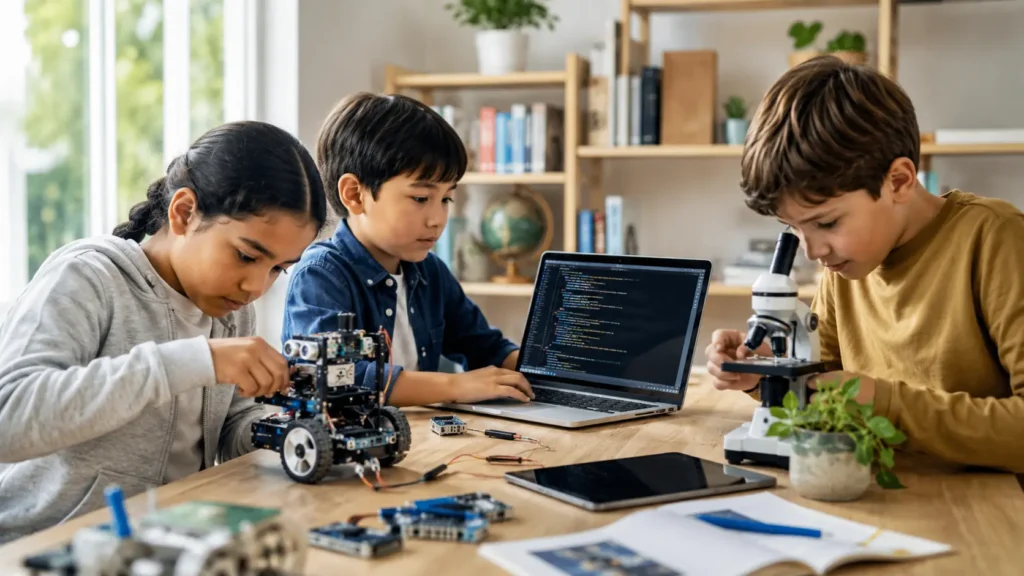
Not all STEM programs are equal. Many use the label without delivering the substance. Here are the seven non-negotiables to verify before enrolling your child in any STEM program:
Every session ends with a tangible output. A project, a working prototype, a piece of code — something your child can show you. If sessions end with only notes or videos watched, the program is consuming, not creating.
Live instruction from a qualified mentor. Pre-recorded videos are tutorials — not STEM education. A real instructor who adapts to your child in real time is the single most important quality factor. Ask: is every session live and interactive?
Curriculum personalised to your child. A child who loves animals should build animal-themed projects. A child interested in space should code space simulations. Generic, scripted lessons kill STEM curiosity faster than anything else.
A free trial before you pay. Any STEM program that won’t let your child experience one session first is not confident in its own product. A single free demo answers more than any marketing page can.
Age-specific tracks — not one-size-fits-all. STEM for a 6-year-old looks nothing like STEM for a 14-year-old. If a program doesn’t differentiate clearly between age groups, it has designed for neither effectively.
Industry-standard tools and languages. Programs that use only proprietary platforms produce skills that vanish the moment the subscription ends. Python, Scratch, JavaScript, C++, and real robotics frameworks give your child transferable capability.
Regular parent progress updates. You’re making the investment. A quality STEM provider keeps you informed proactively — not just when you ask. Visibility is a trust signal.
Use this alongside our full guide: How to choose the right coding course for your child and our honest assessment of whether online STEM coding is worth it for kids.
STEM careers span every sector of the economy — and the salary data is striking. According to the Bureau of Labor Statistics, the median wage for STEM occupations is significantly higher than the national average across virtually every experience level. But more importantly, STEM skills are transferable across career changes in a way that narrower specialisations are not.
💻 Technology & Software
⚙️ Engineering & Robotics
🔬 Science & Research
🌐 Cross-Discipline STEM Roles
The careers available to a child who builds STEM skills now — even careers that don’t exist yet — will be more varied and better compensated than those available to their peers who don’t. Explore: Best STEM careers for kids to explore and unexpected careers that involve coding.
ItsMyBot’s programmes are built on three STEM pillars — Technology (coding), Engineering (robotics), and AI — delivered through live 1:1 instruction that adapts entirely to your child. Every programme share the same core principles: real projects, real mentors, real progress visibility.
🌱 Little Coder
Ages 5–7 · Play-Based STEM
ScratchJr animations, basic logic, creative digital projects. Every session is a game — with real STEM foundations being built quietly underneath.
💻 Junior Coder
Ages 8–11 · Real Projects
Scratch, Python, Roblox Lua, web design, AI basics. Your child picks the direction. The mentor builds around their interests and pace.
🚀 Senior Coder
Ages 12–15+ · Portfolio-Grade
Python, C++, JavaScript, full-stack dev, AI engineering. University-ready portfolio outcomes with industry-standard tools and methods.
🤖 Robotics Courses
Ages 8–15 · Hands-On Engineering
Physical robotics builds combined with real code. From entry-level Cruiser to advanced IoT Master Engineering. Hardware + software together.
🧠 AI Courses
Ages 8–15 · Future Skills
Machine learning, AI tools, prompt engineering, and real AI projects. The fastest-growing skill set in the global economy — for children who want to lead it.
☀️ Summer STEM Camp
All Ages · Intensive Introduction
A focused, project-heavy coding and robotics camp — ideal for starting a STEM journey over school holidays with structured intensity.
View the full programme map on our courses page or start with a free coding trial class with no commitment.
Understanding STEM
Coding in STEM
Robotics & AI in STEM
What You Now Know
STEM education is not a trend or a nice-to-have. It’s the framework through which children learn to think systematically, build things that work, and face difficulty with confidence. Whether through coding, robotics, AI, or science projects — every good STEM experience shares the same core: your child makes something real.
The stakes of not engaging with STEM early aren’t dramatic — they’re quiet. Children who miss this window don’t fail. They just arrive at secondary school, university, and career decisions without the confidence and capability that their peers who built these skills possess. That gap is preventable.
Book a free demo with ItsMyBot and see what STEM education looks like for your child — in one real session, with a live mentor, personalised for where they are right now.
Turn screen time into skill time — one free STEM session first.
Special circumstances? We have you covered.
Homeschooling families, children with ADHD, girls who haven’t been exposed to coding — ItsMyBot’s personalised approach works for every child.
What age should children start STEM education?
Children can engage with STEM from age 5 through play-based activities — pattern-making, building, simple experiments. Structured STEM programmes with projects and outcomes suit ages 7 and above. The earlier the exposure, the more natural the STEM mindset becomes. Interest is a stronger indicator of readiness than age.
Is STEM education only for children who want a career in technology?
No — and this is the most important misconception to correct. STEM builds skills that transfer across every profession: medicine, law, design, business, and the arts all benefit from systematic problem-solving, data literacy, and creative technical thinking. STEM education is preparation for clear thinking — not just for tech careers.
What’s the difference between STEM and STEAM?
STEAM adds Arts to the STEM framework — design thinking, creative expression, and artistic problem-solving alongside scientific and technical rigour. For children who love art alongside science, STEAM can be a more engaging framing. In practice, the best STEM education already incorporates creative thinking, so the distinction matters less than the quality of the programme.
How do I know if a STEM programme is actually good?
Ask two questions: Can my child show me something they built after every session? And is every session live with a real instructor who adapts to my child? If both answers are yes, you have a quality programme. If sessions end with videos watched and no project output, the programme is consuming content — not creating STEM learners.
Does STEM education help with school performance?
Yes — consistently and measurably. Research from Google and Gallup shows children in structured STEM programmes score higher in maths and reading comprehension across all subjects. The systematic problem-solving STEM builds transfers directly into academic performance, particularly in science, maths, and essay-based subjects.
What STEM subjects does ItsMyBot cover?
ItsMyBot covers the Technology and Engineering pillars of STEM — coding (Scratch, Python, JavaScript, C++), robotics (hardware builds and programming), and AI (machine learning, AI projects, prompt engineering). All programmes use live 1:1 instruction with personalised curricula for ages 5–15, and every session produces a real project output.
Can girls do well in STEM? Is it really for everyone?
Yes — unequivocally. Research confirms girls perform equally to boys in STEM when given equal access and encouragement. The gender gap in technology careers is a pipeline problem — created by under-exposure, not under-capability. Girls who engage with STEM before age 12 are significantly more likely to maintain that interest through secondary school and beyond.
How long does it take to see real STEM progress in a child?
With live, structured instruction, most children complete their first real project within 1–3 sessions. Noticeable, independent problem-solving — where a child works through a challenge without needing to ask for the answer — typically develops within 4–8 weeks of consistent weekly classes. Commit to 8 sessions minimum before evaluating a programme.