
Your teen wants to learn coding — and you’re already asking the real question: how long will it take before they’re actually good at it? It’s a fair thing to wonder. Between school, screen time limits, and the pressure of getting results, the last thing any parent wants is for their child to spend months learning something with nothing to show for it.
This guide gives you an honest, practical timeline for teen coding progress — broken down by age, learning frequency, and learning style. By the end, you’ll know exactly what to expect, what accelerates results, and how structured online coding classes for kids and teens can make the biggest difference.
Quick Facts
- What: A realistic timeline for teen coding progress
- Who: Teens aged 12–17 and their parents
- Why: To set realistic expectations and choose the right learning path
- When: Relevant from day one of starting to code
- How: Structured practice, guided mentorship, and real projects
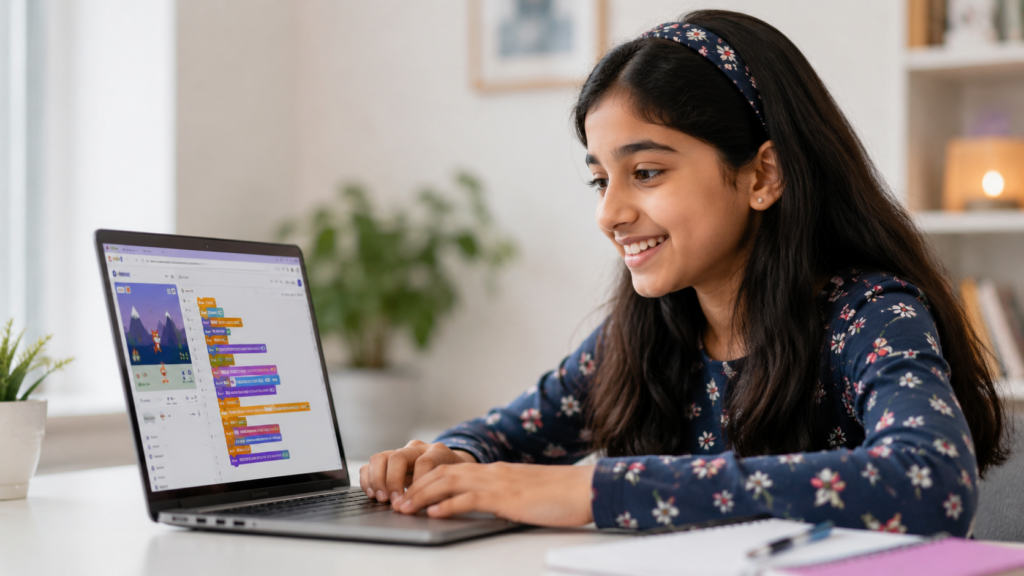
Before we answer the timeline question, we need to define the goal. ‘Good at coding’ means different things depending on what you’re measuring.
For most teens, being genuinely competent at coding means being able to:
That’s the real benchmark — not memorising syntax, but building and problem-solving independently. Most teens reach that stage within 6 to 18 months when they follow a structured learning path.
If your teen is just starting out, the Junior Coder programme at ItsMyBot is designed to get them from zero to building real projects — at their own pace, with a mentor guiding each step.
Here’s a realistic breakdown of what most teens experience when they learn coding with consistent effort.
Your teen learns what code is, how computers ‘think’, and writes their first programmes. Expect small wins — a calculator, a simple quiz — but also frustration when things don’t work. This is completely normal. The important thing is they keep going.
This is where things start clicking. Your teen can write short programmes on their own, understands logic flow, and is starting to build real mini-projects. This stage is where most teens discover what they actually enjoy — games, apps, websites, or robotics.
At ItsMyBot, teens in this phase often discover a passion for C++ programming for kids, which builds powerful computational thinking alongside creative project work.
Now your teen starts working on meaningful projects. They’re combining concepts, fixing their own bugs, and producing things they’re proud to show people. This is when the ‘aha’ moments accelerate. Their curiosity fuels the learning from this point forward.
By 12 to 18 months of consistent, structured practice, most dedicated teens can build functional applications, contribute to collaborative projects, and think like a programmer. This is the stage that opens doors — whether that’s a hackathon, a school competition, or a future career.
Explore our full coding classes for kids and teens to see which programme aligns with where your teen is right now.
Frequency matters far more than single marathon sessions. Here’s what the research on skill development and our own experience with thousands of young learners shows:
| Practice Frequency | Expected Progress | Time to First Real Project |
|---|---|---|
| 1 hour/week | Slow but steady | 12–18 months |
| 3 hours/week | Good momentum | 6–9 months |
| 5+ hours/week | Fast, visible growth | 3–5 months |
ItsMyBot’s structured after-school coding classes are designed around consistent, guided weekly practice — so your teen builds momentum without burning out.
The language your teen starts with affects how quickly they feel competent. Here’s a practical overview:
Most teens build genuine skill fastest when they start with one language and stick to it consistently — rather than jumping between languages every few weeks.
The biggest factor in how long it takes your teen to get good at coding isn’t raw intelligence — it’s structure and consistency.
🚀 Book a Free Trial Class — Turn Your Teen’s Screen Time into Real Skill →
Yes — but not in the way most parents expect. Younger teens often progress more slowly through concepts, but they have more time to reach mastery. Older teens pick up concepts faster, but have less time before exams and applications take priority.
The best time to start is now, regardless of age. A 12-year-old who starts today will be genuinely skilled by 14. A 16-year-old who starts today can build a portfolio project within 6 months.
ItsMyBot offers age-specific programmes so the content and pace match exactly where your teen is:
These are the patterns we see most often — and how to fix them.
❌ Mistake 1: Starting with the ‘hardest’ language to impress colleges Without foundations, teens get frustrated and quit.
✅ Fix: Start with the language that matches their goal, not someone else’s expectation.
❌ Mistake 2: Learning without a project goal Abstract coding feels pointless without something to build.
✅ Fix: Pick a project goal on day one — a game, a website, a chatbot.
❌ Mistake 3: Relying entirely on free YouTube tutorials No feedback, no progression structure, no accountability.
✅ Fix: Combine structured courses with project work. Our online coding classes for kids and teens do exactly that.
❌ Mistake 4: Skipping the fundamentals to jump to ‘cool’ stuff Without solid foundations, every advanced concept requires re-learning the basics.
✅ Fix: Follow a curriculum that builds layer by layer.
At ItsMyBot, we’ve built our programmes around one goal: helping your child go from curious to competent — as quickly and confidently as possible.
Here’s what makes our approach different:
Whether your teen is exploring AI and machine learning, Android app development, or robotics, we have a programme designed to take them from where they are to where they want to be.
Most teens reach a beginner-competent level within 3 to 6 months with consistent practice of 3–5 hours per week. Building genuinely independent coding skills typically takes 12 to 18 months with structured mentorship and real project work — not passive tutorial watching.
Yes — but it’s much slower and harder without structure. Self-taught teens often plateau early or develop bad habits. A guided curriculum with a real mentor gives 13-year-olds a clear path, faster feedback, and the accountability to keep going when it gets challenging.
Python is the most recommended starting language for teens aged 11–14 because of its clean, readable syntax and wide application. Teens aged 12 and above who want to build games or explore robotics often benefit from starting with C++ for its depth and power.
Three to five hours per week is the sweet spot for most teens. Structured sessions — even 45 minutes, three times a week — are far more effective than a single long session on weekends.
Online coding classes offer flexibility, access to expert mentors globally, and the ability to learn at your teen’s own pace. ItsMyBot’s online coding classes for kids and teens combine live mentorship with project-based learning — giving teens the best of both worlds.
Yes — significantly. The first few months are the steepest part of the learning curve. Once a teen understands core programming logic — how loops, functions, and conditionals work — they can pick up new languages and tools much faster. Progress genuinely accelerates over time.
Coding skills, hackathon experience, and a strong portfolio of projects are increasingly valued by university admissions teams — especially for STEM, business, and design courses. Beyond admissions, computational thinking improves performance across science, maths, and even humanities subjects.
Turn screen time into skill time — your teen’s coding journey starts with one free class.
We covered the realistic coding timeline for teens, the factors that speed up or stall progress, age-specific considerations, and the most common mistakes to avoid.
How long it takes for a teen to get good at coding depends entirely on three things: how they learn, how often they practice, and whether they’re building something real. With the right structure, 6 to 12 months is genuinely achievable.
Don’t wait for the ‘right time’ — book a free demo class today and let your teen build something brilliant.
Explore More
- What is Lua Programming in Roblox?
- Top Science Fiction Books
- What are Scratch Extensions?
- Top 7 Coding Games for Kids
- How to Teach Kids Coding Online: Benefits of Early Education
- Block-Based vs Text-Based Coding for Kids
- What is Roblox Studio? Beginner’s Guide for Parents
- Myths About Coding for Kids
- Introduction to Robotics for Kids
- Learn How to Code

Online coding, AI, and robotics classes that help kids ages 6–18 build real skills — and confidence — one project at a time.
No commitment · Live class with an expert teacher
© ItsMyBot 2026. All Rights Reserved.