
You’ve probably heard that C++ is one of the most powerful programming languages in the world — used in video games, robotics, operating systems, and competitive programming. But most guides either make it sound impossibly advanced for children or dangerously oversimplify what learning it actually involves. As a parent, you deserve a clear, honest answer: can kids learn C++, should they, and what does that journey actually look like?
The wrong decision here costs your child time and motivation. Start too early, without the right foundations, and C++ becomes a frustrating wall. Start at the right point, with the right structure, and it becomes one of the most career-defining skills your child can build — and the foundation for robotics, AI, game development, and competitive programming at the highest level. This complete guide gives you everything you need to make that decision well.
Table of Contents
C++ (pronounced “C plus plus”) is a general-purpose programming language created by Bjarne Stroustrup in 1979 as an extension of the C language. In 2026, it remains one of the most widely used programming languages in the world — and one of the most sought-after by employers in software engineering, game development, systems programming, robotics, and competitive programming.
What makes C++ distinct — and what makes it genuinely valuable for ambitious young learners — is its combination of low-level control and high-level structure. Unlike Python, which manages many technical complexities automatically, C++ requires programmers to think carefully about how a computer uses memory, processes data, and executes instructions. This depth of understanding is exactly what separates a capable programmer from a truly skilled one.
For children with ambitions in any of these areas, C++ is not a distant advanced skill — it’s the foundational language of the domains they want to enter.
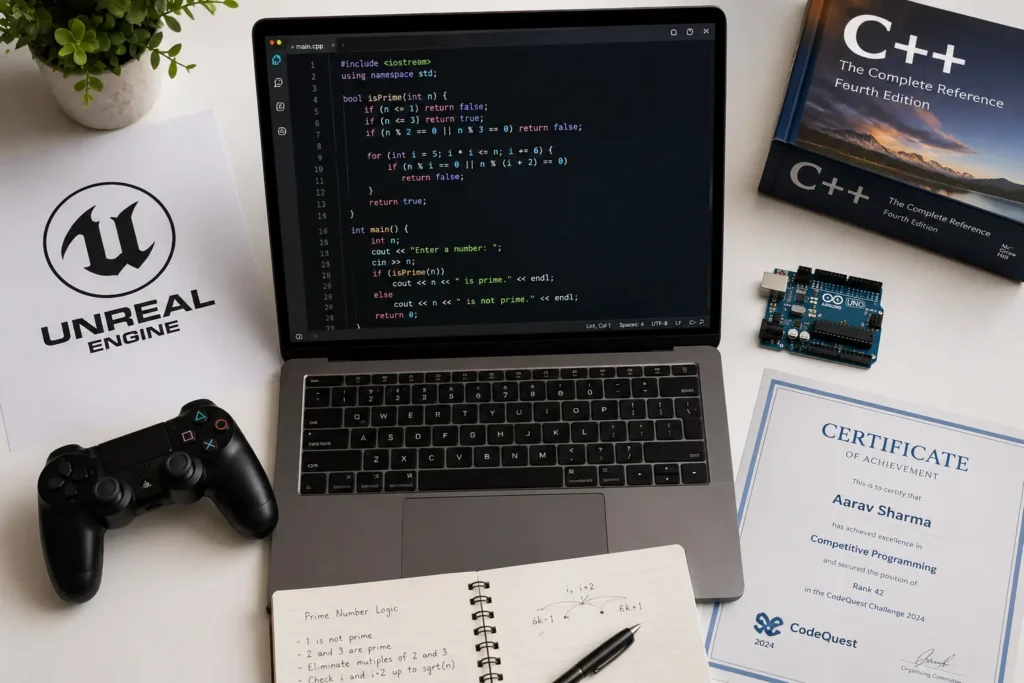
The direct answer is: yes, for the right children at the right stage — and here’s the nuance that most guides skip.
C++ is not a beginner language. It was not designed to be forgiving, nor to hide complexity from the programmer. A child with no coding experience who starts with C++ will face unnecessary friction that has nothing to do with their intelligence and everything to do with sequence. The children who thrive in C++ are those who arrive with foundations — either in Python, Scratch, or another structured language — and who have a specific, motivating goal: competitive programming, game development, or robotics.
That said, when the foundations are in place, C++ is one of the most transformative things a young programmer can learn. It teaches:
In 2026, with AI tools capable of generating basic code in seconds, the children who will stand out are those who understand what code is doing at a deeper level — not just what it produces. C++ builds exactly that depth.
For broader context on why programming education matters now, read our posts on why STEM education is important for kids and is coding really helpful for kids.
There is no single correct age — there is a correct readiness profile. The two most important factors are prior coding experience and motivation. Age is secondary to both.
A child who has learned Python or Scratch to a solid intermediate level — who understands variables, loops, conditionals, functions, and basic logic — can begin C++ meaningfully from around age 11–12. The concepts won’t be foreign; the challenge will be the new syntax and the greater precision required. With a good instructor and clear project goals, this is an achievable and rewarding transition.
For most children, 13–15 is the ideal window to go deep in C++. Cognitive maturity makes abstract memory concepts (pointers, references, scope) easier to hold. The academic pressure of school hasn’t yet crowded out curiosity. And competitive programming competitions — which C++ dominates — are typically aimed at secondary school students in this range. A child who invests seriously in C++ at this age has time to reach a genuinely advanced level before university applications.
Starting C++ at 16 or 17 is absolutely viable — especially for children who’ve built strong Python foundations. The learning curve is steeper in a shorter time, but motivated older students often progress quickly precisely because they can connect C++ concepts to everything they already know.
Not sure if your child has the foundations needed? Read our guides on signs your child is ready to learn coding, the best age to start coding, and our comparison of moving from Scratch to Python — the natural stepping stone before C++.
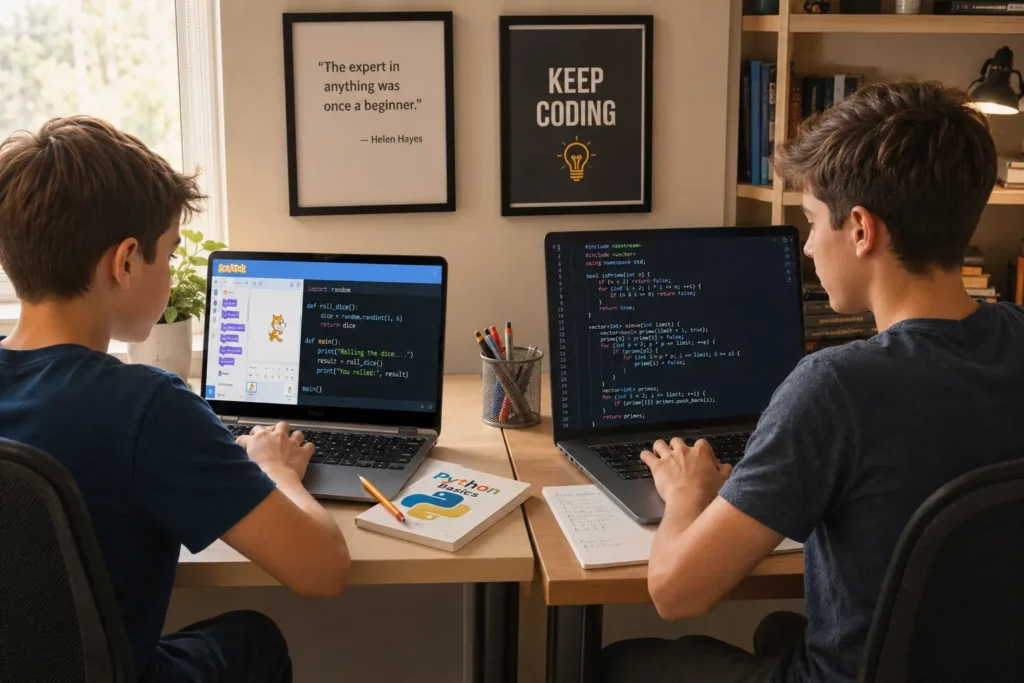
This is the most common question parents ask when considering C++ — and it has a clear answer in almost every situation: Python first, C++ second. But the reasoning matters as much as the recommendation.
| Factor | Python | C++ |
|---|---|---|
| Beginner-friendliness | High — clean syntax, forgiving, quick feedback | Low — strict syntax, complex compilation, less forgiving |
| Concept depth | Hides memory management; great for logic building | Exposes memory; teaches how computers actually work |
| Performance | Slower; interpreted language | Very fast; compiled; used where speed is critical |
| Project variety | AI, data science, web, automation, games | Game engines, robotics, systems, competitive programming |
| Competitive programming | Used, but less common at top level | Dominant language at IOI, ICPC, Codeforces |
| Industry demand | Extremely high; most versatile career language | Very high in specific domains; premium salaries |
| Recommended sequence | Start here — builds logic foundation | Progress here — deepens understanding, unlocks domains |
The Python-first approach isn’t about Python being “better” than C++. It’s about sequencing. A child who learns to think algorithmically in Python — who understands how to decompose a problem, write clean functions, and debug their own code — will find C++ challenging but navigable. A child who starts directly in C++ without those foundations will find it genuinely difficult in ways that have nothing to do with ability.
For a detailed guide on Python as the stepping stone, read our complete Python for kids guide. For the language comparison landscape, see our posts on Python vs Java for kids and the difference between Python and C++.
Projects are the proof of learning. Here is what children realistically build at each stage of a well-structured C++ programme:
The jump from “understanding C++ concepts” to “building something this complex” is significant — and it’s why the quality of the instructor and the programme structure matters so much. Project-based learning, guided by a mentor who knows how to scaffold complexity, is the difference between a child who gets there and one who gives up midway.
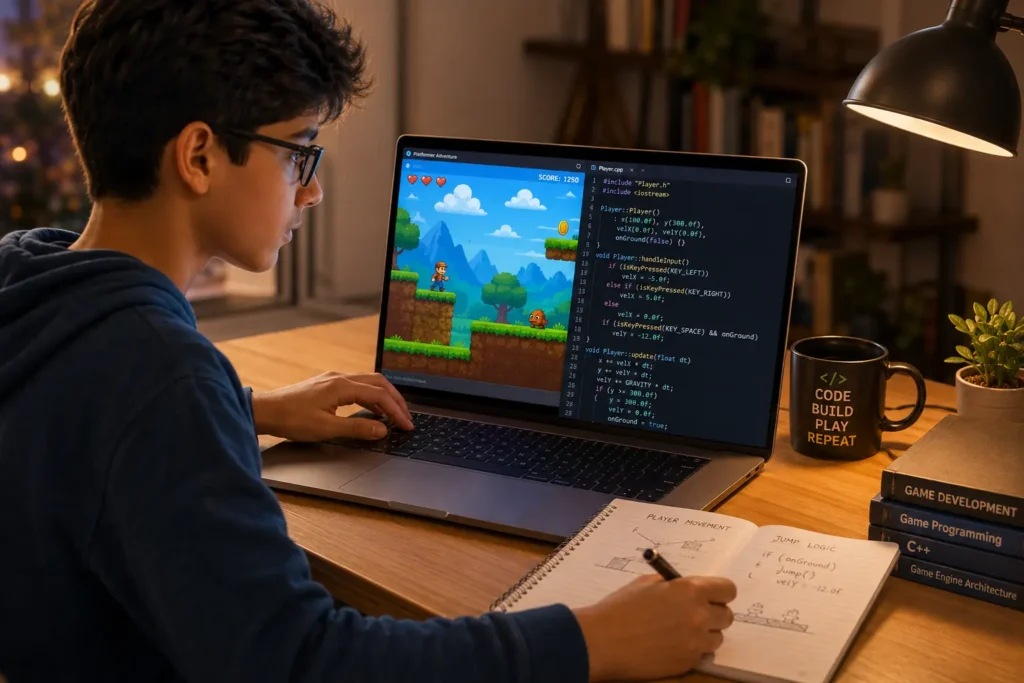
Understanding the conceptual curriculum helps parents assess whether their child is ready and what they’ll gain. C++ education for children typically moves through the following stages:
cin and cout to interact with the userif, else, while, for loopsnew and delete, understanding memory leaksThis curriculum mirrors what computer science undergraduates study in their first two years — but made accessible through well-designed projects and patient, expert instruction.
A realistic, well-sequenced C++ learning path for a child starting from scratch (assuming Python foundations already in place) looks like this:
📍 The ItsMyBot C++ Progression Framework
Phase 1 — Transition (Months 1–2)
C++ syntax, compilation process, basic I/O, variables, control flow. Goal: write clean, working C++ programs that mirror what the child already knows in Python.
Phase 2 — Core C++ (Months 3–5)
Functions, arrays, strings, pointers (introductory), and the STL. Goal: build small, complete programs — calculators, games, utilities — entirely in C++.
Phase 3 — Object-Oriented C++ (Months 6–9)
Classes, objects, inheritance, polymorphism. Goal: design and build a multi-class project — an RPG, a simulation, a management system.
Phase 4 — Algorithms and Data Structures (Months 10–15)
STL containers, sorting algorithms, trees, graphs, dynamic programming. Goal: solve competitive programming problems; build technically sophisticated projects.
Phase 5 — Specialisation (Months 15+)
Choose a direction: game development (SFML/Unreal), competitive programming (IOI/ICPC track), robotics (Arduino/ROS), or systems programming.
This timeline assumes one to two structured sessions per week with a qualified instructor. Self-study is possible but significantly slower without mentored feedback, particularly in phases 2 and 3 where misconceptions about pointers and memory can silently undermine progress.
For guidance on choosing the right course format, see our post on live 1-on-1 vs group coding classes for kids and our framework for how to choose the right coding course for your child.
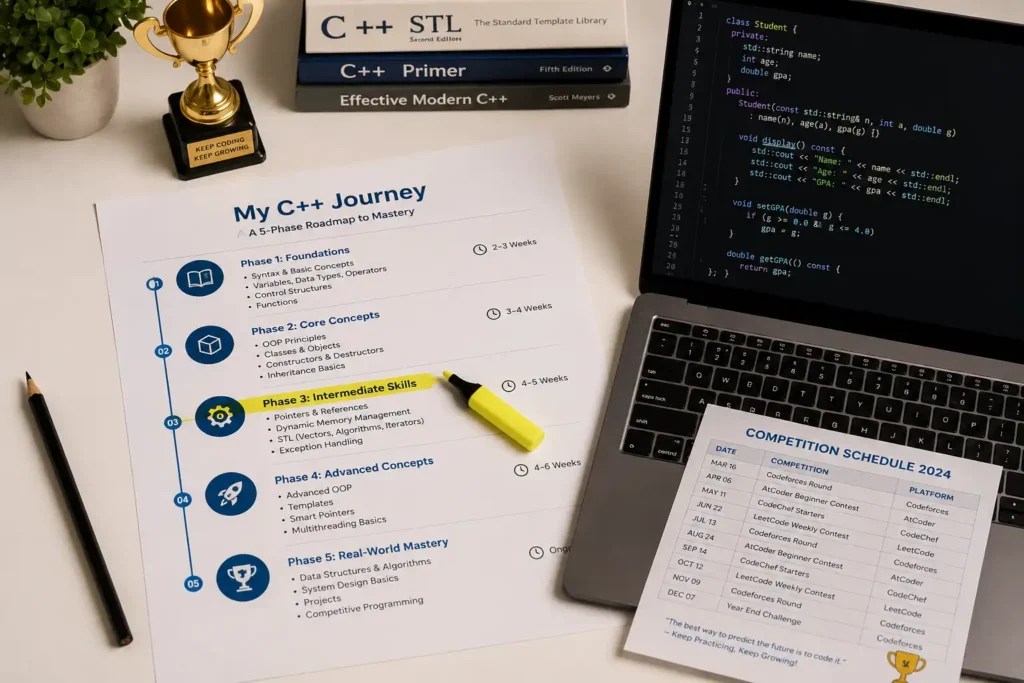
Competitive programming is one of the most intellectually demanding pursuits available to young coders — and C++ is its dominant language. Competitions like the International Olympiad in Informatics (IOI), the International Collegiate Programming Contest (ICPC), and platforms like Codeforces, LeetCode, and AtCoder all see C++ used by the majority of top performers.
The reason is straightforward: C++ is faster than Python and Java in execution time, and competitive programming problems often have strict time limits that Python-based solutions fail. C++’s Standard Template Library also provides a rich set of data structures and algorithms that experienced competitive programmers use fluently.
Competitive programming is a long game — it typically takes 12–24 months of dedicated practice to compete meaningfully at national level. But the thinking skills it develops — algorithmic precision, complexity analysis, elegant problem decomposition — are among the most valuable any young programmer can build.
Read our guide on how to prepare kids for coding competitions for a full breakdown of what’s involved and how to start.
Two of the most exciting applications of C++ for young learners — and the ones most likely to sustain long-term motivation — are robotics and game development.
Arduino — the most widely used beginner robotics platform in the world — uses a language that is a direct subset of C++. A child learning C++ at ItsMyBot isn’t just learning an abstract skill; they’re learning the language that will control the robots they build. More advanced robotics platforms, including ROS (Robot Operating System), also use C++ as a primary language.
The connection between C++ programming and physical robotics creates one of the most powerful learning loops available: code that has immediate, observable physical consequences. For more on how robotics and coding connect, see our complete robotics for kids guide and posts on programming robots — a beginner’s guide and artificial intelligence in robotics.
The Unreal Engine — used to build some of the world’s most ambitious games — is C++ based. While Unreal’s Blueprint visual scripting system allows surface-level game creation, professional game developers and serious young creators work in C++ directly. Even at a beginner level, building 2D games with SFML (a lightweight C++ multimedia library) teaches rendering, input handling, game loops, and physics in ways that no visual tool can match.
For children interested in game development more broadly, our posts on Roblox coding for kids and the best coding languages for game developers provide context on how C++ fits into the full game development landscape.
“C++ is too difficult for my child.”
C++ is genuinely more demanding than Python — that’s not a myth. But “too difficult” depends entirely on foundations and instruction quality. A child with solid Python experience, guided by a qualified instructor who knows how to scaffold C++ incrementally, can absolutely succeed. The difficulty is real; it’s also navigable.
“My child hasn’t learned Python yet — should they start with C++?”
Not recommended. Python is a faster, more rewarding first language for building logic and confidence. Once those foundations are solid, C++ becomes a powerful next step rather than a painful starting point. Our Python for kids complete guide is the right place to start.
“Is C++ even used anymore? Is it worth learning?”
C++ is the fifth most used programming language globally (TIOBE Index, 2026) and among the highest-paying. Game engines, robotics platforms, operating systems, trading systems, and AI infrastructure are all built on it. It is not a declining language — it is evolving and remains deeply embedded in performance-critical software.
“Will C++ be replaced by newer languages?”
Languages like Rust are growing in the systems programming space, but C++ has a decades-deep installed base and continues to evolve with new standards (C++20, C++23). For competitive programming and game development specifically, C++ has no imminent replacement. More importantly, a child who understands C++ deeply has the foundations to learn any future language quickly.
“How do I know if my child is making real progress?”
Ask for project evidence at every stage. A child genuinely progressing in C++ can show you working programs — at beginner level, a text-based game; at intermediate level, an object-oriented multi-class project; at advanced level, a competitive programming solution or a 2D game. Certificates without projects are not evidence of progress. Read our post on how to support your child’s coding journey for a parent’s framework.
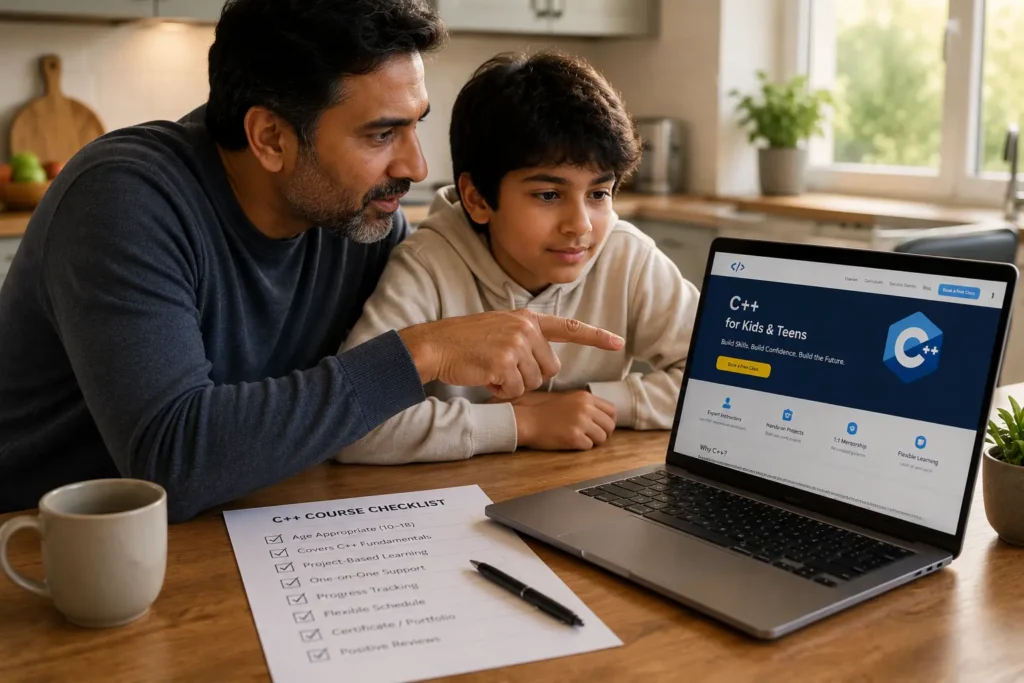
Not all C++ courses for children are equal — and the gaps are large. Use this checklist before committing to any programme.
✅ C++ Course Quality Checklist for Parents
For broader guidance on evaluating any coding programme for your child, see our complete guide on how to choose the right coding course for your child and our round-up of top coding programmes for kids in 2026.
At ItsMyBot, we turn screen time into skill time. Our C++ programme is built for children who are ready to go deeper — who have the Python foundations, the motivation, and the ambition to learn one of the world’s most powerful programming languages properly.
Here’s what makes our approach different:
ItsMyBot offers year-round C++ courses as part of our broader coding curriculum. Explore our full coding classes for kids and summer coding programmes across Singapore, Doha, Abu Dhabi, Malaysia, and more locations worldwide.
Book Your Child’s Free C++ Demo Session
One live session. A qualified C++ instructor. A real project to start. No commitment — just proof that this is the right fit.
Yes — with the right foundations and instruction. Children aged 11–12 with prior Python experience can begin C++ meaningfully. Ages 13–15 is the optimal window for going deep. The key is not treating C++ as a first language — prior coding experience makes the transition achievable rather than overwhelming.
Most children are ready to begin C++ from ages 11–12, provided they have solid Python or Scratch foundations. Ages 13–15 is the most productive window for serious C++ development. Starting too early, without prior coding experience, typically leads to frustration rather than progress. See our guide to the best age to start coding.
Python first, almost always. Python builds the logical thinking, debugging habits, and programming confidence that make C++ learnable. A child who starts C++ without Python foundations will find it significantly harder than necessary. Once Python is solid (beginner-intermediate level), C++ becomes a natural and exciting next step.
C++ is the dominant language in competitive programming — used by the majority of top performers at IOI, ICPC, and platforms like Codeforces — because of its execution speed and the power of its Standard Template Library. Problems with strict time limits often require C++ solutions; Python is frequently too slow. Read our guide on how to prepare kids for coding competitions.
Arduino — the most popular beginner robotics platform — uses a direct subset of C++. Children who learn C++ can program physical robots using exactly the same language they use for software projects. Advanced robotics platforms (ROS, embedded systems) also use C++. Read our complete robotics for kids guide and post on programming robots.
Three things: stricter syntax (a missing semicolon stops the programme from compiling), explicit memory management (children must think about how variables are stored and freed), and the compilation step (code must be compiled before it runs, unlike Python’s immediate execution). All three are learnable — they just require patient, expert guidance at the right time.
With one to two structured sessions per week, most children reach solid intermediate C++ (object-oriented programming, STL) in 8–12 months. Reaching competitive programming or game development level typically takes 15–24 months from the beginning of C++ study. Progress is significantly faster with live instructor guidance than self-study.
Yes — C++ remains the fifth most used programming language globally and is dominant in game development, robotics, competitive programming, and systems software. It is actively developed (C++23 was released in 2023) and has no imminent replacement in its core domains. The salary premium for C++ engineers remains high across the industry.
C++ Is One of the Most Powerful Skills Your Child Can Build
It takes the right foundations, the right instruction, and the right sequencing. ItsMyBot provides all three — with live mentors, real projects, and a clear path from Python foundations to advanced C++ mastery.
→ Explore ItsMyBot C++ and Coding Courses
→ Start With Python — The Complete Kids’ Guide

Online coding, AI, and robotics classes that help kids ages 6–18 build real skills — and confidence — one project at a time.
No commitment · Live class with an expert teacher
© ItsMyBot 2026. All Rights Reserved.