
Have you ever tried talking to a robot and gotten a completely weird answer that made no sense? Or maybe you’ve used ChatGPT, Claude, or another AI assistant and wondered why sometimes it gives you exactly what you want, and other times it seems like it’s reading your mind backwards?
Here’s the secret: AI communication isn’t magic – it’s a skill called prompt engineering for kids, and it’s one of the most exciting abilities you can learn today! Think of it like learning a new language, except instead of talking to people from other countries, you’re learning to communicate clearly with artificial intelligence.
Imagine having a superpower where you could ask any AI assistant to help you with homework, create amazing stories, solve problems, or even build cool projects – and it would understand exactly what you want every single time. That’s what prompt engineering for children gives you!
By the end of this guide, you’ll know how to write prompts that get incredible results, avoid common pitfalls that trip up even adults, and use AI tools safely and effectively. Whether you want to create epic stories, get help with school projects, or just have fun exploring what AI can do, mastering AI prompt writing for kids will give you a huge advantage as you grow up in our AI-powered world.
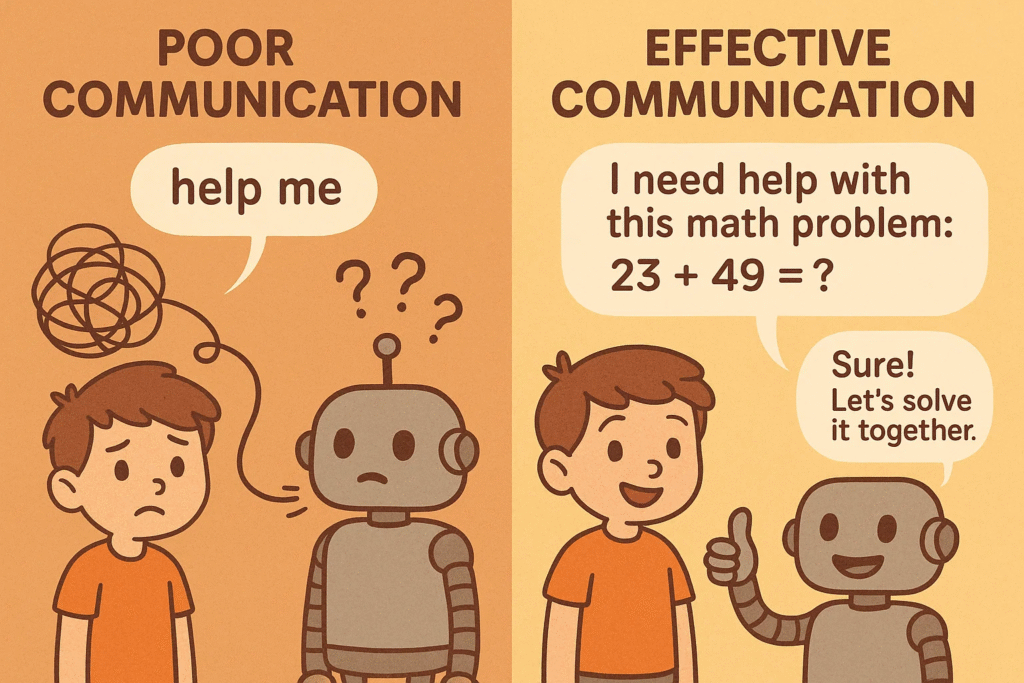
Prompt engineering for kids is like being a translator between human thoughts and AI understanding. Just as you might need to explain something differently to a younger sibling than to your teacher, you need to communicate with AI in ways it can understand best.
Imagine you have a friend who is incredibly knowledgeable about everything – they’ve read every book, watched every movie, and know facts about topics you’ve never even heard of. But here’s the catch: they take everything you say exactly as you say it, with no ability to guess what you “really meant.”
If you tell your human friend, “Help me with my science project,” they might ask what subject, what grade level, or what you’re struggling with. But an AI assistant needs much more specific instructions to give you truly helpful answers.
AI communication skills for children are becoming as important as reading, writing, and basic computer literacy. Here’s why:
When you type a prompt into an AI system, something amazing happens in milliseconds:
💡 Pro Tip: The better your prompt, the more helpful the AI’s response. It’s like the difference between asking “What’s that thing?” versus “What’s the red bird with a black beak sitting on our fence?”
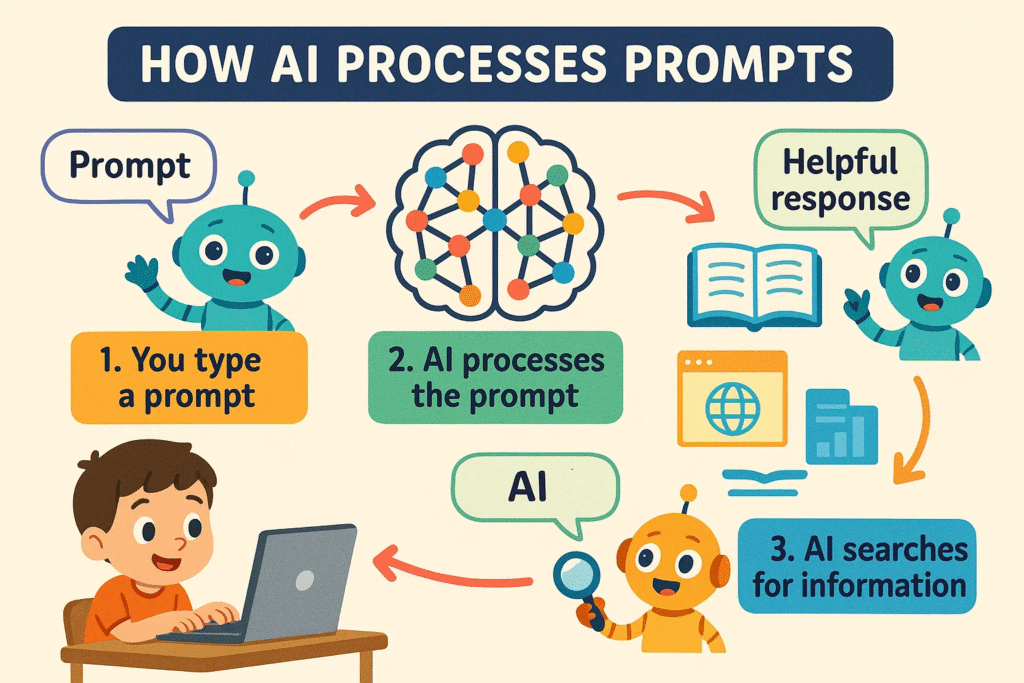
Before diving into prompt engineering techniques for kids, let’s understand what’s happening inside an AI system when you talk to it. This knowledge will make you a much better prompt engineer!
This might surprise you, but AI doesn’t think the way you do. When you’re solving a math problem, you might visualize the numbers, remember similar problems, or even count on your fingers. AI does something completely different – it uses patterns it learned from enormous amounts of text to predict what words should come next.
Think of AI like a super-advanced autocomplete system:
You type: "The cat sat on the..."
Your phone suggests: "mat"
AI does this but with entire conversations!
Simple Example:
AI systems are trained on massive amounts of text from books, websites, articles, and conversations. They learn patterns about:
But here’s the important part: AI doesn’t have personal experiences like you do. It can’t remember what you told it yesterday (unless it’s in the same conversation), it doesn’t have feelings, and it doesn’t truly understand context the way humans do.
In computer science, there’s a famous principle: “Garbage In, Garbage Out.” This means that if you put low-quality information into a system, you’ll get low-quality results out. The same applies to AI prompt engineering for beginners:
Now let’s learn the essential components that make effective prompts for kids work like magic. Think of these as the ingredients in a recipe – you need the right combination to get delicious results!
Context tells the AI what situation you’re in and what kind of help you need.
Examples:
This is the specific action you want the AI to perform.
Clear Task Examples:
Tell the AI exactly how you want the response structured.
Format Options:
Set boundaries and limitations to get exactly what you need.
Useful Constraints:
Sometimes showing an example of what you want makes everything clearer.
Example Structure:
"Write three riddles about animals. Here's the style I want:
Q: I'm black and white and love to eat bamboo. What am I?
A: A panda!

Now create three more like this about different animals."
Context + Task + Format + Constraints + Example = Powerful Prompt
Before (Weak Prompt): “Help me with math”
After (Strong Prompt): “I’m a 6th grader struggling with fractions. Can you explain how to add fractions with different denominators? Please use a step-by-step format with simple examples, and pretend you’re a friendly math teacher talking to someone who finds math challenging.”
Try improving these prompts using our 5 ingredients:
Let’s walk through a systematic approach to teaching prompt engineering to kids. This process works whether you’re asking for help with homework, creating something fun, or solving a problem.
Before writing any prompt, ask yourself:
Example Goal: “I want to understand how volcanoes work so I can write a good report for science class.”
Think about:
Example Context: “I’m in 5th grade, I learn best with examples and stories, and I already know that volcanoes are mountains that shoot out lava.”
Different tasks need different approaches:
Information Tasks: “Explain…”, “Describe…”, “What is…” Creative Tasks: “Write…”, “Create…”, “Imagine…” Problem-Solving Tasks: “How can I…”, “Help me figure out…”, “What’s the best way to…” Analysis Tasks: “Compare…”, “What are the pros and cons…”, “Why does…”
PROMPT TEMPLATE:
"[CONTEXT: Who you are and what you're working on]
[TASK: What you want the AI to do]
[FORMAT: How you want the response structured]
[CONSTRAINTS: Any limitations or requirements]
[EXAMPLE: Show what you mean if helpful]"
Great prompt engineering for children involves iteration – trying, evaluating, and improving:
Example Iteration:
First Try: “Explain volcanoes to me”
AI Response: [Probably too technical or too basic]
Second Try: “I’m a 5th grader writing a science report about volcanoes. Can you explain how volcanoes form and why they erupt? Please use simple language and include at least one cool fact that would impress my classmates. Keep it under 300 words.”
AI Response: [Much better!]
Let’s apply this process to a common scenario:
Scenario: You need help understanding fractions for a math test tomorrow.
Step 1 – Goal: Understand fraction basics well enough to solve problems on the test
Step 2 – Context: 4th grader, struggling with adding/subtracting fractions, test tomorrow
Step 3 – Task Type: Information + Problem-solving
Step 4 – Build Prompt: “I’m a 4th grader who has a math test tomorrow on fractions. I understand what fractions are (like pieces of a pizza), but I get confused when adding and subtracting them, especially when the bottom numbers are different. Can you:
Please keep your explanation under 400 words total.”
Step 5 – Test: If the response is too complex, you might add: “Pretend you’re explaining this to someone who has trouble with math and needs extra encouragement.”
Learning AI prompt writing for kids is way more fun when you practice with engaging activities! Here are hands-on exercises that make prompt engineering feel like play rather than work.
Goal: Learn to write detailed, specific prompts by creating unique characters.
Your Mission: Use AI to create the most interesting character possible for a story.
Prompt Building Steps:
Example Final Prompt: “I’m writing a fantasy adventure story and need a unique main character. Create a character who seems brave on the outside but has an unexpected fear that makes them interesting. Please include:
Bonus Challenge: After getting your character, ask the AI to write a short scene showing both their bravery and their fear!
Goal: Practice getting AI to explain complex things in simple, fun ways.
Choose a Complex Topic: Pick something that usually sounds boring or complicated:
Prompt Challenges (Try each one):
Challenge A – Age Adaptation: “Explain [your topic] like I’m 6 years old” “Explain [your topic] like I’m 12 years old” “Explain [your topic] like I’m in high school”
Challenge B – Style Variations: “Explain [your topic] as if you’re a pirate” “Explain [your topic] using only sports metaphors” “Explain [your topic] as a fairy tale” “Explain [your topic] like you’re teaching an alien who just landed on Earth”
Challenge C – Format Fun: “Explain [your topic] as a rap song” “Explain [your topic] as a conversation between two friends” “Explain [your topic] as a comic book storyline”
Goal: Learn to break down problems and ask for specific help.
Setup: Create different “events” where you use AI to solve various challenges.
Event 1 – The Homework Helper:
Example Prompt: “I have a history test on the American Revolution tomorrow. I understand the basic timeline, but I get confused about why different groups of people supported different sides. Can you:
Event 2 – The Creative Block Buster:
Event 3 – The Life Skills Solver:
Goal: Learn how follow-up prompts can build on previous responses.
How It Works:
Starting Prompt: “Write the beginning of an adventure story about a middle schooler who discovers something unusual in their school locker. Keep it under 150 words and end with a cliffhanger.”
Follow-up Prompt Ideas:
Goal: Learn to prompt AI for reliable information and identify when to double-check responses.
Your Mission: Become a fact-checking detective by learning to ask for sources and verification.
Good Information-Gathering Prompts:
Red Flag Practice: Learn to spot when AI responses might need verification:
Even adults make these prompt engineering mistakes, but knowing about them will make you a much better AI communicator from the start!
What It Looks Like: Using the same type of prompt for every situation.
Example: Always asking “Tell me about X” whether you want basic facts, creative content, or problem-solving help.
Why It’s Problematic: Different goals need different approaches. Asking for a creative story the same way you’d ask for homework help leads to mismatched responses.
The Fix: Match your prompt style to your goal:
What It Looks Like: Assuming the AI knows your context, preferences, or previous conversations (when starting fresh).
Example: “Continue with the character we discussed” (when you haven’t discussed any character in this conversation)
Why It’s Problematic: AI doesn’t remember previous conversations unless you’re in the same chat session. It also doesn’t know your age, interests, or background unless you tell it.
The Fix: Always provide context in new conversations:
What It Looks Like: Prompts that could mean dozens of different things.
Examples:
The Fix: Use the 5 W’s and H method:
What It Looks Like: Spending forever trying to write the “perfect” prompt before sending anything.
Why It’s Problematic: You learn more from trying and adjusting than from over-planning. Plus, you can always refine your prompt based on the response you get.
The Fix: Use the “Good Enough, Then Improve” approach:
What It Looks Like: Getting frustrated when AI doesn’t read your mind or understand implied requests.
Example: Asking “Why is this wrong?” without showing what “this” is, or expecting AI to remember your homework assignment from yesterday.
The Fix: Remember that AI is like a very smart but literal-minded assistant:
Before: “This is confusing” After: “I’m reading a 7th grade science textbook about the water cycle, and I don’t understand how evaporation and transpiration are different. Can you explain the difference using a simple analogy and give me an example of each?”
Before: “Make it more interesting” After: “I’m writing a story about a detective for my English class. The plot is good but my teacher said the dialogue feels boring. Can you help me rewrite this conversation to make it more exciting and realistic? Here’s the current dialogue: [paste your text]”
Before: “Help with math” After: “I’m a 5th grader struggling with long division. I understand the concept but I keep making mistakes in the steps. Can you walk me through one example problem step-by-step, then give me a similar problem to practice? Please explain why each step is important.”
Now that you’ve mastered the basics of prompt engineering for children, let’s explore some advanced techniques that will make you a true AI communication expert!
What It Is: Asking the AI to take on a specific role or personality to get better responses.
Why It Works: Different roles have different knowledge, communication styles, and approaches to problems.
Simple Examples:
Advanced Role-Playing Prompts:
"I want you to be Dr. Discovery, a scientist who makes complex ideas fun and easy to understand. Dr. Discovery always:
- Uses cool analogies and metaphors
- Gets excited about science
- Asks questions to make sure students understand
- Gives memorable examples

As Dr. Discovery, explain how photosynthesis works to a 6th grader who thinks science is boring."
What It Is: Asking AI to think through problems or explanations in clear, logical steps.
Magic Phrases That Work:
Example Application:
"I need to write a persuasive essay about why our school should have a longer lunch period. I've never written one before. Can you break down the process into simple steps?

For each step, tell me:
- What I need to do
- Why that step is important
- An example of what it might look like

Make it like a recipe for writing a great essay."
What It Is: Providing examples before and after your request to make your expectations crystal clear.
Structure:
Example:
"I love how this author describes settings:
'The library wasn't just quiet—it was the kind of silence that made you want to whisper to your own thoughts.'

I'm writing a story and need help describing a creepy basement. Can you write 2-3 descriptive sentences that have the same creative, engaging style as the example above? Make it spooky but not too scary for middle grade readers."
What It Is: Adding creative limitations that actually make responses better and more focused.
Useful Constraints for Different Goals:
For Creative Writing:
For Learning:
For Problem Solving:
What It Is: Asking AI to show its thinking process, which often leads to better answers.
Magic Phrases:
Example:
"I'm trying to decide between three topics for my science fair project: volcanoes, robotics, or plant growth. Help me choose by thinking through this step by step:

1. First, tell me what factors should matter when choosing a project
2. Then, evaluate each topic based on those factors
3. Finally, give me your recommendation with reasons

I'm in 7th grade, I like hands-on activities, and I have 6 weeks to complete it."
What It Is: Asking for the same information from different viewpoints to get a richer understanding.
Examples:
Here’s how to combine multiple advanced techniques:
"I want you to be Ms. Rodriguez, an enthusiastic middle school history teacher who makes boring topics come alive through storytelling.

I'm struggling to understand why the Civil War happened—it just seems like a bunch of dates and battles to me.

Think through this step by step:
1. First, explain the main causes in a way that shows why people got so passionate about these issues
2. Then, tell me a brief story about one specific person (real or fictional) that illustrates these causes
3. Finally, help me see connections to issues young people care about today

Use language and examples that would engage a 7th grader who usually finds history boring. Don't just list facts—help me understand why this mattered to real people."
The best way to master AI prompt writing for kids is through hands-on creative projects that are fun and rewarding. Here are engaging projects that will strengthen your prompt engineering skills while creating cool stuff!
Skill Focus: Sequential prompting, narrative consistency, and creative direction.
What You’ll Create: An interactive story where readers make choices that affect the outcome.
Phase 1 – Story Foundation:
"Help me create a choose-your-own-adventure story for middle schoolers. I want it to be about [your chosen theme: space exploration, mystery solving, time travel, etc.].

Create:
1. A main character (age 12-14) with an interesting background
2. The opening situation that presents the first choice
3. Two different path options for readers to choose from

Keep each section under 200 words and end with a clear choice prompt. Make it engaging but appropriate for school."
Phase 2 – Story Branching: After you get the opening, use follow-up prompts to develop each path:
"Continue the story from Path A [describe the choice made]. Create the next scene that:
- Shows consequences of their choice
- Introduces a new challenge or discovery
- Ends with two new choices that feel natural to the story
- Maintains the same writing style and character voice as before"
Phase 3 – Story Endings:
"Create three different endings for this adventure:
1. A triumphant success ending
2. A bittersweet learning experience ending
3. A cliffhanger that sets up a sequel

Each ending should be satisfying but feel earned based on the choices that led there."
Skill Focus: Detailed specifications, systematic thinking, and audience awareness.
What You’ll Create: A complete concept for an educational game that makes learning fun.
Step 1 – Game Vision:
"I want to design an educational video game that teaches [subject: math, science, history, language arts] to [grade level] students. Help me brainstorm:

1. A core game mechanic that's naturally fun (like puzzle-solving, exploration, building, racing, etc.)
2. How to integrate learning into the gameplay (not just quiz questions!)
3. A theme/setting that would excite kids this age
4. The main character or characters players would control

Think about games kids actually want to play, not just educational software that feels like disguised homework."
Step 2 – Detailed Game Design:
"Based on our game concept, help me design:

Game Mechanics:
- How players move through the game
- What actions they can take
- How they earn points/progress
- What makes it challenging but not frustrating

Learning Integration:
- Specific skills/concepts the game teaches
- How learning happens naturally during play
- How the game adapts to different skill levels
- Ways to assess learning without traditional tests

Make this detailed enough that a game developer could understand the vision."
Step 3 – Marketing Pitch:
"Help me write a 2-minute elevator pitch for this game that would convince:
1. School principals to consider buying it
2. Parents to support their kids playing it
3. Kids to actually want to play it

Include the educational benefits, the fun factor, and what makes it different from other educational games."
Skill Focus: Hypothesis formation, experimental design, and scientific thinking.
What You’ll Create: A complete experiment proposal for a science fair or class project.
Investigation Prompt:
"I'm interested in [your chosen topic: plant growth, food preservation, sound/music, weather, psychology, etc.] and want to design a science experiment that's:
- Safe for a middle schooler to conduct
- Doable with household or easily obtained materials
- Interesting enough to impress judges/classmates
- Scientifically valid with measurable results

Help me develop:
1. A specific, testable research question
2. A hypothesis with reasoning
3. A clear experimental procedure
4. Variables I need to control and measure
5. How to collect and analyze data

Think like a real scientist—what would genuinely be worth investigating?"
Skill Focus: Research organization, storytelling structure, and audience engagement.
What You’ll Create: A script for a 5-10 minute documentary on a topic you’re passionate about.
Research and Structure Prompt:
"I want to create a mini-documentary about [your topic] for an audience of my peers. Help me:

1. Identify the most compelling angle or story within this topic
2. Structure the documentary with a clear beginning, middle, and end
3. List key facts, statistics, or expert quotes I should research
4. Suggest creative ways to present information (interviews, animations, demonstrations, etc.)
5. Write an engaging opening that hooks viewers in the first 30 seconds

Make this informative but entertaining—think YouTube educational channels that kids actually watch."
Skill Focus: Problem analysis, solution development, and persuasive communication.
What You’ll Create: A campaign to address a real problem in your school or community.
Campaign Development Prompt:
"I've noticed [specific problem in your school/community] and want to create a campaign to help solve it. Guide me through developing:

Problem Analysis:
- Root causes of this issue
- Who is most affected
- Why previous solutions haven't worked
- What resources are available

Solution Strategy:
- Realistic, actionable steps
- How to get people involved
- Ways to measure success
- How to sustain progress over time

Communication Plan:
- Key messages for different audiences (students, teachers, parents, community)
- Creative ways to spread awareness
- How to motivate people to take action

Think like a real activist—what would actually create positive change?"
After completing any project, use these prompts to deepen your learning:
"Help me reflect on this project by analyzing:
1. What prompt engineering techniques worked best for this type of creative work?
2. Where did I need to provide more context or constraints to get better results?
3. How could I improve my prompts for similar projects in the future?
4. What did this teach me about communicating clearly and specifically?"
Learning prompt engineering for children comes with important responsibility. Just like learning to drive a car or use the internet, using AI tools safely requires understanding both the opportunities and the risks.
AI Doesn’t Have Recent Information: Most AI systems have a knowledge cutoff date. They don’t know about very recent events, new scientific discoveries, or current news.
AI Can’t Replace Human Judgment: While AI is great at providing information and ideas, you still need to think critically about whether the advice makes sense for your specific situation.
AI Doesn’t Understand Context Like Humans Do: It might miss subtle social cues, cultural context, or the emotional nuance of a situation.
AI Can Make Mistakes: Just like humans, AI can be wrong about facts, make logical errors, or misunderstand what you’re asking.
Don’t Include:
Safe Alternatives:
Always Double-Check:
Good Verification Sources:
Appropriate Uses:
Inappropriate Uses:
Questions to Ask Yourself:
Stop Using AI and Talk to a Trusted Adult If:
Even though AI isn’t human, practicing respectful communication builds good habits:
AI systems are trained on human-created content, which means they can reflect human biases:
How to Handle This:
Work with your parents or teachers to create guidelines that work for your family and school:
Questions to Discuss:
If AI Provides Inappropriate Content:
If You Accidentally Share Personal Information:
If You’re Not Sure Something Is Appropriate:
Congratulations! You’ve learned the fundamentals of prompt engineering for kids, but this is just the beginning of your exciting journey into the AI-powered future. Let’s explore how to keep growing these skills and prepare for amazing opportunities ahead.
As you grow more comfortable with AI communication skills for children, explore these exciting areas:
Writing and Storytelling:
Visual and Audio Creation:
Science and Math:
Social Studies and Languages:
Understanding AI communication opens doors to exciting future careers:
Document your AI learning journey to track progress and showcase skills:
The AI field changes rapidly, so staying informed is important:
As you grow in your AI skills, consider how you can help make AI better for everyone:
This Month:
Next Three Months:
This Year:
Looking Ahead:
Continue your technology education journey with our comprehensive guides:
You’ve just completed an incredible journey into the world of prompt engineering for kids! From understanding how AI really works to creating complex, creative projects, you now have the skills to communicate effectively with artificial intelligence and use it as a powerful tool for learning, creating, and problem-solving.
Remember these key principles as you continue practicing:
🎯 Be Specific and Clear – The more precisely you communicate what you want, the better results you’ll get
🔧 Iterate and Improve – Great prompt engineers aren’t born, they’re made through practice and refinement
📝 Stay Curious and Critical – Always question AI responses and verify important information
🛡️ Use AI Safely and Ethically – Protect your privacy and use AI to enhance, not replace, your own thinking
🚀 Keep Learning and Growing – AI technology is constantly evolving, and so should your skills
The future belongs to people who can work effectively with AI while maintaining their uniquely human creativity, empathy, and critical thinking. By mastering AI prompt writing for kids at a young age, you’re not just learning a technical skill – you’re preparing to be a leader in an AI-powered world.
Whether you use these skills to excel in school, pursue creative projects, solve real-world problems, or eventually build a career in technology, you now have a foundation that will serve you well for years to come. The AI tools will change and improve, but the core skills of clear communication, critical thinking, and ethical technology use will always be valuable.
Keep experimenting, keep learning, and most importantly, have fun exploring all the amazing things you can accomplish when you combine human creativity with artificial intelligence. The future is bright, and you’re well-prepared to be part of shaping it!
Ready to explore more exciting technology topics? Discover additional learning adventures at ItsMyBot and join thousands of young innovators building tomorrow’s world, one skill at a time.
Q: What age should kids start learning prompt engineering? A: Kids as young as 8-10 can start with basic prompt writing concepts, while 11+ can handle more advanced techniques. The key is adapting the complexity to match reading and reasoning skills.
Q: Is it safe for children to use AI tools?
A: Yes, when used appropriately with adult supervision and proper safety guidelines. Always follow platform age requirements and discuss AI use with parents or teachers.
Q: Will learning prompt engineering help with school subjects?
A: Absolutely! Prompt engineering for children improves research skills, critical thinking, and clear communication – all essential for academic success across subjects.
Q: Can prompt engineering replace learning to write and think independently?
A: No, and it shouldn’t! The goal is to use AI as a tool to enhance learning and creativity, not replace fundamental skills like writing, research, and critical thinking.
Q: What’s the difference between prompt engineering and regular computer programming?
A: Programming involves writing code to create software, while prompt engineering involves crafting natural language instructions to get desired outputs from AI systems. Both involve logical thinking and clear communication.
Q: How can parents support their children’s prompt engineering learning?
A: Parents can learn alongside their kids, set appropriate boundaries for AI use, encourage critical thinking about AI responses, and connect AI learning to children’s existing interests and school subjects.
Want your child to go further? Explore ItsMyBot’s Artificial Intelligence Course for Kids — structured coding courses designed for kids!

Online coding, AI, and robotics classes that help kids ages 6–18 build real skills — and confidence — one project at a time.
No commitment · Live class with an expert teacher
© ItsMyBot 2026. All Rights Reserved.