Reading Time: 12 mins
You’re watching your child spend hours on screens. What if that time could build actual career skills? The choice between Python and Java as your child’s first programming language will shape their entire coding journey. Both languages open doors to high-paying tech careers, but they teach fundamentally different approaches to problem-solving.
Here’s what makes this decision urgent: children who start with the wrong language often struggle, lose confidence, and abandon coding entirely. This guide reveals which language matches your child’s age, learning style, and future goals—turning screen time into genuine skill time.

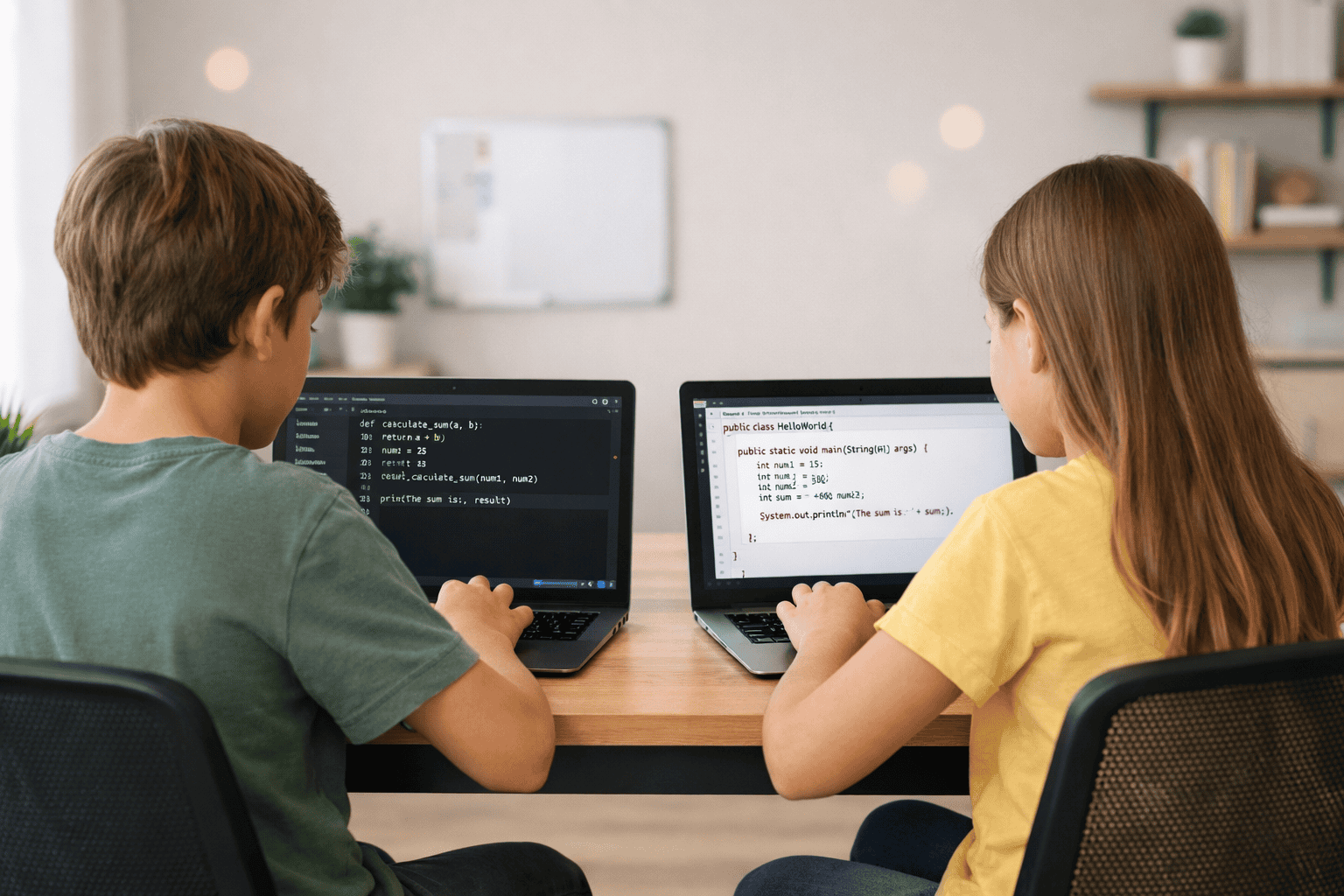
Python reads like English, making it the natural starting point for most children. Java requires more structure and syntax precision from the very first line.
Python’s simplicity shines through in basic tasks:
Python Example:
print("Hello, World!")
name = "Alex"
Java Example:
public class HelloWorld {
    public static void main(String[] args) {
        System.out.println("Hello, World!");
        String name = "Alex";
    }
}
Your child can write their first Python program in minutes. Java demands understanding classes, methods, and data types before printing a single word. This difference determines whether coding feels like creative play or frustrating homework.
Python handles memory automatically—kids focus on solving problems, not managing computer resources. Java exposes more technical details, teaching valuable computer science concepts but adding cognitive load.
Key Differences:
For children starting their coding journey, Python removes technical barriers that distract from creative problem-solving.

Age determines not just which language to choose, but when to introduce text-based coding at all. Pushing too early frustrates; waiting too long misses critical learning windows.
Children this young think in pictures, not text. They’re building foundational logic through:
Don’t introduce Python or Java yet. Explore how Scratch prepares kids for text-based coding before making this jump.
This age range marks the sweet spot for Python. Kids can read simple sentences and understand variables as containers holding information.
Python Advantages at This Age:
Start with simple projects: calculators, guessing games, drawing programs. Python coding challenges for beginners provide age-appropriate exercises.
Pre-teens develop abstract thinking—the cognitive skill Java demands. They can grasp:
Java Advantages at This Age:
Teenagers possess the cognitive maturity for either choice. Base decisions on:
Understanding the difference between block-based and text-based coding helps parents recognize when children are ready for this transition.
Your child’s natural approach to learning matters more than curriculum popularity. Match language to learning style, not the other way around.
These kids think in pictures and patterns. They excel at:
Python Advantage: Immediate visual feedback through libraries like Turtle, Pygame, and Matplotlib. Kids see their code create shapes, animations, and charts within minutes.
Java Consideration: Requires more setup before visual results appear, but JavaFX enables powerful GUI applications.
Children who love puzzles, patterns, and systematic thinking thrive with structure. They appreciate:
Java Advantage: Strict typing and explicit structure satisfy logical minds. Every variable, method, and class follows clear patterns. Understanding Java fundamentals (link references Python but concept applies) builds systematic thinking.
Python Consideration: More forgiving syntax might feel too “loose” initially, though logical learners eventually appreciate Python’s elegance.
Hands-on kids learn by doing, experimenting, and iterating quickly. They prefer:
Python Advantage: Write-run-see cycle happens in seconds. Perfect for robotics projects, IoT experiments, and interactive applications. Explore Python science fair projects for hands-on learning.
Java Consideration: Longer compile-run cycles slow experimentation. Better suited after foundational understanding exists.
Word-oriented children who read voraciously and write creatively connect with Python’s natural language approach. They enjoy:
Python Advantage: Syntax mirrors natural language. Kids who love writing stories transition easily to writing programs.

Show your child what they can actually build. Abstract concepts bore kids; tangible projects ignite passion.
Python dominates in fields that excite young learners:
Artificial Intelligence & Machine Learning:
Kids can make AI in Python without advanced mathematics, using libraries that handle complex calculations.
Data Science & Visualization:
Pandas makes data analysis accessible even for beginners, turning raw numbers into meaningful insights.
Game Development:
Robotics & IoT:
Web Scraping & Automation:
Java prepares kids for enterprise software development:
Android App Development:
Game Development:
Enterprise Software:
Server-Side Web Development:
Both languages lead to excellent careers. Python currently shows faster job growth in emerging fields like AI and data science. Java maintains strength in established enterprise markets.
Small missteps early create lasting frustration. Learn from patterns that trip up thousands of families.
The Problem: An 8-year-old struggles with Java’s verbose syntax, type declarations, and object-oriented concepts. Frustration builds. They declare “coding is too hard” and quit.
Why It’s Problematic: Java’s complexity overwhelms young learners before they grasp basic programming logic. The syntax becomes the barrier, not the thinking.
✅ Correct Approach: Start with Python for ages 8-10. Its simple syntax lets kids focus on problem-solving. Transition from Scratch to Python naturally for visual learners.
Real Example: Sarah, age 9, tried Java first and quit after two weeks. Six months later, she started Python and built her first game in three days. The language choice made the difference.
The Problem: Dad’s a Java developer, so naturally, the child should learn Java. Ignores the child’s age, interests, and learning style.
Why It’s Problematic: Adult professional experience doesn’t match children’s developmental needs. What works for experienced programmers frustrates beginners.
✅ Correct Approach: Consider your child’s:
The Problem: Jumping straight into advanced projects—building websites or apps—before understanding variables, loops, and functions.
Why It’s Problematic: Without foundations, kids memorize code without comprehension. They can’t debug, adapt, or create independently.
✅ Correct Approach: Build systematically:
Understanding what variables are in Python before complex projects prevents confusion.
The Problem: “My friend’s child is already building apps. Why is mine still on basic programs?”
Why It’s Problematic: Every child learns at their own pace. Comparison creates pressure, killing the joy that fuels learning.
✅ Correct Approach: Celebrate your child’s progress against their own starting point. Focus on:
Real Example: Tim took 6 months to grasp functions. Emma understood them in 2 weeks. Both now work as successful developers—the timeline didn’t matter.
The Problem: Months of theory and exercises without building anything real. Coding feels like homework, not creation.
Why It’s Problematic: Kids need tangible wins. They want to show friends and family what they built, not explain abstract concepts.
✅ Correct Approach: Balance theory with projects:
Python coding challenges provide structured practice with clear goals.
The Problem: Child learns alone without peer interaction, mentorship, or community resources.
Why It’s Problematic: Coding is collaborative. Kids need:
✅ Correct Approach: Connect your child with:
Both Python and Java open doors to high-paying careers. The question isn’t which is “better”—it’s which aligns with your child’s interests and industry trends.
Python Dominance in Growing Fields:
Java Strength in Established Markets:
2026-2030 Projections:
Python Growth Areas:
Java Evolution:
The Smart Strategy: Master one language deeply first, then add the second. Kids who truly understand one language learn the second in weeks, not months.
Real Success Story: Emma learned Python from age 10-13, building AI projects and data tools. At 14, she picked up Java in 6 weeks for AP Computer Science. Strong Python foundations made Java feel like a different dialect, not a different language.

Your involvement determines success more than the language choice. Here’s how to create an environment where coding thrives.
Physical Space Matters:
Digital Tools and Resources:
Consistency beats intensity. Here’s a proven weekly structure:
For Ages 8-10 (Python):
For Ages 11-15 (Either Language):
Critical Rule: Stop when frustration appears. Coding under pressure kills joy and creates negative associations.
The Delicate Balance:
Do This:
Avoid This:
Real Example: Mark pushed his 11-year-old daughter daily on Java. She quit after 3 months. They took a break, returned with Python, made it optional, and she’s now learning independently—because she wants to, not because she has to.
Link programming to passions:
Loves Sports?
Interested in Art?
Enjoys Stories?
Curious About Science?
Explore what Python can do across different interests.
Eight years old is perfect for starting Python. The language’s simple syntax reads like English, making it accessible for confident readers. Start with visual projects using Turtle graphics or simple games for immediate results. Focus on variables, basic operations, and simple loops—most 8-year-olds grasp these within 2-3 months. If your child struggles, try visual programming first before transitioning to text-based code.
Yes, but master one deeply first. A child who truly understands Python can learn Java basics in 4-6 weeks because they’re learning new syntax, not new concepts. Think of it like learning Spanish after French—grammar translates, only vocabulary changes. Start with Python for ages 8-12, then add Java around age 13 if interested in Android development or AP Computer Science.
For basic proficiency: Python takes 3-6 months, Java needs 6-9 months with 3 weekly sessions. Building actual projects requires 8-12 months for Python, 12-18 months for Java. Advanced skills in either language need 2-3 years of continuous practice. Remember: professional developers never stop learning. Focus on consistent progress, not arbitrary endpoints.
Java is the clear winner. Minecraft Java Edition is built entirely in Java, and creating mods requires Java programming. Python works through limited plugins like RaspberryJam. If Minecraft modding motivates your child, start with Java despite steeper learning. The excitement of modifying their favorite game powers through initial challenges. Begin with 2-3 months of basic Java before Minecraft-specific tutorials.
Colleges care about problem-solving ability over specific languages. Java appears in AP Computer Science A, while Python dominates university data science and AI courses. Neither gives significant admissions advantage. Strong project portfolios, competition participation, and demonstrated passion matter most. Focus on building genuine skills and interesting projects rather than gaming admissions.
Absolutely. Python thrives in indie game development, game tools, and AI programming. Pygame enables full 2D games. Studios use Python for level editors, automated testing, server logic, and data analysis. Major engines use C#/C++, but understanding Python makes learning C# straightforward. Many indie developers start with Python for game logic before transitioning to complex engines.
Java isn’t dying. It remains primary for Android development, enterprise systems, backend services, and financial applications. Job postings stay strong with consistent Fortune 500 demand. The language evolves with modern features. Learning Java provides security in established industries, even as Python captures headlines in emerging tech. Best strategy: Learn Python first for versatility, add Java later for specific career paths.
Watch for reading fluency (chapter books independently), logical thinking (multi-step problems), delayed gratification (multi-session goals), abstract reasoning (variables as containers), and technology comfort. If they excel with block-based platforms and want more challenge, they’re ready. Start with Python’s visual aspects. If they engage positively for 3-4 weeks, continue. If frustration dominates, return to block coding and retry in 3-6 months.
Your child doesn’t need to choose the “perfect” language—they need the right starting point for their current age and interests. Python’s simplicity makes it ideal for most young learners aged 8-12, building confidence through quick wins and creative projects. Java’s structure serves older students (13+) ready for professional-grade development and abstract thinking.
Key Takeaways:
The truth? The language matters less than consistent practice, supportive environment, and connecting coding to your child’s passions. Both Python and Java lead to excellent futures—your child’s engagement and progress matter infinitely more than the syntax they start with.
Ready to turn your child’s screen time into genuine skill time? ItsMyBot provides personalized, industry-level coding education that adapts to your child’s pace and potential. We guide families from their first “Hello, World!” to building impressive projects that open doors to future-ready careers.
Start your child’s coding journey with confidence → Explore ItsMyBot’s Programs