Reading Time: 13 mins
Your child spends hours watching Netflix recommendations powered by AI. They ask ChatGPT-5 homework questions. They explore Instagram Reels with personalized algorithms. But do they know one programming language powers all three?
Python isn’t just code—it’s the language reshaping how your child will work, create, and solve problems. With 25% market dominance in 2026 and usage by tech giants like Google, Netflix, and Tesla, Python continues building futures.
Here’s what makes this crucial: while other parents wonder if coding is “just a phase,” forward-thinking families are giving their children Python skills that open doors to high-paying, future-ready careers. Python now powers everything from quantum computing to climate tech solutions. This comprehensive guide shows you exactly what Python is used for and why your child’s Python journey should start today.
Python transforms complex programming into readable English-like commands. While other languages overwhelm beginners with confusing syntax, Python encourages exploration.
Key benefits for young coders:
Transitioning from visual programming? Python bridges the gap perfectly for students ready for text-based coding.

Why it matters for kids: AI isn’t the future—it’s the present your child navigates daily.
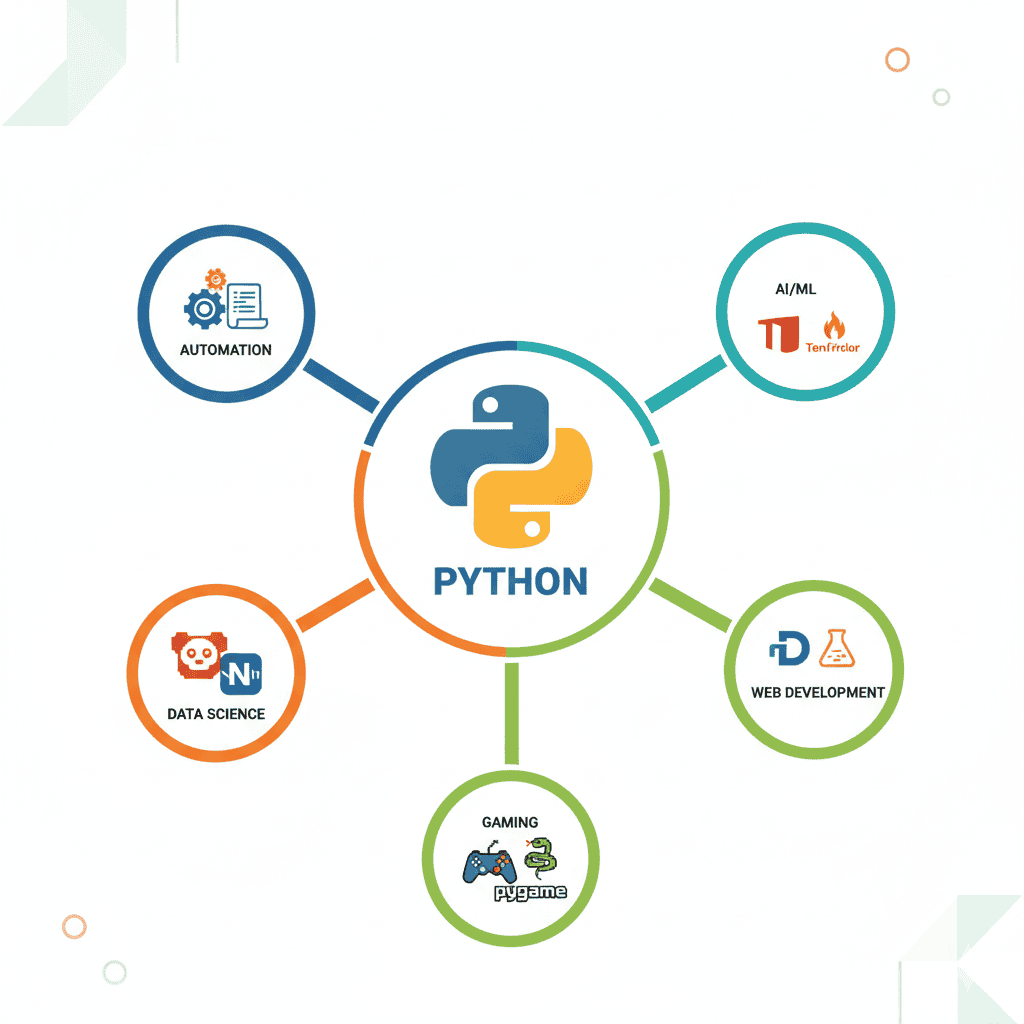
43% of Python developers build machine learning applications in 2026. Your child can start with simple AI projects like:
Real-world context: OpenAI’s ChatGPT-5, Google’s Gemini Ultra, and Tesla’s Full Self-Driving all run on Python. Understanding what is machine learning gives your child insight into technology shaping their world.
Kid-friendly libraries:
Our AI literacy program for kids introduces these concepts through hands-on projects designed for young learners.
Why it matters for kids: Games teach logic, creativity, and persistence—core skills for any career path.
Your child doesn’t need expensive game engines to create engaging experiences. Python’s game libraries make it simple:
What young developers build:
Popular frameworks:
Students who master block-based coding through Scratch programming find Python game development a natural next step.
Why it matters for kids: Every business needs websites and apps—your child can build them.
Python frameworks power Instagram (handling billions of photos daily), Spotify (streaming to 600+ million users), and Discord (connecting global gaming communities).
What kids create:
Beginner-friendly frameworks:
Why it matters for kids: Data literacy is essential for every career in 2026.
54% of Python developers work with data analysis. Your child can explore data science through:
Engaging projects:
Essential tools:
Explore our guide on cleaning and preparing data with Pandas in Python to see how young students tackle real datasets.
Why it matters for kids: Python teaches efficiency—automate boring tasks to focus on creativity.
Your child can build AI-powered tools that save time and eliminate repetition:
Practical automation examples:
Key libraries:
Why it matters for kids: Python bridges software and physical world—code that moves, senses, and responds.
Your child can control real hardware using Python:
Exciting IoT projects:
Popular platforms:
Understanding the basic components of IoT systems prepares students for hands-on IoT-based projects. Curious about the difference between IoT and robotics? We’ve got you covered.
Why it matters for kids: Cyber threats escalate daily—Python equips tomorrow’s digital defenders.
Python plays a crucial role in cybersecurity as AI-powered attacks become more sophisticated:
Age-appropriate security concepts:
Security-focused tools:
Build a simple password generator in Python as your child’s first security project.
Why it matters for kids: Python powers discoveries from Mars missions to medical breakthroughs.
Student-friendly science applications:
Scientific libraries:
Perfect for Python science fair projects that impress teachers and judges.
Why it matters for kids: Create cross-platform software running on Mac, Windows, and Linux.
Your child can build professional desktop applications:
Project ideas:
GUI frameworks:
Master Python Tkinter to create your first desktop application.
Why it matters for kids: Python builds the platforms making learning engaging and personalized through AI.
Educational applications:
At ItsMyBot, we leverage Python’s educational potential through our comprehensive coding programs designed specifically for young learners.
Why it matters for kids: Python merges technology with artistic expression through generative AI.
Creative possibilities:
Why it matters for kids: Financial literacy through practical coding projects prepares for economic independence.
Age-appropriate projects:
Learning Python effectively means avoiding common pitfalls:
❌ Mistake 1: Skipping the Basics
❌ Mistake 2: Passive Learning Only
❌ Mistake 3: Not Using Projects
❌ Mistake 4: Ignoring Error Messages
❌ Mistake 5: Comparing Progress to Others
| Feature | Python | JavaScript | Java | Scratch |
|---|---|---|---|---|
| Readability | Excellent | Good | Complex | Visual Blocks |
| Learning Curve | Beginner-friendly | Moderate | Steep | Very Easy |
| Career Value | Very High | Very High | High | Foundation Only |
| Project Variety | Extensive | Web-focused | Enterprise-focused | Educational |
| Community Support | Massive | Massive | Large | Educational |
| Age Recommendation | 8+ | 10+ | 12+ | 5+ |
The verdict: Python perfectly bridges block-based and text-based coding, making it ideal for students progressing beyond visual programming.
Arjun started learning Python at age 10 through ItsMyBot’s coding programs. By age 12, he tackled an ambitious project that would impress even professional developers. His challenge was creating a program that could identify different dog breeds from photos—a real-world AI application used by pet adoption centers and veterinary clinics.
Using Python’s TensorFlow library, Arjun spent three months training his model with over 10,000 images of various dog breeds. He learned how neural networks recognize patterns, how to clean and prepare image data, and how to test his model’s accuracy. The process wasn’t always smooth—he faced bugs, incorrect predictions, and moments of frustration. But with guidance from his ItsMyBot mentor and determination to solve the problem, he persisted.
The results exceeded everyone’s expectations. Arjun’s AI classifier achieved 87% accuracy in breed identification, performing better than many beginners twice his age. He built a simple web interface where users could upload photos and instantly receive breed predictions. His project won first place at his regional science fair, earning recognition from local tech professionals.
But the real victory went beyond awards. Arjun discovered his passion for computer vision and artificial intelligence. Today, he mentors younger students in AI projects, sharing his knowledge and inspiring others to explore Python’s possibilities. What started as curiosity about coding transformed into technical skills, confidence, and a clear vision for his future career in technology.
Start with visual programming like Scratch to understand programming concepts through blocks and immediate visual feedback.
Focus areas:
Perfect age for transitioning to text-based Python. Kids have developed reading skills and logical thinking abilities.
Recommended projects:
Wondering about the best age for kids to start coding? Research shows that 8-10 is optimal for Python introduction.
Ready for complex projects integrating multiple concepts and real-world applications.
Advanced topics:
Beginner-friendly options:
Note: Python 3.12 and 3.13 are the current stable versions in 2026, offering significant performance improvements and new features.
Professional tools for growing skills:
Check our guide on minimum hardware requirements for Python programming before setting up your child’s coding environment.
Structured learning paths:
Where to find ideas:
Python connects all STEM disciplines:
Science: Analyze experimental data, create simulations, visualize results
Technology: Build applications, automate systems, control hardware
Engineering: Design solutions, test prototypes, optimize processes
Mathematics: Calculate complex equations, create visualizations, explore patterns
Understanding what STEM means in education helps parents appreciate Python’s role in comprehensive tech literacy.

AI/Machine Learning Engineer
Data Scientist
Full-Stack Developer
DevOps/MLOps Engineer
Cybersecurity Analyst
Quantum Computing Integration: Python dominates quantum algorithm development through IBM’s Qiskit 1.0, Google’s Cirq 2.0, and Microsoft’s Q# integration. Students can now experiment with quantum circuits through beginner-friendly tutorials.
AI-Native Development: GitHub Copilot, Amazon CodeWhisperer, and other AI coding assistants accelerate Python development. Young coders learn alongside AI, making programming more accessible than ever.
Enhanced Performance: Python 3.13+ introduces significant speed improvements through Just-In-Time compilation and optimized memory management. The performance gap with compiled languages continues narrowing.
Mobile Development Maturity: Python mobile frameworks like Kivy 2.3 and BeeWare 2024 make iOS and Android development practical. Kids can build apps for phones and tablets using familiar Python syntax.
Climate Tech and Sustainability: Python powers renewable energy optimization, carbon footprint tracking, and environmental monitoring systems. Young developers contribute to solving climate challenges.
Web3 and Blockchain: Python libraries for blockchain development, smart contracts, and decentralized applications make Web3 accessible to student developers.
Edge AI and TinyML: Python runs machine learning models on tiny devices, from smartwatches to sensors. Kids create intelligent gadgets that process data locally without internet.
Spatial Computing: Python integrates with AR/VR platforms, enabling students to create immersive experiences for Apple Vision Pro, Meta Quest, and other spatial computing devices.
Children aged 8-10 typically have the reading comprehension and logical thinking skills needed for Python. However, students who’ve mastered visual programming like Scratch can start earlier. The key is ensuring they understand basic programming concepts before diving into text-based code.
Absolutely! Python enhances learning across subjects. Students use it for analyzing data in science class, creating visualizations for history presentations, solving complex math problems, and automating research tasks. It’s a universal tool for academic success.
Frustration is normal in coding—it means your child is challenging themselves! Break complex problems into smaller steps, celebrate small wins, take breaks when needed, and remind them that every programmer faces bugs and errors. Our mentors specialize in turning frustration into breakthrough moments.
Basic arithmetic helps, but advanced math isn’t required for starting Python. In fact, Python helps kids understand math concepts by visualizing them through code. As they progress, mathematical thinking develops naturally through programming problem-solving.
Scratch uses visual blocks while Python uses text-based code. Scratch teaches fundamental programming concepts through immediate visual feedback—perfect for younger learners. Python offers more power and flexibility for building real-world applications. Many students start with Scratch, then transition to Python as their skills grow.
Yes! Teens with Python skills find freelance opportunities building websites, creating automation scripts, and developing simple applications. Many tech companies offer internships to students demonstrating strong Python abilities. Early mastery provides significant advantages in college applications and career preparation.
Python transforms screen time into skill time. From AI-powered applications to creative games, from data analysis to robotics control—Python provides your child with tools to build, create, and innovate in 2026 and beyond.
The question isn’t whether your child should learn Python—it’s when they’ll start. With 59% of developers using Python and demand accelerating with AI adoption, early adopters gain tremendous advantages. Python powers technology across every industry from healthcare to entertainment, preparing your child for careers that don’t exist yet.
As AI assistants, quantum computing, and edge devices become everyday tools, Python remains the language connecting them all. Your child won’t just use technology—they’ll create it.
At ItsMyBot, we turn screen time into skill time through personalized, industry-level Python courses adapting to your child’s pace and potential. We provide international collaboration opportunities, keep parents informed every step of the way, and equip kids with skills opening doors to high-paying, future-ready careers.
Ready to start your child’s Python journey? Explore our comprehensive programming courses designed for young learners, or discover our robotics programs combining Python with hands-on engineering.
Your child’s next great project is just a few lines of Python code away. Let’s build it together.