
Quick Overview
Table of Contents
Every parent who Googles “robotics classes for kids near me” runs into the same wall: the local robotics club has a waitlist, meets once a week during soccer practice, or is already mid-season when your child shows interest. You came looking for consistent, structured robotics learning — and what you found was a scheduling puzzle.
The problem is not that robotics clubs are bad. Many are excellent. The problem is that clubs alone — one session a week, 10 kids per mentor, three-month season — rarely provide the consistent instruction time a child needs to build real robotics and coding skills. Most kids plateau. A few thrive. The difference usually comes down to what they’re doing outside the club.
This guide compares both options honestly — on access, schedule, cost, attention, and long-term skill development — so you can make the right call for your child right now.
Access to a quality robotics club in the US is not evenly distributed. It depends heavily on your zip code, your child’s school, and whether the local program has the volunteer mentors and equipment to run consistently.
Here is what parents across the US regularly encounter:
For a full picture of what children build through structured robotics learning, see our guide: robotics for kids — a complete parent’s guide.
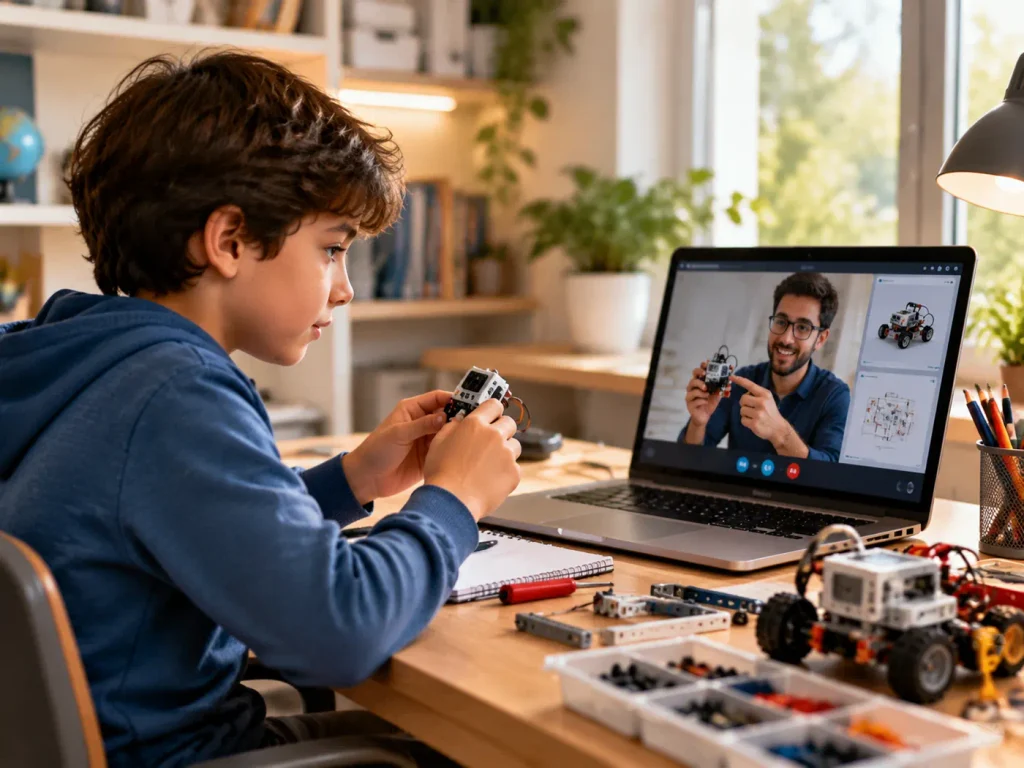
A robotics club meets when the school or organiser decides. For most programs, that means one fixed day per week during the school year — and nothing over holidays, summers, or competition off-seasons. For a family with sports, music, sibling schedules, or any kind of travel, a fixed weekly slot becomes a constant source of conflict.
The scheduling reality for each option:
🏫 Robotics Club
🌐 Live Online Classes
Also relevant: live 1:1 vs group coding classes — what the research shows.
This is the question most robotics club marketing avoids entirely. In a group of 10–12 children with one or two volunteer mentors, the actual per-child instruction time in a 60-minute session is approximately 5–8 minutes. The rest is waiting, listening to group explanations, or working independently without guidance.
That is not a criticism of clubs — it is the mathematical reality of group learning. Here is how it plays out in practice:
A confident child dominates the session. In most robotics clubs, 2–3 children naturally drive the activity while quieter children observe. A child who needs a concept explained three times before it clicks will rarely get that in a group setting — the mentor has nine other children to attend to.
Pace is set by the group, not the child. If the team is building toward a competition deadline, your child moves at the team’s pace — whether they are ahead or behind. There is no room for the personalised stretch that produces genuine skill growth.
Every minute of the session is your child’s. In live 1:1 online instruction, the mentor’s full attention is on your child’s screen, their specific code, their specific confusion. When they get something wrong, it is corrected immediately — not at the end of the session if time allows.
Progress feedback reaches parents after every session. Quality online programs provide a written update after each class: what was covered, what clicked, what needs reinforcement. No club provides this routinely — and it matters enormously for parents who want to support their child’s learning between sessions.
See what a real live robotics session looks like — for your child’s age and level.
ItsMyBot offers a free trial session with a specialist robotics and coding mentor. No commitment — one real class is worth more than any comparison article.
Robotics clubs look cheaper on the surface. The real cost picture is more nuanced — and in many cases, more expensive than parents expect.
| Cost item | Robotics club | Live online classes |
|---|---|---|
| Program fee | $0–$200/season (school clubs often free; private clubs $100–200) | $80–$200/month (varies by session frequency) |
| Equipment / kit | $50–$400 (team kits, competition registration fees) | $30–$80 (starter robotics kit, one-time) |
| Competition travel | $100–$600+ per event (fuel, entry fees, accommodation) | $0 |
| Commute / time cost | 15–45 min each way, weekly — significant parent time cost | Zero |
| Year-round availability | ❌ School-year only; summer gap breaks momentum | ✅ 52 weeks/year — no momentum lost |
| Real skill output | Team project; individual skill depth varies widely | Individual project portfolio every 8–12 weeks |
More guidance on getting started: how to choose the right STEM course for your child.
Robotics is the entry point, not the destination. Children who develop real depth in robotics — who understand the code behind the movement, not just the movement itself — gain access to the full STEM career pathway: software engineering, AI research, data science, and machine learning.
This progression looks different across the two formats:
🏫 Robotics Club progression
Most club participants do not progress to AI or Python without additional structured instruction.
🌐 Online class progression
Each stage builds directly on the last — no gaps, no resets between seasons.
Related: ItsMyBot AI & ML courses | Junior Coder AI course for ages 7–12 | LLMs explained for kids and teens
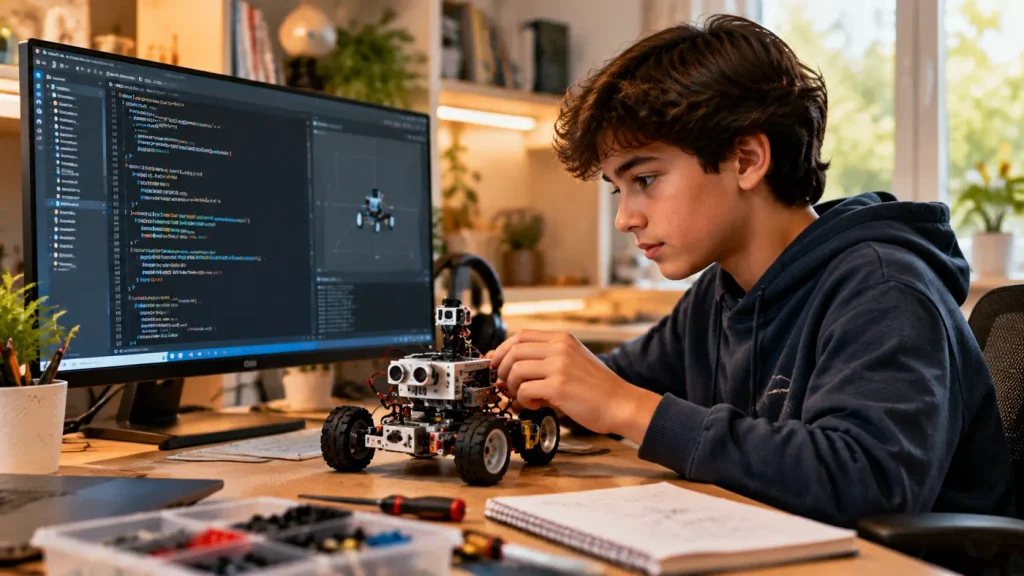
This guide would not be honest without acknowledging what robotics clubs do well — because they do several things very well.
What robotics clubs genuinely offer:
Live online robotics classes build the skills. The club is where those skills compete.
See also: will robotics and coding help my teen get into university?
Here is every factor that matters, compared directly:
| Factor | Robotics club | Live online 1:1 classes |
|---|---|---|
| Access / availability | ⚠️ Location-dependent; waitlists common | ✅ Available anywhere in the US, any week |
| Schedule control | ❌ Fixed time, school-year only | ✅ Flexible, year-round, reschedule anytime |
| Per-child attention | ⚠️ 5–8 min/session in a group of 10–12 | ✅ 100% of session time, every session |
| Personalised pace | ❌ Team pace; child adapts to group | ✅ Entirely personalised to the child |
| Real cost (full year) | ⚠️ $500–$1,200+ (equipment + travel + fees) | $1,200–$1,800/yr — zero travel, zero equipment cost |
| Coding skill depth | ⚠️ Varies; often shallow without outside support | ✅ Structured progression: robotics → Python → AI |
| AI / Python pathway | ❌ Not built in | ✅ Built-in, structured, age-appropriate |
| Parent progress updates | ❌ Rarely | ✅ After every session |
| Team / competition experience | ✅ Yes — the genuine club advantage | ⚠️ Not direct (but prepares children to excel in clubs) |
ItsMyBot’s live 1:1 online classes follow a structured progression from first robotics concepts through to Python, AI, and machine learning. Every student gets their own dedicated mentor, session-by-session progress updates, and a free trial to confirm the right entry point before committing.
🌱 Junior Coder
Ages 6–10 · Robotics + Block Coding
Visual coding, robotics fundamentals, and first real project builds. The right starting point for children with no prior coding experience who are curious about how robots and technology work.
🚀 Senior Coder
Ages 10–16 · Python + Robotics + AI
Python programming, advanced robotics control, and the foundations of AI and machine learning. For children ready to move beyond block-based tools and build real, shareable projects.
🤖 AI & ML Courses
Ages 10–16+ · Python + TensorFlow
Machine learning, computer vision, NLP, and LLMs. Portfolio-grade AI projects for teens who have Python foundations and are ready for the skills that lead into STEM university programs.
The Bottom Line
Robotics clubs are worth joining — if there’s one available, if the schedule fits, and if your child has the underlying coding skills to contribute. The problem is that most children arrive at clubs without those skills. And without them, a child in a group of 12 with one mentor gets very little actual instruction in any given session.
Book a free trial class — one real session with a real mentor building a real project, before you commit to anything.
No waitlist. No commute. Book a free robotics & coding trial class — any age, any level.
Is a robotics club better than online robotics classes?
Neither is better in every situation — they serve different purposes. Clubs excel at team dynamics, competition experience, and in-person collaboration. Online live classes excel at skill depth, personalised instruction, schedule flexibility, and structured progression into Python and AI. For most US families, the most effective combination is consistent online instruction to build foundational skills, with club participation when one is available and accessible.
What if there’s no robotics club near me?
This is the situation for a significant portion of US families, particularly outside major metro areas. Live online robotics classes provide everything a club does in terms of skill development — and more, in terms of personalisation and pacing — without any geographic limitation. Your child can start this week, with a specialist instructor, regardless of where you live.
Can my child do both a robotics club and online classes?
Yes — and this is genuinely the strongest combination. Children who take live online robotics and coding classes consistently arrive at club sessions with better skills, contribute more immediately, and tend to become team leaders rather than observers. The club provides the team and competition experience; the online classes provide the skill foundation that makes the club experience actually meaningful.
What age should my child start robotics classes?
Children can start meaningful robotics learning from age 6–7 with visual, block-based tools. Programming-based robotics — where children write code to control their robots — becomes accessible from age 9–10. The earlier a child builds consistent foundational skills, the more advanced they can be by the time competitive robotics clubs become available to them. Starting at 7 and progressing consistently means arriving at a middle school robotics club at 11 with four years of real coding experience — a significant advantage.
Do online robotics classes require buying equipment?
A basic robotics starter kit (typically $30–$80) is recommended for hands-on sessions, but a significant portion of the curriculum — particularly coding, AI, and software-based robotics simulation — requires only a laptop. Your instructor will recommend the right kit for your child’s level before the first session. There are no surprise equipment costs after that.
How do online robotics classes prepare kids for competitions?
Robotics competitions test coding skills, engineering problem-solving, and the ability to adapt under pressure — all of which are built through consistent structured instruction. Children with strong robotics and Python foundations from online classes consistently outperform peers who rely on club time alone for skill development. The competition is won in the months of practice before it — not in the club sessions.
What’s the difference between group online classes and 1:1 online classes?
Group online classes carry most of the same limitations as in-person groups — shared instructor attention, fixed pace, no adaptation to individual needs. Live 1:1 online instruction is fundamentally different: every minute of every session is spent on your child’s specific code, their specific questions, and their specific pace. The speed of progress in 1:1 settings is consistently faster. For robotics and coding specifically, where children need immediate feedback on their code, 1:1 instruction is not a luxury — it is the format that actually works. See the full comparison: live 1:1 vs group coding classes.

Online coding, AI, and robotics classes that help kids ages 5–16 build real skills — and confidence — one project at a time.
No commitment · Live class with an expert teacher
© ItsMyBot 2026. All Rights Reserved.