
Quick answer: Online coding classes suit most Singapore families who want a flexible schedule, 1:1 attention and no commute. In-person centres suit children who need a physical setting or hands-on hardware on site. Outcomes depend more on live instruction, class size and weekly consistency than on format. Compare cost per hour, not per term.
Singapore parents have plenty of coding options: centres in the malls, home tutors, school enrichment and live online classes. That makes the choice harder, not easier, especially with CCAs, tuition and school terms already filling the week.
Your child also gets some coding at school. Since 2020, every upper primary student has done the 10-hour Code for Fun programme or a comparable one. Private classes are about going further than that: building real projects, moving from Scratch to Python, and starting on AI and robotics.
This guide compares online and in-person classes on the three things parents ask about most: cost, results and schedule. It includes published fee ranges, what the research can and cannot tell us, and a checklist you can use with any provider.
Online vs In-Person Coding Classes at a Glance
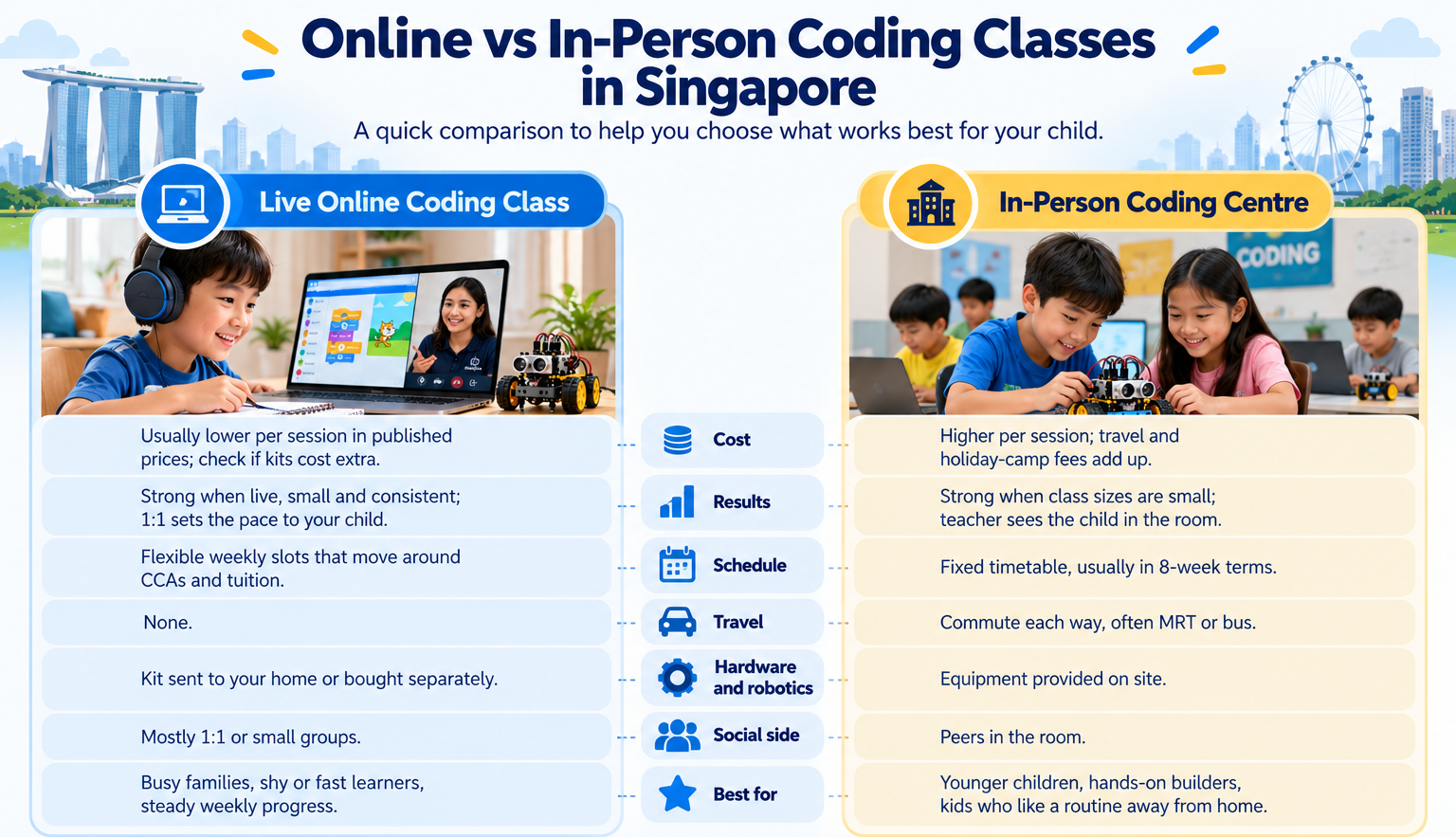
Use this table for a quick comparison. The sections after it explain each row.
| Factor | Live Online Class | In-Person Centre |
|---|---|---|
| Cost | Usually lower per session in published prices; check if kits cost extra. | Higher per session; travel and holiday-camp fees add up. |
| Results | Strong when live, small and consistent; 1:1 sets the pace to your child. | Strong when class sizes are small; teacher sees the child in the room. |
| Schedule | Flexible weekly slots that move around CCAs and tuition. | Fixed timetable, usually in 8-week terms. |
| Travel | None. | Commute each way, often MRT or bus. |
| Hardware and robotics | Kit sent to your home or bought separately. | Equipment provided on site. |
| Social side | Mostly 1:1 or small groups. | Peers in the room. |
| Best for | Busy families, shy or fast learners, steady weekly progress. | Younger children, hands-on builders, kids who like a routine away from home. |
How Much Do Coding Classes Cost in Singapore?
Published prices run from about S$10 to S$15 per online class at one large provider, and about S$53 to S$63 per lesson at centre-based classes once term fees are divided out. Lesson length differs, so compare cost per hour, not the headline price.
These are published prices seen on 29 October 2026. Providers change them often, so confirm before you decide.
| Format | What Is Published | Approx. Per Lesson | Source |
|---|---|---|---|
| Centre-based, term fees | S$420–500 and S$445–495 per 8-lesson term at two Singapore centres. | S$53–63 (derived) | SmileTutor 2026 roundup |
| Centre-based, holiday camps | From S$300 and from S$385. | Not stated | SmileTutor 2026 roundup |
| Online, group and 1:1 packages | About S$10–11 per class (group) and S$12–15 per class (1:1), in packages of 6 to 150 sessions. | S$10–15 as advertised; class length not stated | BrightChamps Singapore |
| ItsMyBot live online | [ADD YOUR PUBLISHED RATE AND PACKAGE OPTIONS BEFORE PUBLISHING] | ADD RATE | ItsMyBot pricing page |
Costs That Do Not Show in the Headline Price
Ask about these before you compare two quotes:
- Kits and equipment: Some centres provide equipment on site. Online robotics classes may need a kit.
- Software and platform licences: Usually free for Scratch, but not always for other tools.
- Competition and exam fees: Optional, but they add up.
- Travel time and fares: Easy to forget, and a real weekly cost in time.
- Make-up lessons: Check what happens when your child misses a class for CCA or exams.
How to Compare Two Quotes in One Minute
Divide the total price by the total hours of live teaching. For example, a S$420 term of 8 lessons that are 1.5 hours long works out to S$35 per hour (an example only, not a quoted price). Then compare class size: a 1:1 class and a group of eight are not the same product, even at the same price per hour.
Which Format Gets Better Results?
Neither format wins on its own. What the evidence we found points to is that live teaching, small classes and steady weekly practice matter more than where the lesson happens.
What the Research Says, and What It Cannot Say
- A Czech study compared full-time school teaching with online teaching of high school computer science, including programming and robots. It found no statistically significant difference in achievement between the two groups. It covers teenagers in one country, so treat it as a signal, not proof for every child.
- A 2022 study of early-childhood coding found that a planning-and-monitoring strategy did not help when children lacked explicit instruction and social interaction, and it did help once it was taught directly through games and collaboration. For ages 5 to 7, that points to live, guided sessions rather than a child working alone.
- Quality matters more than format. As one provider guide puts it, tutor-to-student ratio has a direct effect on learning outcomes, whether the class is online or in a room.
Where Each Format Has an Edge
- Online: 1:1 pacing, a choice of specialist teachers across Singapore, and no commute, so more of the week goes into practice.
- In-person: Hands-on hardware you do not have to buy, a teacher who sees the whole room, and peers for children who learn through other children.
- Not the same as online: Self-paced video libraries. They have no live teacher, so they are a supplement, not a replacement for a class.
What School Already Covers
Since 2020, all upper primary students do 10 hours of Code for Fun or a comparable programme. IMDA also lists an extra five to ten hours of lessons from 2025 through AI for Fun modules. A private class should take your child past that: longer projects, a path from Scratch to Python, and a portfolio.
How to Tell If a Class Is Working
Ask the provider to show these within the first term, whatever the format:
- Two or three finished projects your child can demo to you.
- A written progress note after each unit.
- A clear next level, such as Scratch to Python or Python to AI.
- Your child asking to do it, not being nagged to attend.
For a deeper look at progression, see our top coding programs for kids and the benefits of coding for elementary kids.
Schedule: Fitting Classes Around School Terms, CCAs and Holidays
Online classes fit around the Singapore school week more easily because they run in flexible weekly slots, while most centres run fixed 8-week terms and holiday camps. The right choice depends on how packed your child’s week already is.
MOE schools run on a January to November calendar. The 2026 holiday windows for MOE kindergartens, primary and secondary schools are:
| Holiday | Dates (2026) |
|---|---|
| Between Terms 1 and 2 | 14–22 March |
| Mid-year (between Semesters 1 and 2) | 30 May–28 June |
| Between Terms 3 and 4 | 5–13 September |
| End of school year | 21 November–31 December |
Dates are from the MOE calendar as summarised by Public Holidays SG. MOE publishes each year’s calendar ahead of time (the 2026 dates came out on 30 July 2025), so check moe.gov.sg/calendar for next year.
How Each Format Handles the Singapore Week
- After school on weekdays: Online lets you book a slot after CCA and tuition without a commute. In-person works if the centre is close to school or home.
- Weekends: Both formats offer them, but in-person weekend slots at popular centres fill early.
- School holidays: Centres run intensive camps. Online classes can continue weekly, or switch to a project-based block.
- Exam weeks: Plan a lighter load or a pause. Online and 1:1 classes are easier to reschedule, but always ask about the make-up policy.
- Travel and family trips: Online classes can follow your child, so the same teacher and project continue.
The end-of-year holidays start on 21 November, so this is a good time to decide whether your child does a holiday camp or starts a steady weekly class in January. Many families do both: a camp to try it, then weekly online lessons to build skill.
Our local pages cover after-school programmes in Singapore and summer and holiday classes for kids in Singapore.
Which Format Fits Your Child?
Choose online if your week is packed or your child learns best with 1:1 attention. Choose in-person if your child is young, loves building with hardware, or needs a routine away from home. Use this table to match your situation.
| Your Situation | Better Fit | Why |
|---|---|---|
| Ages 5–7 | In-person, or live online with a parent nearby | Young children need guided, interactive sessions and short lessons. |
| Ages 8–10, new to coding | Either, as long as it is live | Scratch works well in both formats. |
| Ages 11–16, ready for Python or AI | Online 1:1 or small group | Specialist teachers and individual pace matter more than the room. |
| Busy week with CCA and tuition | Online | No commute and flexible slots. |
| Loves building robots | In-person camp, or online with a kit | Hands-on hardware is the draw, and you can get it either way. |
| Shy or easily distracted in groups | Online 1:1 | One teacher, one child, no audience. |
| Learns from other kids | In-person group | Peers motivate and compare. |
| Family travels often | Online | Same teacher and project, wherever you are. |
Not sure? Try a hybrid. Start with a school-holiday camp to see what your child enjoys, then move to a weekly online class to build real skill. Many families combine the two this way.
If robotics is the draw, see our picks for the best beginner robotics kits for kids and our guide to the best robotics classes for kids. If you are choosing a first language, Scratch vs Blockly helps ages 5 to 15.
7 Questions to Ask Any Coding Class in Singapore
These questions work for any provider, online or in-person. Ask them before you pay.
- Is the teaching live? A live teacher who sees your child’s work is different from pre-recorded video.
- What is the class size? Ask for the tutor-to-student ratio, and whether 1:1 and group classes are priced differently.
- How long is each lesson, and how many hours in total? This is what you need to work out the cost per hour.
- What is the learning path? Look for a clear progression, such as Scratch to Python to AI, matched to your child’s age.
- How do you show progress? Ask for a sample feedback report and examples of finished student projects.
- What else will I pay for? Kits, licences, competition fees and travel.
- Can we try a lesson first, and what is the make-up policy? A trial shows you the teacher’s style, and rescheduling rules matter during exam weeks.
See how ItsMyBot answers these on our robotics and coding classes in Singapore page. If your child is curious about AI, start with our AI course for kids in Singapore.
Frequently Asked Questions
Are online coding classes as good as in-person classes for kids in Singapore?
Yes, when they are live, small and consistent. One study of high school computer science found no statistically significant difference between online and face-to-face teaching, and class size matters more than format. In-person has an edge for on-site hardware. Online has an edge for 1:1 pacing and scheduling.
How much do coding classes for kids cost in Singapore?
Published prices seen in October 2026 were about S$420 to S$500 per 8-lesson term at two centres (roughly S$53 to S$63 a lesson) and about S$10 to S$15 per class at one online provider. Lesson length varies, so compare the cost per hour of live teaching.
Is 1:1 or group better for coding classes?
1:1 suits children who are shy, fast or behind, because the teacher sets the pace. Small groups suit children who learn from peers. For ages 5 to 7, either works if the class is live and interactive. Always ask for the class size before you enrol.
What age should my child start coding?
Picture-based coding works from about age 5, Scratch from about 8 and Python from about 11. Start when your child can follow short instructions and likes building things. There is no deadline, and older beginners often move quickly.
Does my child need a special laptop for online coding classes?
No. Most beginner coding runs in a web browser on a standard laptop or desktop, and Scratch is free and browser-based. See our Scratch system requirements guide. Robotics needs a kit, which some classes include. Check the requirements before the first lesson.
Can online classes fit around CCAs and tuition?
Yes. Online classes usually run in flexible weekly slots with no commute, so you can book after CCA or on weekends. Ask about the make-up policy, and plan a lighter load during school exam weeks.
Does school coding make private classes unnecessary?
School gives a basic start. Since 2020, all upper primary students do 10 hours of Code for Fun or a comparable programme. Private classes go further, with longer projects, text languages like Python, and AI and robotics, which suit children who want more than the school basics.
Can kids learn robotics online?
Yes. Online robotics classes use a kit that is sent to your home or bought separately, with a live teacher guiding the build and the code. Centres provide equipment on site, which some families prefer for younger children.
The Best Format Is the One Your Child Attends Every Week
Online classes win on flexibility, 1:1 pace and commute time. In-person centres win on hands-on equipment and a room full of peers. On results, the evidence points to live teaching, small classes and steady practice, not the format. Compare providers on cost per hour, ask the seven questions above, and use a trial lesson to see how your child responds.
Ready to see where your child fits? Book a trial class with ItsMyBot and an instructor will match your child to the right starting level. Explore our robotics and coding classes in Singapore or the AI course for kids.
Explore Coding & Robotics Classes Explore AI ClassesPlanning the year-end break? See our summer and holiday classes for kids in Singapore.
Sources
Checked through search on 29 October 2026. Prices and dates change, so re-confirm them right before publishing.
- MDDI: Code for Fun enrichment programme (mandatory for upper primary since 2020).
- IMDA: Code for Fun.
- MOE: School terms and holidays for 2026.
- Public Holidays SG: Singapore school holidays (2026 MOE holiday windows).
- SmileTutor: Top 20 coding and robotics classes in Singapore, 2026 (centre term fees and camp prices).
- BrightChamps Singapore: Coding classes for kids (online per-class prices).
- Coufal: Comparison of face-to-face and online computer science education in high school.
- Wang et al. (2022): Cognitive control strategies and coding learning in early childhood.
- Codeyoung: Online vs in-person coding classes.
