Reading Time: 20 mins
My 10 year old nephew asked me a question last month that stopped me in my tracks.
“Uncle, how does ChatGPT know everything? Is it smarter than you?”
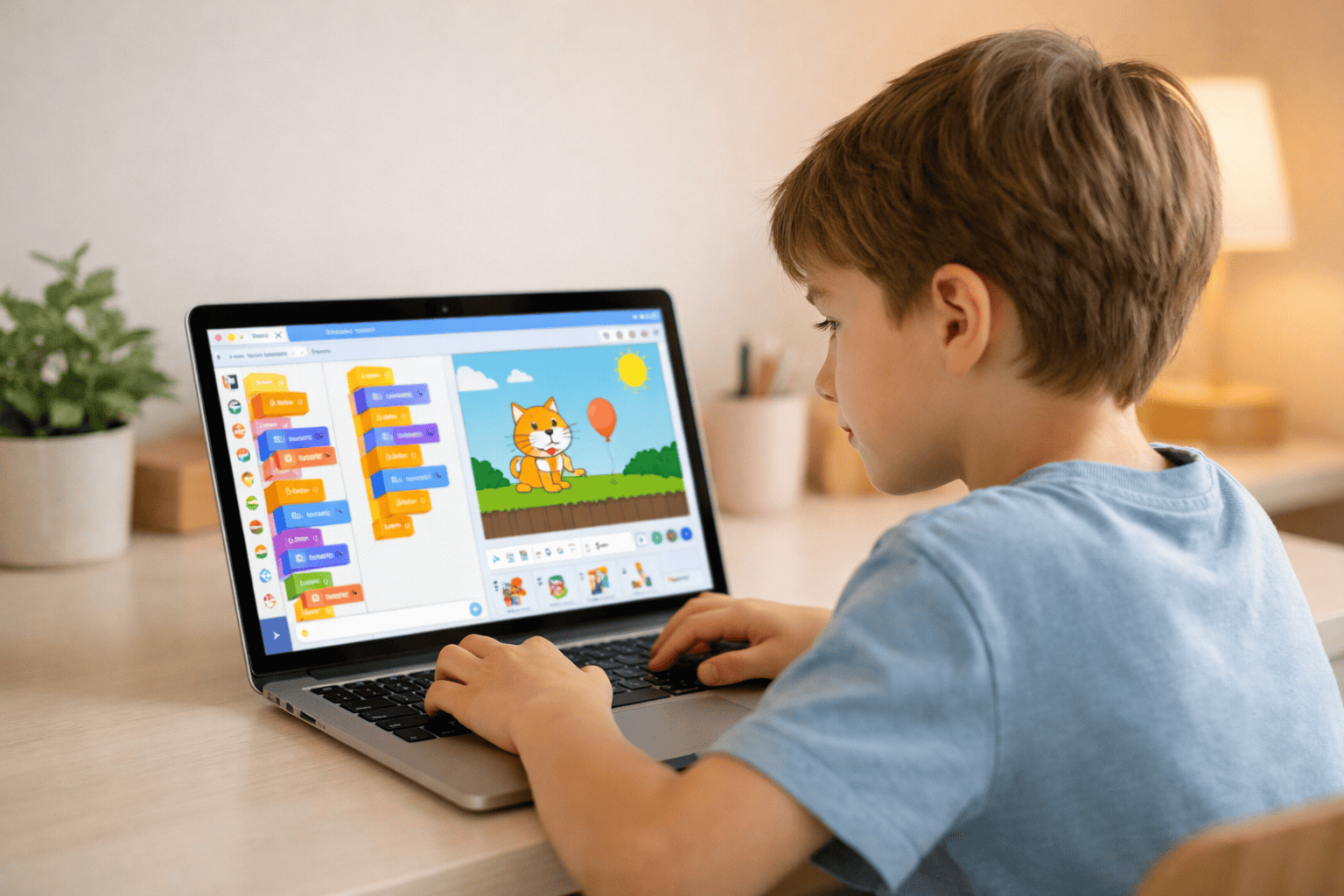
I laughed at first. Then I realized he was completely serious. He’d been using AI to help with homework, generate story ideas, and even debug his Scratch projects. To him, AI was magic. A mysteriously intelligent entity that just knew things.
And that’s when it hit me: we’re raising the first generation of kids who will grow up with AI as ubiquitous as smartphones. But unlike smartphones, which are tools we can see and touch and understand, AI feels abstract. Invisible. Almost supernatural.
This isn’t just about one curious kid. I see this pattern everywhere. Children using AI daily without understanding how it works, what its limitations are, or when they should question its output. They’re developing relationships with AI tools without developing AI literacy.
And that’s a problem. Not because AI is dangerous, but because uninformed use of any powerful tool carries risks. You wouldn’t hand a kid a car and say “figure it out.” You teach them how it works, when to use it, and how to use it safely.
AI deserves the same approach. And that’s exactly what AI literacy is about.
Let me be clear about something right away: AI literacy for kids is not about teaching them to build neural networks or understand transformer architecture. That’s AI development, and it’s not what most kids need.
AI literacy is about understanding AI as a user and a citizen. It’s about knowing enough to use AI tools effectively, question their outputs critically, and think about their broader implications.
Think of it like financial literacy. You don’t need to understand the Federal Reserve’s monetary policy to manage a budget and make smart financial decisions. But you do need to understand concepts like interest, saving, and the difference between wants and needs.
AI literacy works the same way. Kids need to understand:
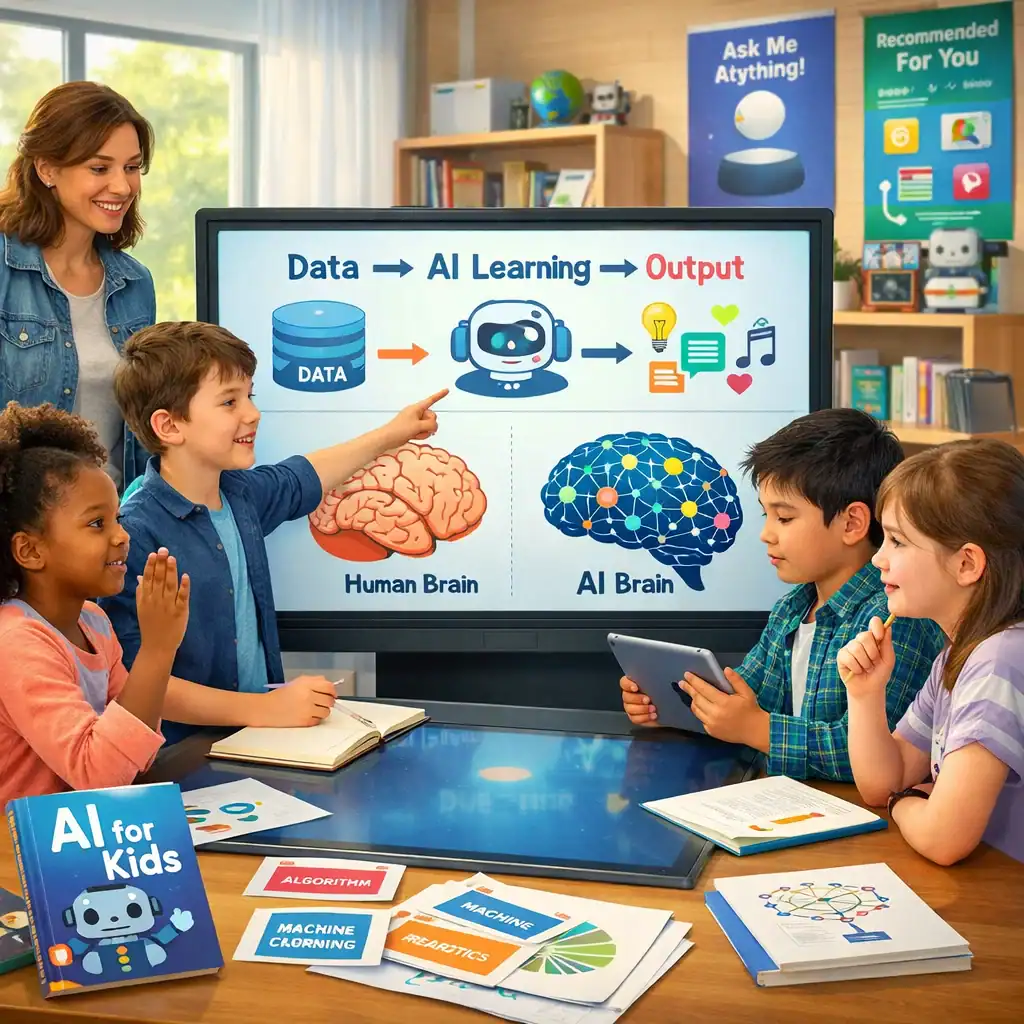
What AI actually is: Not magic. Not sentient. A tool that learns patterns from massive amounts of data and uses those patterns to generate responses or predictions.
What AI can and can’t do: It’s excellent at pattern recognition, prediction, and generation. It’s terrible at truly understanding context, reasoning about completely novel situations, or knowing what’s true versus what sounds plausible.
How to use AI as a learning tool: When it enhances learning versus when it prevents learning. How to verify information. When to think for yourself versus when to seek AI assistance.
The ethical dimensions: Privacy concerns. Bias in AI systems. The environmental cost of AI computation. How AI affects jobs and society.
How to think critically about AI: Questioning outputs. Understanding that AI reflects the data it was trained on, including human biases. Recognizing AI generated content.
This isn’t a computer science curriculum. It’s a modern literacy as fundamental as reading or basic math. And just like those literacies, it needs to start young.

I know what some parents are thinking. “My kid is 8. Do they really need to understand AI? Can’t this wait?”
The short answer: no, it can’t wait. And here’s why.
Whether you realize it or not, your child probably interacts with AI multiple times a day. YouTube recommendations. Siri or Alexa. Predictive text on their messages. Gaming NPCs. Educational apps.
And increasingly, they’re using generative AI tools. ChatGPT, Google’s Gemini, Microsoft Copilot. These tools are showing up in schools, in homework help, in creative projects.
According to recent surveys, over 50% of students have used ChatGPT for schoolwork. Many more use it without reporting. This isn’t coming. It’s here.
Without AI literacy, kids use these tools without understanding their limitations. They trust AI outputs without verification. They don’t recognize AI generated misinformation. They can’t make informed decisions about privacy and data sharing.
Today’s kids will enter a job market transformed by AI. Not destroyed, as some fearmongers claim. Transformed. Jobs will change. New jobs will emerge. But the one constant will be this: people who understand how to work effectively with AI will have enormous advantages.
More fundamentally, they’re growing into a world where AI shapes everything from the news they see to the loans they can get to the medical diagnoses they receive. Understanding these systems, even basically, is a prerequisite for informed citizenship.
Compare this to previous generations learning about the internet. Kids in the 1990s who understood how the web worked, what websites could and couldn’t be trusted, and how to navigate digital information had massive advantages. That’s where we are with AI now.
AI literacy is a defense against manipulation. Kids who understand that AI reflects human biases are less likely to accept discriminatory outputs as objective truth. Kids who understand that AI generates plausible sounding content are more likely to fact check.
In an era of increasingly sophisticated AI generated misinformation, scams, and manipulation tactics, basic AI literacy is a form of digital self defense.
Here’s something counterintuitive: teaching kids about AI actually strengthens their appreciation for human creativity and thinking.
When kids understand that AI generates content by remixing patterns from training data, they realize it’s not actually creating anything new. It’s synthesizing. Real creativity, the kind that comes from lived experience, unique perspectives, and genuine insight, remains distinctly human.
This understanding helps kids use AI as a tool to enhance their creativity rather than replace it. They learn to use AI for brainstorming, research, or tedious tasks, while reserving the actual creative thinking for themselves. Our guide on why AI learning is important for kds explores this balance in depth.
Based on years of teaching technology to kids, I’ve found it helps to think about AI literacy in developmental stages. Not strict age ranges, but conceptual levels that build on each other.
At this level, kids are just becoming aware that AI exists and is different from other kinds of technology.
Core concepts:
Teaching approaches: Use concrete examples from their daily life. “You know how YouTube suggests videos you might like? That’s AI noticing patterns in what you watch.”
Simple demonstrations work well. Show them how voice recognition sometimes makes mistakes to illustrate that AI isn’t perfect.
Relate AI to learning they understand. “Remember learning to recognize letters? You saw lots of As until you knew what an A looked like. AI learns patterns the same way, but with millions of examples.”
Kids at this level can grasp more nuance about how AI works and start thinking critically about its use.
Core concepts:
Teaching approaches: Hands on experimentation. Let them use AI tools while discussing what’s happening. “Let’s ask ChatGPT the same question three times and see if we get different answers. Why do you think that happens?”
Compare AI outputs to trusted sources. Have them fact check AI generated information to develop verification habits.
Discuss AI ethics through relatable scenarios. “If you use AI to write your essay, whose work is it? What did you actually learn?”
Introduce the concept of training data. “AI is trained on things people created. If most of those people thought one way, the AI might think that way too, even if it’s not right.”
Older kids can understand AI’s broader implications and use it thoughtfully as a genuine tool.
Core concepts:
Teaching approaches: Project based learning where they use AI tools thoughtfully. Maybe building a chatbot in Scratch, analyzing AI outputs for bias, or creating AI assisted art while documenting their process.
Discussions about real world AI applications and controversies. Should schools allow AI tools? How should artists be credited when AI trains on their work?
Encouraging them to develop their own frameworks for AI use. “When is using AI helpful versus harmful to your learning?”

Theory is great, but you want practical strategies you can use today. Here’s how to actually teach AI literacy in everyday situations.
Don’t introduce AI as a scary new topic. Start with what’s familiar.
“You know how Siri understands what you say? Let’s talk about how that works.” Then explain, simply, that Siri was trained on millions of voice recordings so it learned to match sounds to words.
Point out AI in their daily life. Netflix recommendations. Photo organization on phones. Autocorrect. Each is an opportunity for a brief conversation about AI.
This approach makes AI feel approachable and understandable rather than mysterious and intimidating.
Here’s an activity I do with kids constantly. Pick a topic your child knows well. Maybe dinosaurs, or their favorite sport, or a book series they love.
Have them ask an AI tool like ChatGPT questions about that topic. Then have them evaluate the answers.
“Is this information correct? How do you know? What did the AI get right? What did it get wrong?”
This teaches critical evaluation and makes the abstract concept of AI limitations concrete. Kids quickly realize that AI can sound confident while being wrong, which is one of the most important lessons.
Use AI as a creative tool, then talk about the process.
Generate a story together using ChatGPT. Or create an image with AI art tools. Or have AI help brainstorm ideas for a school project.
Then discuss: “What parts did you create? What did the AI create? Is this your work or the AI’s work? What did you learn doing this?”
These conversations develop nuanced thinking about AI as a tool rather than a replacement for human creativity.
Whenever your child encounters AI generated content, whether they know it’s AI or not, ask questions:
“How do you know this information is accurate?” “Where do you think this came from?” “Does this seem biased in any way?” “What would you change about this?”
Over time, this questioning becomes automatic. That’s the goal. Not paranoia, but healthy skepticism and independent verification.
Several excellent resources exist specifically for teaching kids about AI:
Machine Learning for Kids (machinelearningforkids.co.uk): Hands on activities where kids train simple AI models using Scratch.
AI4K12 (ai4k12.org): Curriculum guidelines and activities organized by age and concept.
Quick, Draw! (quickdraw.withgoogle.com): Google’s game that demonstrates how AI learns to recognize drawings.
These make abstract concepts tangible and fun rather than academic and boring.
At ItsMyBot, we’ve integrated AI literacy into our curriculum across all age groups. When students learn Scratch, we discuss how the platform might eventually use AI. When they build projects, we talk about using AI tools ethically. Our instructors are trained to help kids understand AI as users and future creators, not just consumers.
Some aspects of AI literacy are harder to teach than others. Here’s how to approach the challenging topics.
You don’t need to teach gradient descent or backpropagation. But kids should understand the basic concept of learning from patterns.
Here’s an analogy that works: “Imagine you want to teach a computer to recognize cats. You show it 10,000 pictures of cats and 10,000 pictures of things that aren’t cats. The computer notices patterns. Cats tend to have pointed ears, whiskers, a certain shape. After seeing thousands of examples, the computer gets pretty good at guessing ‘cat’ or ‘not cat’ for new pictures. That’s essentially how AI learns, but with much more complicated patterns.”
Follow up with why this matters: “Because AI learns from examples, it can only be as good as the examples it sees. If all the cat pictures were of orange tabbies, it might not recognize a black cat. That’s why the data AI learns from really matters.”
This is crucial but tricky. Kids need to understand that AI can be biased without becoming cynical or confused.
Start with human bias: “You know how sometimes people make assumptions about others based on limited information? Sometimes those assumptions aren’t fair or accurate. AI can learn those same unfair assumptions if it’s trained on data that reflects human biases.”
Make it concrete: “If an AI was trained to recommend jobs by looking at old job data, it might notice that most engineers in that data were men. It might then assume engineering jobs should mostly go to men. That’s bias, and it’s not fair.”
Emphasize that recognizing bias is empowering: “Understanding this helps you catch when AI might be making unfair suggestions. You can question it and think for yourself.”
Kids need to understand that using AI tools often means sharing data, and that has implications.
Frame it practically: “When you use ChatGPT, the company can see what you asked. When you use an AI photo editor, the company might keep copies of your photos. Sometimes that’s fine. Sometimes it’s not. You need to think about what you’re sharing.”
Give them guidelines:
Kids hear scary headlines about AI taking jobs. Address this directly but thoughtfully.
Acknowledge the changes: “Yes, AI will change many jobs. Some jobs might go away. But new jobs will be created too. And many jobs will just change, with people using AI as a tool to do their work better.”
Focus on adaptability: “The most important thing is learning to work with AI, not compete against it. People who understand AI and know how to use it will have lots of opportunities.”
Emphasize human skills: “AI is good at patterns and generating content. But it’s not good at true creativity, empathy, physical tasks, or understanding complex social situations. Human skills are still incredibly valuable.”

One of the most important aspects of AI literacy is developing ethical frameworks for AI use. This goes beyond rules to internalized principles.
Kids need clear guidance on using AI for schoolwork. Here’s a framework that works:
AI as research assistant: Usually okay. Using AI to explain concepts, suggest resources, or clarify confusing topics is like using a tutor.
AI as brainstorming partner: Usually okay. Generating ideas or overcoming creative blocks is legitimate, as long as the final work is yours.
AI as ghost writer: Not okay. Having AI write your essay, solve your math problem, or create your project means you’re not learning.
But emphasize nuance: “The question isn’t ‘can I use AI?’ It’s ‘what am I actually learning?’ If using AI prevents you from developing skills or understanding, it’s problematic.”
Encourage transparency: “If you use AI to help with an assignment, be honest about it. Describe how you used it. That shows integrity.”
When kids create with AI tools, they need to think about credit and ownership.
“If you generate an image using AI, you didn’t create it from scratch. The AI created it based on art it was trained on. You should mention it was AI assisted.”
“If you use AI to help write a story, think about what parts are yours (the ideas, the plot, the revisions) versus what the AI contributed. Give credit honestly.”
This develops integrity and respect for creative work, both human and AI generated.
Kids need to understand they can’t upload others’ information or images to AI tools without permission.
“That photo of your friend? You can’t put it into an AI editor without asking them first. Their image, their choice.”
“Don’t ask AI questions about specific people by name. That’s invading their privacy.”
This extends general privacy principles into the AI age.
Encourage kids to think beyond their own use to broader implications.
“If everyone used AI to do their homework, what would happen to learning?”
“If AI can create art instantly, how does that affect human artists who spent years developing skills?”
“If AI uses a lot of energy and resources, when is using it worth that cost?”
These questions don’t have simple answers. That’s the point. They develop thoughtful, ethical reasoning.
After working with hundreds of families on tech education, I’ve seen patterns in how parents approach AI literacy. Here are the most common missteps and how to avoid them.
Many parents think AI literacy is too advanced for young kids. By the time they decide to address it, kids have developed habits and assumptions that are hard to change.
Better approach: Start age appropriate AI literacy as soon as kids start interacting with AI. Even 5 year olds can understand “the computer learned by seeing lots of examples.”
Some parents, concerned about AI’s downsides, prohibit their kids from using AI tools at all.
This doesn’t work. Kids will encounter AI at friends’ houses, at school, and eventually on their own. Better to teach informed use than enforce impossible restrictions.
Better approach: Set guidelines, not bans. “You can use AI for brainstorming and research, but not for doing your work for you.” Then discuss why these boundaries exist.
On the flip side, some parents treat AI as this mysterious, powerful thing they don’t understand themselves. This teaches kids that AI is beyond comprehension.
Better approach: Learn alongside your kids. You don’t need to be an expert. Exploring AI tools together and figuring them out is valuable modeling.
Yes, AI has risks and limitations. But dwelling only on what can go wrong creates fear rather than literacy.
Better approach: Balanced education. Discuss capabilities and limitations. Opportunities and risks. How to use AI well, not just what to avoid.
Many schools are still figuring out their AI policies and curriculum. Relying entirely on schools to teach AI literacy leaves gaps.
Better approach: Supplement school education at home. Ask what your child’s school teaches about AI. Fill in gaps with conversations and activities at home.
Once kids have basic AI literacy, where do they go next? Here are natural progressions that deepen understanding.
Move from understanding AI to building with it. Depending on age and interest:
Younger kids (8 to 10): Use tools like Machine Learning for Kids to train simple models in Scratch. Maybe create a rock paper scissors recognizer or a sentiment analyzer.
Middle kids (11 to 13): Explore more sophisticated AI tools. Maybe build a chatbot, create AI art, or use AI to help with a meaningful project.
Older kids (14+): Consider introductory AI programming courses using Python. Tools like Google’s Teachable Machine make AI concepts accessible. Our guide on how to make AI in Python walks through beginner friendly projects.
Encourage kids to identify and analyze AI systems in daily life.
“Where do you think that app is using AI? How can you tell? What might it be trained on? What are its limitations?”
This develops an analytical eye that serves them in all contexts.
As kids mature, involve them in family or classroom discussions about AI policy and ethics.
“Should your school allow AI tools? Under what conditions? How should they prevent misuse while allowing beneficial use?”
These conversations develop the critical thinking skills they’ll need as AI literate adults.
For kids showing serious interest, explore potential AI related career paths. Not just AI engineering, but also:
Understanding career possibilities makes AI literacy feel relevant and future focused. Our article on what STEM means in education helps contextualize how AI skills fit into broader STEM learning pathways.

Let me be honest about something. I don’t know exactly what role AI will play in our kids’ adult lives. The technology is evolving so rapidly that predictions feel almost pointless.
But here’s what I do know: kids who develop strong AI literacy now will adapt to whatever comes. They’ll have the frameworks to understand new AI tools as they emerge. They’ll have the critical thinking skills to evaluate AI outputs and implications. They’ll have the ethical foundation to use AI responsibly.
Most importantly, they’ll see AI as a tool they can shape and control, not a mysterious force that happens to them.
That sense of agency matters enormously. Kids with AI literacy aren’t passive consumers of AI technology. They’re informed users who make intentional choices. And some of them will become the people who build, govern, and shape AI systems in ways we can’t yet imagine.
This isn’t about creating a generation of AI engineers, though some kids will go that route. It’s about raising a generation of AI literate citizens who can participate meaningfully in a world where AI is everywhere.
When that 10 year old asked me if ChatGPT was smarter than me, I eventually gave him a better answer than my initial laugh.
“ChatGPT knows a lot of information,” I said. “But it doesn’t understand what it knows the way you and I understand things. It can’t think about whether something is right or wrong. It can’t have new ideas that no one’s ever had before. It can’t care about things or people. Those are human abilities. ChatGPT is a tool, a really impressive one, but just a tool. And you can learn to use it really well while staying smarter than it in all the ways that actually matter.”
He thought about that, then nodded. “So I should use it like a calculator? It can help me, but I still need to know what I’m doing?”
Exactly. That’s AI literacy. And that’s what we need to teach.
At what age should I start teaching my child about AI?
Start as soon as your child begins interacting with AI powered tools, which for most kids is around age 5 to 6. At this age, lessons are simple: “The computer learned by seeing lots of examples” or “AI helps YouTube suggest videos you might like.” As they grow, discussions become more sophisticated. The key is making AI literacy an ongoing conversation that evolves with their understanding, not a one time lesson at an arbitrary age. Early exposure to these concepts prevents misinformation and helps kids develop healthy habits around AI use from the start.
How is AI literacy different from regular computer literacy or coding?
Computer literacy is about using technology, understanding files and folders, internet safety. Coding literacy is about creating with technology and understanding programming logic. AI literacy is specifically about understanding systems that learn from data and make predictions or generate content. It includes knowing how AI works differently from traditional software, recognizing AI limitations and biases, using AI tools effectively, and thinking critically about AI’s role in society. A child could be computer literate and code fluent but still lack AI literacy if they don’t understand how AI systems learn, their limitations, or how to evaluate AI outputs critically.
My child uses ChatGPT for homework. Is that cheating, or is it okay?
It depends entirely on how they’re using it. Using ChatGPT to explain a confusing concept, suggest research resources, or help brainstorm ideas is generally fine, similar to asking a tutor. Using it to write essays, solve problem sets, or complete assignments without understanding prevents learning and is problematic. The key question is: “What are you actually learning?” If AI use enhances understanding and skills, it’s a legitimate tool. If it replaces the learning process, it’s not. Encourage transparency: have your child explain to teachers how they used AI. Many schools are developing guidelines, so check your school’s specific policies and have honest conversations about academic integrity.
How do I teach AI literacy if I don’t understand AI myself?
You don’t need to be an expert to teach AI literacy to kids, especially younger ones. Start by learning together. Explore AI tools as a family and discuss what you notice. Ask questions alongside your child: “How do you think this works? Why do you think it gave that answer?” Use age appropriate resources like Machine Learning for Kids or AI4K12. Focus on critical thinking rather than technical details. The most important lessons (AI isn’t magic, verify information, think about bias) don’t require deep technical knowledge. Your willingness to learn and think critically models exactly what you want your child to develop.
Are there good AI tools designed specifically for kids to learn with?
Yes, several excellent educational AI tools exist for different ages. Machine Learning for Kids (machinelearningforkids.co.uk) lets kids train simple AI models in Scratch. Quick, Draw! by Google demonstrates AI learning through a fun drawing game. Teachable Machine lets kids train image, sound, or pose recognition models with no coding. AI Experiments by Google offers various demonstrations of AI concepts. For older kids interested in coding, platforms like Code.org and ItsMyBot offer age appropriate introductions to AI programming concepts. These tools make abstract AI concepts tangible and hands on, which is far more effective than abstract explanations.
How do I talk to my child about AI bias without making them cynical?
Frame bias as a problem to recognize and solve, not a reason to distrust all technology. Start by explaining that AI learns from data created by humans, and humans have biases (we all do). Give concrete examples: “If an AI was trained mostly on pictures of doctors who were men, it might assume doctors are usually men, even though that’s not true anymore.” Emphasize that recognizing bias is empowering, it means we can ask better questions and make fairer systems. Compare it to checking facts you read online: you’re not being cynical, you’re being smart. Kids can understand that tools have limitations without losing all trust in them. The goal is critical thinking, not paranoia.
Should I be worried about my child becoming too dependent on AI tools?
Healthy concern is appropriate, but focus on balance rather than restriction. The goal is teaching kids to use AI as a tool that enhances their capabilities rather than replaces their thinking. Set clear guidelines: AI can help with brainstorming, research, and tedious tasks, but core learning and creative thinking should come from them. Watch for signs they’re using AI to avoid challenges rather than overcome them. Encourage them to try problems without AI first, then use AI to check understanding or explore further. The key is developing judgment about when AI helps versus when it hinders. This is similar to calculator use: appropriate in some contexts, but you still need to understand the underlying math.
Why AI Learning Is Important for Kids Explore the broader context of AI education, understanding why early exposure to AI concepts prepares kids for their future in ways traditional education alone cannot.
How to Make AI in Python: Beginner’s Guide For older kids ready to move beyond understanding AI to building it, this guide provides accessible introduction to creating simple AI projects with Python.
AI Projects for Kids: Hands On Learning Activities Practical, engaging projects that teach AI concepts through creation, perfect for kids who learn best by doing rather than just discussing.
ABCs of AI: Understanding Artificial Intelligence for Kids A comprehensive beginner friendly breakdown of AI terminology and concepts, helping kids (and parents) build solid foundational knowledge.
What Does STEM Mean in Education? Understand how AI literacy fits into broader STEM education and why these interconnected skills matter for 21st century learners.